



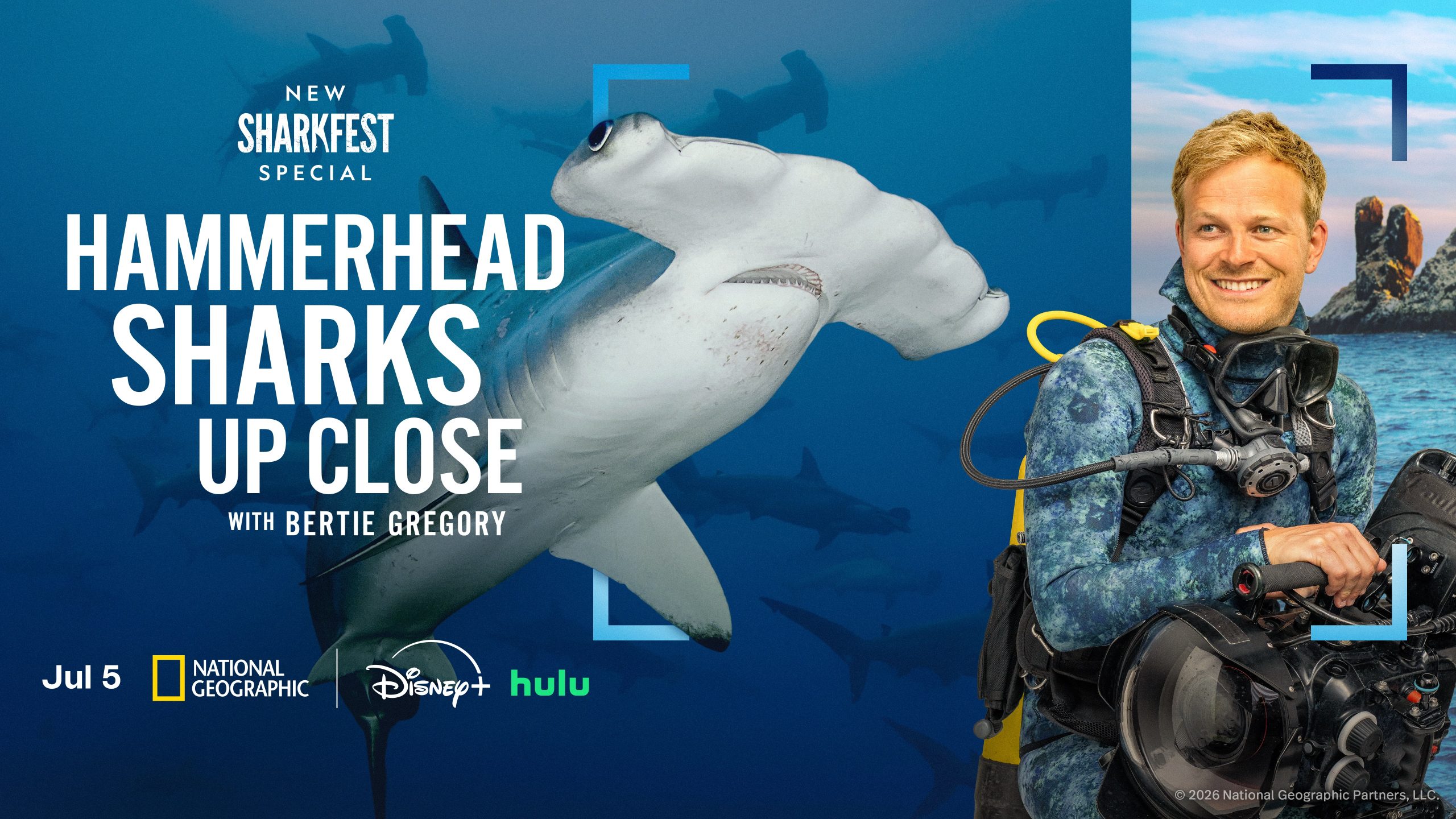
SHARKFEST: HAMMERHEAD SHARKS UP CLOSE WITH BERTIE GREGORY | ©2026 National Geographic
SHARKFEST, the annual celebration of those aquatic marvels of evolution who remain largely unchanged from their ancestors 20 million years ago, launches its fourteenth season on National Geographic Channel, Hulu and Disney+ on Sunday, July 5.
This year’s two-week-long SHARKFEST launches with HAMMERHEAD SHARKS UP CLOSE WITH BERTIE GREGORY. The documentary from the award-winning Gregory examines not only the big sharks famous for their cephalofoil (t-shape or “hammer”) heads, but also protection for the environment that the animals need in order to survive and thrive.
HAMMERHEAD SHARKS UP CLOSE was shot in and around the waters of Cabo Pulmo National Park in Baja California, which is part of Mexico, in the Gulf of California (not to be confused with the Gulf of Mexico) between the Baja Peninsula and the Mexican mainland.
Dr. Katy Ayres and cinematographer Jeff Hester are both part of Gregory’s team for HAMMERHEAD SHARKS UP CLOSE. Dr. Ayres, originally from northern England, is very familiar with Cabo Pulmo, having completed her dissertation on the blacktip sharks in the national park there.
“I’ve done quite a bit of research on hammerheads,” Dr. Ayres explains, “but my PhD research is focused on a marine protected area that encompasses other species as well. So, I’d say my specialty isn’t hammerheads, but it’s sharks that inhabit Mexican waters.”
Based in Southern California, Hester is an award-winning camera operator specializing in underwater environments (he also does aerial work) for documentaries and narrative films and television.
In separate Zoom calls, Dr. Ayres and Hester discuss HAMMERHEAD SHARKS UP CLOSE with Assignment X.
Dr. Ayres says she became involved in the project when the producers “came to film me in the field with a group of local girls who I teach the drone surveys to. Part of my research is using drones to study the sharks when they aggregate close to shore, and one of the main goals is to get locals involved. So, Bertie came and filmed me with my team, doing a survey, and then showing all the sharks that we’ve seen over the years, and sometimes in numbers of over a thousand.”
Dr. Ayres’s drones are aerial, and were initially set up to count the regions blacktip sharks, which we also see in HAMMERHEAD SHARKS UP CLOSE. “We’re trying to find out the numbers of sharks, how their populations are doing, so we do the drone surveys when it’s very low wind. When there’s low wind, the visibility tends to be a lot better.
“We do the surveys at about a hundred meters [above sea level], and then after we do a survey where we count the sharks on the footage, we then lower the drones to about twenty meters, and we record interesting behaviors, we get good confirmation of the i.d.s of the sharks, like what type of sharks we’re seeing, and all this data is shared with the local government, who manage the park. So, all the data we collect is shared locally.”
Hester and his camera, on the other hand, are down in the sea with the sharks. Decisions about what types of cameras to utilize are based on the intended destination of the footage. “If we’re going to a streamer,” Hester says, “to Disney+, to National Geographic, we a lot of the times use RED cameras. So, I was using a RED Raptor X, and Bertie, who’s the show host and director of photography, was using a RED Gemini. Everything’s got to go into an underwater housing. Obviously, electronics don’t like water, especially salt water, so it keeps everything nice and dry, knock on wood. Haven’t had too many floods over the years, and we didn’t have any on this shoot, which was a positive thing.”
When host Gregory is in the shot, Hester is operating the camera, but since Gregory is a cinematographer himself, is it mostly his footage when he’s not in frame?
“It’s usually his footage,” Hester says. “There might be a few insert shots that end up coming from me, but I’m there to document Bertie on this adventure, and so I’m trying to capture those shots [of him] so that people who are watching it can say, ‘Oh, this actually happened in the real world.’”
Baja is one of the better places to try to capture hammerheads on camera, Hester says. “There are a few different populations around the world – Cocos Island [in Costa Rica] is a decent spot, Galapagos, they have good amounts of hammerheads, Japan has some different hammerhead shark populations.”
What Hester finds “really cool” about HAMMERHEAD SHARKS UP CLOSE is that, “for whatever reason, these hammerheads just kept circling us over and over and over again, whereas in the Galapagos, where I filmed them previously, it’s often, they’ll just do a pass, and then keep going on their business, they’ll keep swimming down the reef. You only get small amounts of time with them. That’s what was really special about this island off Baja, is that we were able to spend a proper amount of time with them and capturing the imagery to tell the story.”
Contrary to the stereotype of big sharks that continuously attack everything in sight, including each other, those seen in HAMMERHEAD SHARKS UP CLOSE appear to get along harmoniously.
Dr. Ayres affirms, “In general, sharks aren’t that aggressive with each other, especially sharks that aggregate together. Some species are a lot more solitary – you won’t see them with others. But hammerheads, they do form these really big aggregations, and so do blacktip sharks. That’s what my research is looking at in the national park, using drones. A lot of my work is highlighted in the episode to show these big, big aggregations of sharks.”
Apart from their distinctive head shape, what are some traits that distinguish hammerheads?
Dr. Ayres cites some hammerhead behavior. “Hammerheads do something called ‘refuging,’ which is when sharks rest during the day. Sharks are very active at low light levels, so they go feeding at dusk and dawn and at night, but during the day, they need to recharge. So, hammerheads will aggregate at sea mounts [underwater mountains] in really big numbers. They’ll basically use the current to do all the work for them for breathing. Their gills take oxygen from the water.”
It’s possible that sharks also congregate in deeper waters, but documentarians need sea mounts that are within human diving range.
“You need to be able to reach it on scuba,” Dr. Ayres explains. “There are so many sea mounts in our oceans that you can’t dive, just because [even] the top of the sea mount is too deep for humans to dive to. But here in Baja, we have several sea mounts that come up shallow enough that divers can go and see these hammerheads aggregating in the wild.”
Sharks have a reputation for always being on the move and, in fact, they have to do something to make sure that their gills have enough motion to process the water. However, Dr. Ayres points out, “If you’re resting, you don’t want to be swimming a lot. So, they’ll all hang out in these big aggregations down-current and let the current do the work, so they don’t have to swim so much, so they can get a really good rest in. Then, as the light levels change, that’s when they will go off and hunt.”
Why don’t sharks hunt during the day?
Dr. Ayres replies, “We don’t see a lot of hunting during the day, because that’s when sharks are resting. But on days where the visibility’s bad, the wind is quite high, we’ll see waves, and that’s when we see sharks hunting. Sharks are ambush predators. They use the element of surprise, and they can’t use the element of surprise during the day in really nice visibility.
“So, we’ve seen loads of sharks and fish all swimming together, but not hunting, because the fish can already see the sharks. So, the sharks are not going to waste energy chasing fish. They’re going to wait until the visibility is bad, or when the sun goes down.”
Is there anything different about filming hammerheads than other species of shark?
“Absolutely,” Hester confirms. “All shark species have different ways that we’ll approach them.”
Hester adds that most of the hammerheads we see in HAMMERHEAD SHARKS UP CLOSE are scalloped hammerheads, which have a series of curves across their broad faces. “These ones on particular are really, really skittish.”
Therefore, “One of the ways that we approached them for this episode was to use a different kind of scuba-diving apparatus called a rebreather. It’s a closed circuit, so it’s completely silent, and it doesn’t emit any bubbles, [which] allows us to get really close to the hammerheads, and for them to act a lot more naturally than they would if we on typical scuba diving equipment.”
Since sharks rely heavily on their sense of smell, and since the human camera operators are encased in wetsuits, carrying gear that likewise doesn’t have the scent of a living creature, why don’t the sharks just think the humans and their belongings are the equivalent of old tires being carried by the current?
Hester laughs. “I think, especially hammerheads, they’ve got this big cephalofoil, their head is chock-full of sensory organs, they’re mostly detecting electromagnetic-type things. So, I would think that they’d probably be more tuned into the cameras and the electronics and the computers that we’re using on our dive equipment. I think that’s probably more of our giveaway than the neoprene rubber scent.”
Then again, the cameras do not give off an electronic signature that approximates that of a fish.
“I haven’t seen any of them try to come after the camera at all. I just assume because of how tuned in they are to their environment that they’re likely recognizing it in some way through their sensory organs.”
Hester and Gregory both wear open-cell wetsuits, which have an interior that grips the skin to prevent water from getting in or out. These wetsuits have a blue camouflage pattern. This is, Hester says, “to just break up our shape a little bit more, so that we’re not looking like this odd, giant, funky thing that all these fish and sharks might just swim away quickly from. It’s more to try to blend in with the environment.
“A lot of it underwater is just getting within proximity of the animals that we’re trying to capture [on camera] and then trying to get them into a natural behavior so they’ll do the normal things that they’re doing.
“For the hammerheads in particular, yes, there’s the shyness, so we wanted to approach conservatively and use these rebreathers. But there are also elements where we try to capture different, tighter shots of different parts of their bodies so we can talk about that in different parts of the show. For this one in particular, they have this great dorsal fin that’s huge. Other than that, it’s just all about trying to figure out which animals are going to allow us to come close enough to them to get those tighter shots that are going to be able to convey that story in the best way possible.”
HAMMERHEAD SHARKS UP CLOSE sometimes provides looks at other sharks, including a quintet of whitetip sharks resting together in a pile on an underwater ledge. Hester tells us, “That’s a fairly common thing that happens down there.”
Something Hester says he loves about the National Geographic Channel documentary format “is that we could incorporate that into the show. It’s open ocean, it’s wildlife. You have a goal in mind when you go there, but you don’t know exactly what you’re going to get, and so, it does give us this opportunity for when these amazing things happen, to go and capture that spectacle and incorporate it into the show.
“I think that’s what’s really cool and that’s what makes this format successful. Whereas some other formats, you’re so constricted to, ‘We need to film this animal doing this thing’ that, if you did see something else, you probably just wouldn’t even film it, you’d just crack on filming the animal that you’re there for.”
HAMMERHEAD SHARKS UP CLOSE explores what is needed for shark preservation, Dr. Ayres notes. “Cabo Pulmo National Park is a marine protected area. Unfortunately, a lot of the hammerheads have been fished out. For my Master’s, I was showing how hammerhead populations have declined here, using local knowledge.”
There are some tragic moments in HAMMERHEAD SHARKS UP CLOSE, as when Hesher and Gregory are diving in unprotected waters and come across mostly dead sharks on shark fishing lines. Even when they encounter a still-live shark, though, they cannot do anything more than take footage.
Hester explains, “Because what those shark fishermen are doing is legal, for us to come in and release the shark that was on the line would not be the right move, both from an ethical standpoint and from a legal standpoint.”
Now that the Cabo Pulmo has been designated a sanctuary, Dr. Ayres reveals, “They’ve stopped fishing in this area. The number of sharks has completely boomed. So, it’s showing what happens when we protect a place, and that’s what we need to do for hammerheads that are critically endangered. So, the episode is really focusing on what happens when we protect areas, and how it benefits hammerhead sharks.”
What do Dr. Ayres and Hester most hope that audiences get out of watching HAMMERHEAD SHARKS UP CLOSE?
Per Dr. Ayres, “I hope they see sharks for how beautiful they are. The footage of all these sharks all swimming, it’s very mesmerizing, and I think it’s nice to show sharks not in too much of an aggressive way. Obviously, a lot of shark documentaries and programs like to interest the viewer by biting things and thrashing around. So, I think I really like this episode, because it shows just how peaceful they can be.”
For Hester, “There are some sad moments where we do see the shark fishing that is still going on, but I think in general that it’s this story of hope, that the people in Baja, the communities, the scientists, they’ve all really started working together to protest this incredible place. And it’s really changed, even over the past five years, ten, fifteen, twenty especially.
“Jacques Cousteau used to call the Gulf of California ‘the aquarium of the world.’ For a good chunk of time, it wasn’t like that, it wasn’t that same sea that he had documented decades ago. But it’s returning to that, and I think that is what we want people to get out of it is that, when we protect these places, we create proper management plans and we have community buy-in, things can return to what they were. We can have this abundance again, and we can see a healthy ocean again.”
Follow us on Twitter at ASSIGNMENT X
Like us on Facebook at ASSIGNMENT X
Article Source: Assignment X
Article: SHARKFEST Exclusive Interview: Dr. Katy Ayres and cinematographer Jeff Hester on new special HAMMERHEAD SHARKS UP CLOSE WITH BERTIE GREGORY
Related Posts:
 Loading ...