



In Discovery Channel’s SHARK WEEK, which this year runs on the network Sunday July 26 through Saturday August 1, the documentary BIGGEST MAKO ON EARTH premieres Monday, July 27. Makos are believed to be the fastest-swimming shark species; they can also attain great size.
Shark expert Kendyl Berna (pronounced Burr-NAY), veteran shark tagger Keith Poe, and marine biologists Dr. Tristan Guttridge and Clara Calatayud search the waters off the coasts of Southern California and Mexico for some truly enormous animals.
Berna, a Southern California native, is a marine biologist and documentarian. She founded the marine conservation organization Beyond the Reef, which is based in the British Virgin Islands. She gets on a Zoom call to talk about BIGGEST MAKO ON EARTH.
“This is my fourth year of going out to the Southern California area and studying [mako sharks],” Berna relates, “so it’s been really interesting to get four years of data and observations out there. This year in particular, we had a marine heat wave, and so the makos were much more abundant earlier than they usually are. We filmed this in May [if 2926], which very often is kind of a shoulder month for it being warm enough for makos. This year, there were a ton of them, because they have a ton of prey availability and the conditions are perfect for makos right now.”
Big adult makos prefer deep water. The Southern California Bight, the marine trench between the mainland and the Channel Islands, is estimated to be 3,300 feet deep in some places, which makes it an ideal zone for large sharks, despite some lingering poison.
Berna explains, “There are so many things that make [the Bight] a good mako spot, but in particular, this town that I grew up in, it’s called Palos Verdes, it’s on the mainland and it infamously has a very large DDT dump.” In fact, the Bight was designated as a Superfund clean-up site in 1989.
The coastal shelf starts at only twenty feet deep but, Berna says, “It goes really, really deep quite quickly. And so, the Bight is an incredibly diverse area that hosts a lot of juveniles. It has a tremendous amount of sea lions and seals.”
For big sharks, this means “It has good prey availability. So, it’s an interesting area for these species. Great Whites, for example, like to be more coastal, whereas the makos like to be very pelagic. We think the makos can go up to eight hundred meters [approximately half a mile] deep. So, makos are really existing in quite a bit of depth in the water column.”
However, Berna adds, the big makos do not have to remain in the deep all the time. If the sea floor is higher in some parts of their migration, they can readily adjust.
“The fact that they can go from zero feet, or let’s call it plus-twenty, because I’ve seen them breach pretty high, means they can go from the surface to eight hundred meters of depth pretty easily. That’s all within their realm. And so, they can exist in any of those areas, and there are always deep areas in their routes.
“The route that we’re studying in this show is from off the coast of Mexico, which borders California, up to Southern/Central-ish California. And there are deep areas in that entire route.”
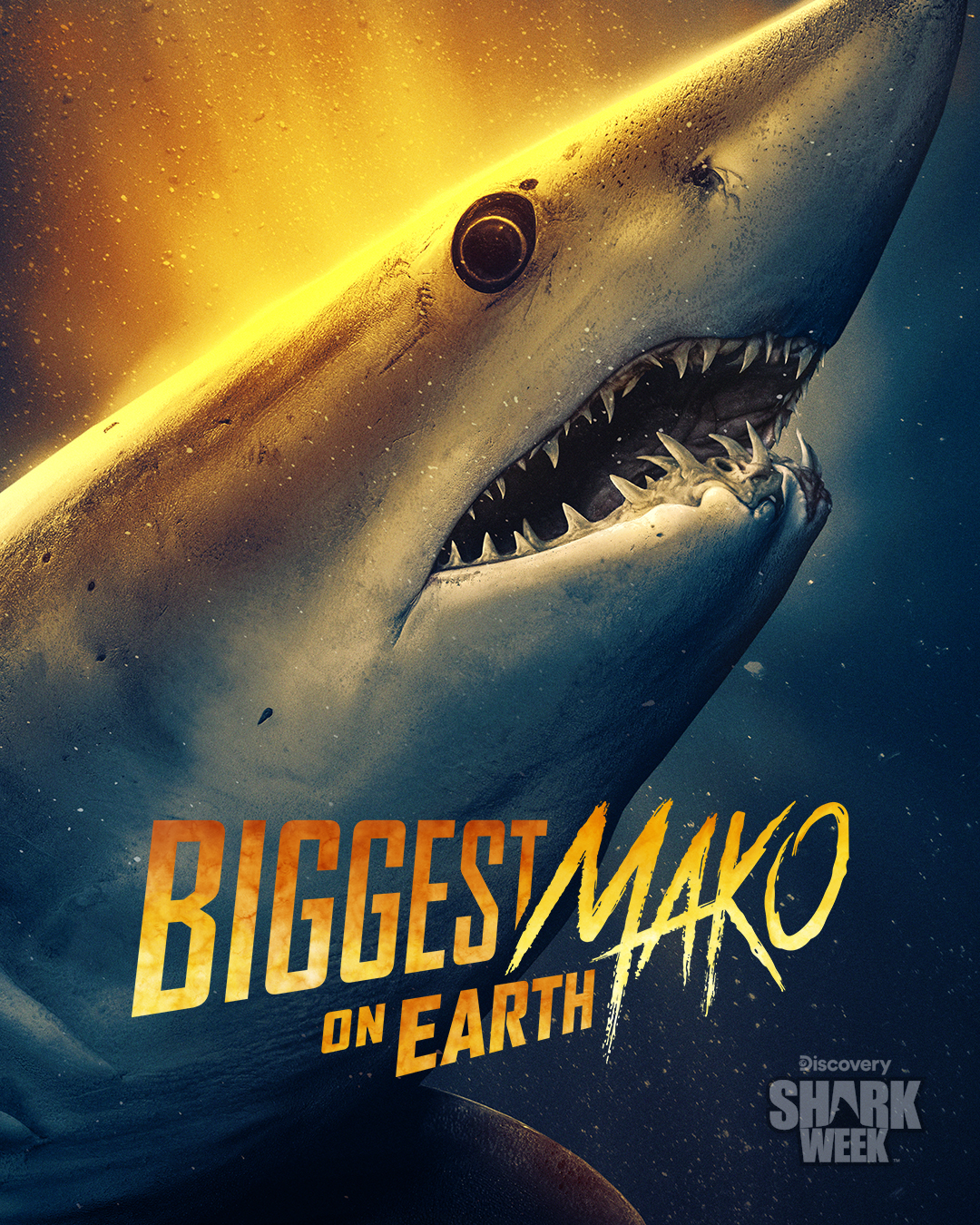
SHARK WEEK : BIGGEST MAKO ON EARTH | ©2026 Discovery Channel
BIGGEST MAKO ON EARTH mentions that makos eat ten percent of their body weight. Is that per day or per meal?
“That’s thought to be per meal. For example, Great White sharks are known for doing gorge events. So, if you’ve ever seen a deceased whale that has a bunch of sharks on it, those are doing gorge feeding. And so, they are eating a tremendous amount in one sitting, where it’s thought that makos need a lot more frequent meals.
“They’re the fastest shark in the ocean, they can travel up to forty-five miles an hour in bursts, and so, they’re expending a lot of energy. It’s thought that they sort of have a quick metabolism in that sense. And so, one of the things we were looking into in this episode was, can a mako in Southern California that has access to something like a dead marine mammal, such as a whale, be eating more in one sitting than a mako typically would be? And, if so, can that sustain it a little longer, can that cause it to get bigger, sort of just seeing what the marine mammal factor could lead to as far as changes in their behavior.”
While finding bigger makos attests to the health and longevity of those individual sharks, Berna cautions that this doesn’t necessarily mean the overall health of the marine area is improving.
“That’s a hard question. The fact that makos in California are getting bigger means there’s an abundance of prey. And that sounds like a really good thing, because it sounds like there’s more prey in the environment. But the fact that it’s warmer, there’s more prey, might also mean that we’re more likely to have outbreaks of disease and algae blooms and things like that.
“So, saying they’re getting bigger isn’t necessarily saying that it’s better for the entire environment, it’s just saying that this particular region is hosting makos in a prey-available state. But I would say there’s always a give and take with that. It’s sort of like saying, ‘Climate change is good for me, because I can wear a tank top.’ But then there are also very bad things with it. So, I would say it might be good for the species in the short term.”
Berna notes that finding bigger makos may possibly mean more sharks really are growing larger; it doesn’t mean that Berna and her team are using more sophisticated technology to find them. “We’re just chumming [putting bait in the water] and knowing where they go and what conditions they like. Keith Poe has basically spent the last twenty years on the water most days of the week, looking at the makos and Great White sharks, and he’s really good at knowing where they’re going to be.”
For BIGGEST MAKO ON EARTH, Berna adds, they are not even tagging sharks – tagging is a method of putting a small physical tracking device on a shark to better understand the animal’s migration habits. “When you do tag sharks, you use a satellite tag, an acoustic tag, a physical tag for some of the younger sharks that you just want to do mark-recapture with. So, I wouldn’t say the technology is really changing. But this year just happened to be warm enough for them, and we’re in the right area where they usually are. So, we lucked out for SHARK WEEK’s sake in being in the right spot at the right time this year. But I wouldn’t say it was thanks to any new technology.”
Berna goes into the water in a shark cage; Poe doesn’t go in the water at all. Would Berna be comfortable going into the water without a cage, the way some of the camera operators do?
“It depends on the shark. Keith Poe has a joke where he says he will never get in the water, because he owes too many debts in there. I think he feels like he’s tagged way too many sharks, and they’re going to come for him eventually if he ever steps foot in the water.
“But it depends on the shark. You can generally tell how aggressive they are, you can tell how fed they are. So, if a shark first shows up to the boat, probably not. Once you get a sense of it, and once it’s come up to the cage enough times, it’s bit the tuna that you’re offering it enough times, you’ve kind of both tired it out and got it used to your presence, then potentially yes. Which I have done before – I have been in the water with makos without a cage, but it’s something that you need to get to know their level of aggression at that moment a bit before you would want to do that.”
Apart from scientific knowledge for its own sake, is there a practical application for the information Berna gathers during BIGGEST MAKO ON EARTH?
“That’s basically like saying, what is science good for?”
In fact, Berna points out, it’s good for lots of things. “You need data to inform any policy. So, similarly to my nonprofit Beyond the Reef in the British Virgin Islands, they had pretty much no data whatsoever, and you need to collect the baseline data in order to know what’s changing and what you need to protect. For example, if you find that you have an endangered species that’s thriving there, then you know that we cannot put up a building here, because we need these mangroves.
“The same goes for sort of any research. You’re figuring out how this species interacts with its environment, and how it changes. That helps to inform policy, and also just baseline research. Because all these species overlap with each other and interact, and sharks also are very much an indicator species, they’re apex predators, they sit at the top of the food chain, and so their health and their changes have a big impact on the environment, and can tell us what’s going on.”
And what would Berna most like people to know about BIGGEST MAKO ON EARTH?
“Not many people are doing things with makos – I think that’s what makes it such an interesting show each year. They’re generally not that easy to find. People don’t interact with them that often, because they’re a deeper-water species for the most part. So, I think they’re one of the smartest sharks out there, they’re the fastest shark, they’re just a really cool prehistoric-looking ancient predator.
“So, I think getting to work with and film makos is a rare opportunity. I might be biased. I work with completely other sharks in my research in the British Virgin Islands, and I love all those sharks, too, but I do think that makos are probably the most fun species to watch, just based on the way they act.”
Follow us on Twitter at ASSIGNMENT X
Like us on Facebook at ASSIGNMENT X
Article Source: Assignment X
Article: Exclusive Interview: Shark expert Kendyl Berna on the fastest swimming sharks on BIGGEST MAKO ON EARTH
Related Posts:
 Loading ...