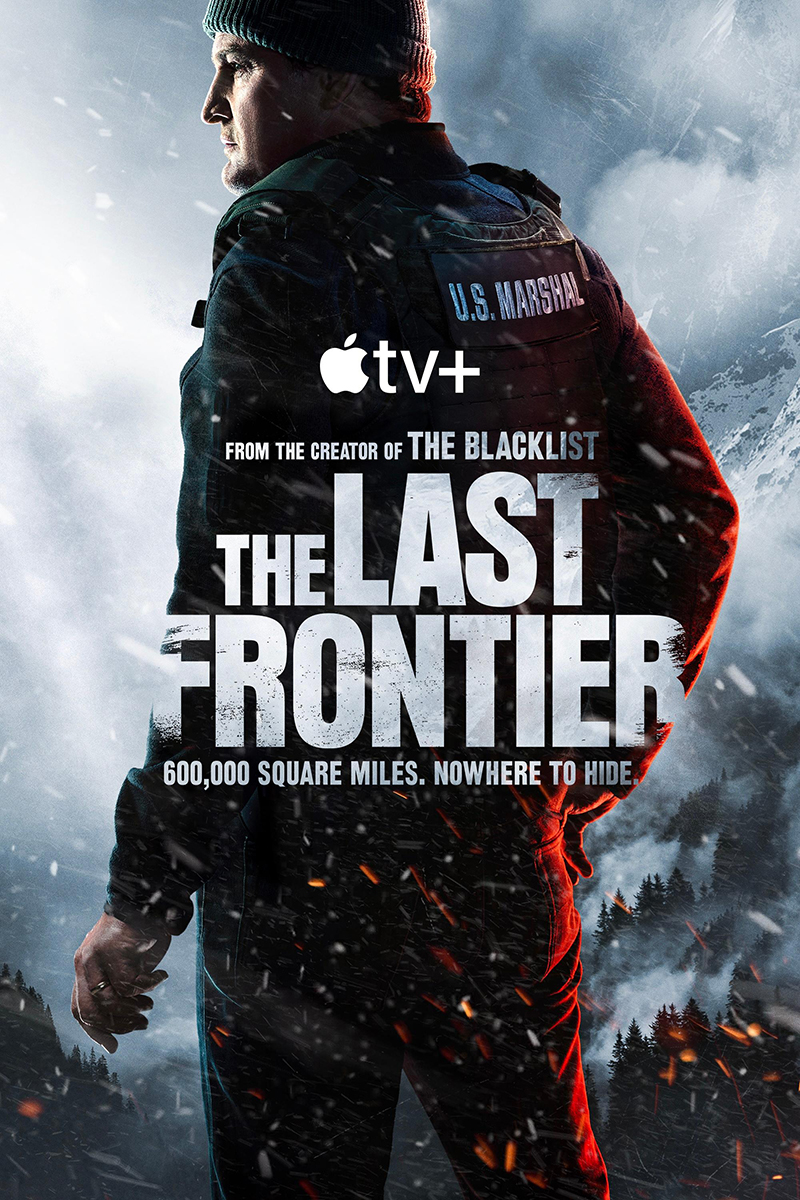
THE LAST FRONTIER – Season 1 – Key Art | ©2025 Apple+
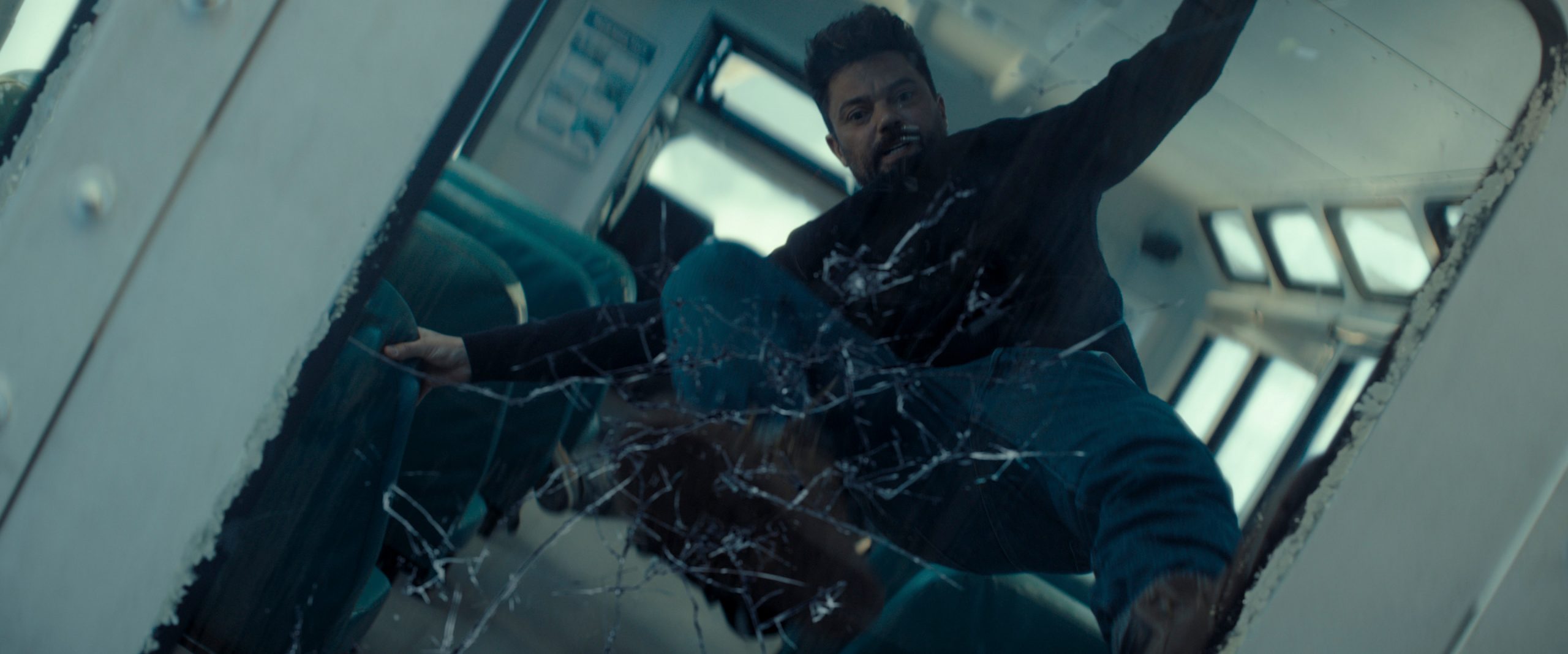
The title of Apple TV’s new series THE LAST FRONTIER refers to a remote, snow-covered region of Alaska, where a government prisoner transport plane has crashed. This was no accident: the disaster was engineered by detainee Levi Hartman, played by Dominic Cooper.
Rounding up Hartman and other crash survivors is the responsibility of local U.S. Marshal Frank Remnick, played by Jason Clarke. His mission becomes much more complicated with the arrival of secretive C.I.A. operative Sidney Scofield, played by Haley Bennett, to say nothing of what happens when Remnick’s wife Sarah, played by Simone Kessell, and son Luke (Tait Blum), are drawn into the growing crisis.
THE LAST FRONTIER has new episodes dropping on Fridays. The series was created by Jon Bokenkamp & Richard D’Ovidio.
Bokenkamp, who serves as showrunner and an executive producer on THE LAST FRONTIER, and Clarke, also an EP on the series, participate in a Zoom Q&A with cast members Bennett, Cooper and Kessell for members of the Television Critics Association (TCA).
Bokenkamp says he is trying to balance THE LAST FRONTIER between serialized suspense and closed-ended procedural. “I’m a sucker for procedural, right? I love a good closed-ended story and I think that this show definitely has a procedural element. The hope going into it is that by the end of each episode, and I think the end of the season, you’re left with both a cliffhanger and with real resolution within the story. With the inmates that are [on the loose] in the background of Alaska, we are definitely focusing each episode on one of them. And yet, there is a much larger story/conspiracy that we’re unpacking, and I think that’s the thing that brings us back each week.”
At present, many U.S. government organizations, including the C.I.A. and the Marshals Service, are not functioning in the ways that they have in the past. Does THE LAST FRONTIER take this into account?
Bokenkamp explains, “The show was written over a course of time that goes back a year or two, probably, so predates anything that’s going on right now. I think there’s a concept of the F.B.I. and the C.I.A. and what they represent, and what it is their job to do. And the show lives in that space. If anything, I hope the show can be a venue for people to escape.”
He continues, “The show is definitely not meant to necessarily be a stark reflection of things that are happening every day, but more a way for people to tune in and forget about all the craziness that’s happening in the world. This is just sort of a cheeseburger. That’s sort of the world that we’re operating in. Cheeseburger Land.”
This gets a laugh from all of the actors. Cooper seems especially taken with the description. “Cheeseburger Land. Brilliant.”
Cooper’s character Levi is an enigma, who is initially described by Sidney, who may not be the most reliable source. Given that we see some reversals of behavior from what we’ve been told to expect and revelations of his motives, how did Cooper approach Levi? Did the actor play the role according to the overview of each scene, or did he play Levi consistently and trust each scene’s context to shape what the audience thinks?
Cooper replies, “I think, and Jon will agree, we were constantly discussing where we are with regards to the story and what we know of him, because he changes throughout. One of the worries was, how do you come across? You need him to be likable, but what he’s doing, and certainly what he does at the beginning, is monstrous. Jon was so brilliant at reminding me where I was exactly in the storyline. Because obviously, we can’t film in sequence. And you did want to play him as an Everyman – or a cheeseburger.
“But my goodness, this man had a complex history and a fascinating idea of what he wanted, and ultimately to save his wife, who he loved. And I think that that raises so many wonderful issues. He’s so beyond anything I truly understand as being a human being,” Cooper observes with a laugh. “He’s a mathematician, genius lecturer who is also from the world of the C.I.A. They want to put a stop to him. But the only thing I could truly do or stick to is to make him truthful and real and believable, because he does such an incredible thing that we are unaware of at the beginning, but we surprisingly and excitedly reflect on afterwards. It was a magnificent character to have the opportunity to play.”
THE LAST FRONTIER – Season 1 | ©2025 Apple+
As to how Kessell sees the marriage between her character Sarah and Clarke’s Frank, she offers, “I think we’re coming into a long marriage. I like where we come in as a couple, because it’s not candy-coated and it’s not like most long relationships, it’s day by day. I felt it was very real for a television marriage. I have a long friendship with Jason, and it felt very easy and I liked that. I liked the fact that we played it like, we’re a very familiar family. There is a back story, which is later revealed, which I think they’re always wearing. There’s a layer of that to both of them.”
Did the actors have to learn anything in order to portray their characters?
For Kessell, whose Sarah is a nurse, her response is semi-joking. “I sanitized a lot. I felt that was a really good action. Now, having just watched THE PITT, they do it as well – but I did it first,” she laughs.
Clarke speaks up on behalf of Bennett. “Haley had to learn a lot of jargon, a lot of complicated things to put across.”
Bennett says of herself with a laugh, “I always talk jargon, [but] not C.I.A. jargon. It’s almost like speaking a different language in a way. And the dialogue – the speech is so heightened. So, it’s just trying to adapt to that and make that as real and truthful as possible.”
The accent was also something to be mastered, Bennett adds. “We did a big table read [of the script] at the top of the show before we started shooting. I’ve been living in the U.K. for seven years. And I remember, after the table read, Jon Bokenkamp came up to me and he said, ‘Do you want to work with Jason and Dom’s dialect coach?’ And I said, ‘Why would I do that? I’m American. I don’t need to work with a dialect coach.’ And he’s like, ‘This character is really American, this is her DNA.’ And I said, ‘Well, I’m from Ohio. It’s okay.’ And he said, ‘Hmm, I think you might have assimilated a little bit to the British dialect.’ So, yeah, I did work with [a dialect coach].”
“We had as many dialect coaches as we did stunt coordinators,” Bokenkamp elaborates. With Clarke being Australian, Cooper being English, Bennett being English-influenced, and Kessell being a New Zealand native, Bokenkamp may not be exaggerating. “It was fantastic.”
“Everyone had to do a fight sequence as well,” Clarke recalls. “That is not easy. And the way [director/stunt coordinator] Sam [Hargrave] and [his brother, second-unit director/stunt coordinator] Dan [Hargrave] film, it’s usually in big, long sequences. So, we all had to take physical training with horses, and then to shoot out in minus twenty-five [temperature]. If you watch the big opening sequence with Dallas [Goldtooth], he’s got a couple of shoulder rolls and knife stabs going in there. That’s not easy, particularly to do it in such cold weather. But these guys are great and they train you. They’ve worked with all the Marvel movies. You spend the time to be able to do it and then execute it under pressure.”
The actors debate the term for the vehicles they use in the snow, with suggestions including “ski-doo,” “tundra buggy,” and “skedaddle.”
“I learned to drive a tundra buggy,” Cooper relates, “which was interesting, because the steering rack didn’t attach to the wheels and the body wasn’t attached to the chassis. But it worked very well. But it was huge. It’s a caravan on wheels. It’s a box. It’s a house. You know when you see those houses being transported down freeways? It’s like that, but it’s got a steering wheel. And it very nearly went over the edge of a cliff, and it’s real. That was my thing I learned.”
Then there is an actual dog sled.
Bennett reports, “My favorite sequence, this incredible sequence in one of the later episodes – Jason just makes everything look so natural. He climbs on the back of this sled. I’m being transported, and that was a great day for me. I just got to lie there while he got [to drive] Huskies. Incredible hounds. It was so magical and mystical-looking in this beautiful wonderland.”
As Clarke is from Australia and Cooper is from England, did either or both find Alaska to be very different from their normal environmental experience?
“You find a lot of similarities,” Clarke observes. “Australia’s a very open, huge country. It doesn’t have mountains like [Alaska], but it’s got the solitude, it’s got the wildness, it’s got the danger, as well as, in those big open places, strong communities are forged because they have to be. And I think there’s a great longing for any of us in life, as we all go on our journey from trying to be actors to them wanting to have a good, strong community wherever we are, and then move back home at some point, as Frank does in the series.”
Cooper agrees with Clarke’s sentiments. “This is Alaska. There are no boundaries. And when we spoke to people, they spoke with such passion about that environment and that world and being part of nature. I think we felt we were very remote from everything. But it was actually a wonderfully freeing feeling and so good to give the sense of the piece of work. That landscape is so much part of this piece of work. And we worked so hard, and the crew worked so hard – every single person worked so hard at making that real and finding the places that felt like it embraced the landscape and the difficulty of the landscape.”
Cooper also feels strongly about real-world attacks on that landscape. “It makes the idea of what we’re all doing on this planet so minuscule. You are in this marvelous beauty, this world, this incredible environment that we have for free, that we are currently destroying. If you don’t notice that while you’re watching this show, you are mad. It will be a beautiful thing to watch.”
Follow us on Twitter at ASSIGNMENT X
Like us on Facebook at ASSIGNMENT X
Article Source: Assignment X
Article: Interview: The co-creator and cast of THE LAST FRONTIER talk about the new Apple+ series
Related Posts:
 Loading ...