




Marine biologist Gibbs Kuguru and the team of shark experts analyze the behavioral patterns of bull sharks to gain insight into the July 4th encounters on South Padre Island, Texas in INVESTIGATION SHARK ATTACK | ©2025 Cineflix /Ian Watson
Shark expert Gibbs Kuguru is one of the investigators assembled for SHARKFEST’s new six-episode series INVESTIGATION SHARK ATTACK, which runs for six consecutive nights, beginning July 5. The episodes debut on National Geographic, Nat Geo Wild, Nat Geo Mundo, Disney Jr. and Disney XD, and are thereafter available on these networks’ streaming platforms, as well as Disney+ and Hulu.
Kuguru is also busy with working on his PhD thesis and is featured on Discovery Channel’s upcoming SHARK WEEK programming later this month.
Over a Zoom session, Kuguru talks about INVESTIGATION SHARK ATTACK. Last year, Kuguru was one of the experts on SHARKFEST’s SHARK ATTACK 360°. Can he talk about the differences between that program and the current INVESTIGATION SHARK ATTACK?
For starters, there’s a new group doing the investigating, bringing their diverse viewpoints to their subject, Kuguru points out. “That’s something that really drew me to the show, is that the different investigators – myself, the illustrious Professor Mike Heithaus, Dr. Megan Winton, and PhD candidate Candace Fields – we all have different expertise, and the spotlight for INVESTIGATION SHARK ATTACK was really on how all of us look at the same problem, using our respective disciplines.
“Mike has had a very long career in shark research and marine ecological and some predatory research, so he’s working a lot with different species of wildlife on an ecological level. Megan is an expert in stats, crunching numbers, analysis, and Candace is an expert in conservation biology and management. And I try to fill in the blanks where I can with evolution
“I’m a nerd of note, so I was like, ‘I want to know what these highly respected scientists that I’ve read all of their work are saying.’ For me, it was like sitting in the watering hole with some good friends. But with hard-hitters like that, I don’t want to say it makes me feel humble, but it makes me feel honored to be in their orbit in such a way.”
Where does INVESTIGATION SHARK ATTACK find the incidents being examined?
“For Season 1,” Kuguru relates, “we are exploring a lot of the attacks that happened between the East and West Coasts of the United States, and also around Hawaii, in the Pacific. That’s where our home base is, between places like Florida, California, Maui, some attacks in North Carolina, but you really can’t skip over Florida, because that is the shark bite capital of the world, measured by many metrics.”
There are now shark attacks near places where drainage pipes dump their contents into the ocean. This is because an ecosystem has built up around the sewage, creating new microscopic species that attract very small fish, which attract slightly larger fish, and so on, until finally the size of potential prey attracts sharks. Is this still happening?
“Oh, yeah,” Kuguru affirms. “It’s commonplace. Every time we open a can of something, or a jar of something, or we drain something in the sink, or in the toilet, or the shower, it’s all going somewhere. I feel like it’s less just a problem of sharks encountering our pollutants, and more just the entire environment encountering our pollutants and trying to respond to it in the only way they know how. Especially with regard to sharks, if you cause this shift in the dynamic, you change their behavior, you change their ecology, and then eventually they start adapting to the pollution you’re putting into the water and start using that almost like a checkpoint in their life history.
“This is scary stuff, not just because it could potentially bring humans into contact with sharks [resulting in] negative encounters, but it’s just bad, because it unbalances the whole ecosystem. It’s so delicately put together, and we’re so good at disrupting it.”
Obviously, a shark bite in itself is damaging, but has anyone ever gotten a septic infection from being bitten by a shark that has been eating prey affected by sewage?
Kuguru considers this. “I don’t think that the infections that you would get from a shark bite would be particularly more pathogenic than any other bite. For example, I would say for sure, you don’t want to get bitten by a seal in South Africa. They’re just swimming in rabies.
“But as someone who’s been bitten by sharks multiple times, some good rubbing alcohol will get it cleaned out, and a good night’s rest as well. But for a lot of these victims, of course, the severity of the wound will probably increase the severity of their infection. You have to look at each bite on a case-by-case basis, but I don’t see any particular effect from our pollutants yet. That does not necessarily mean that there isn’t something happening. I just don’t know.”
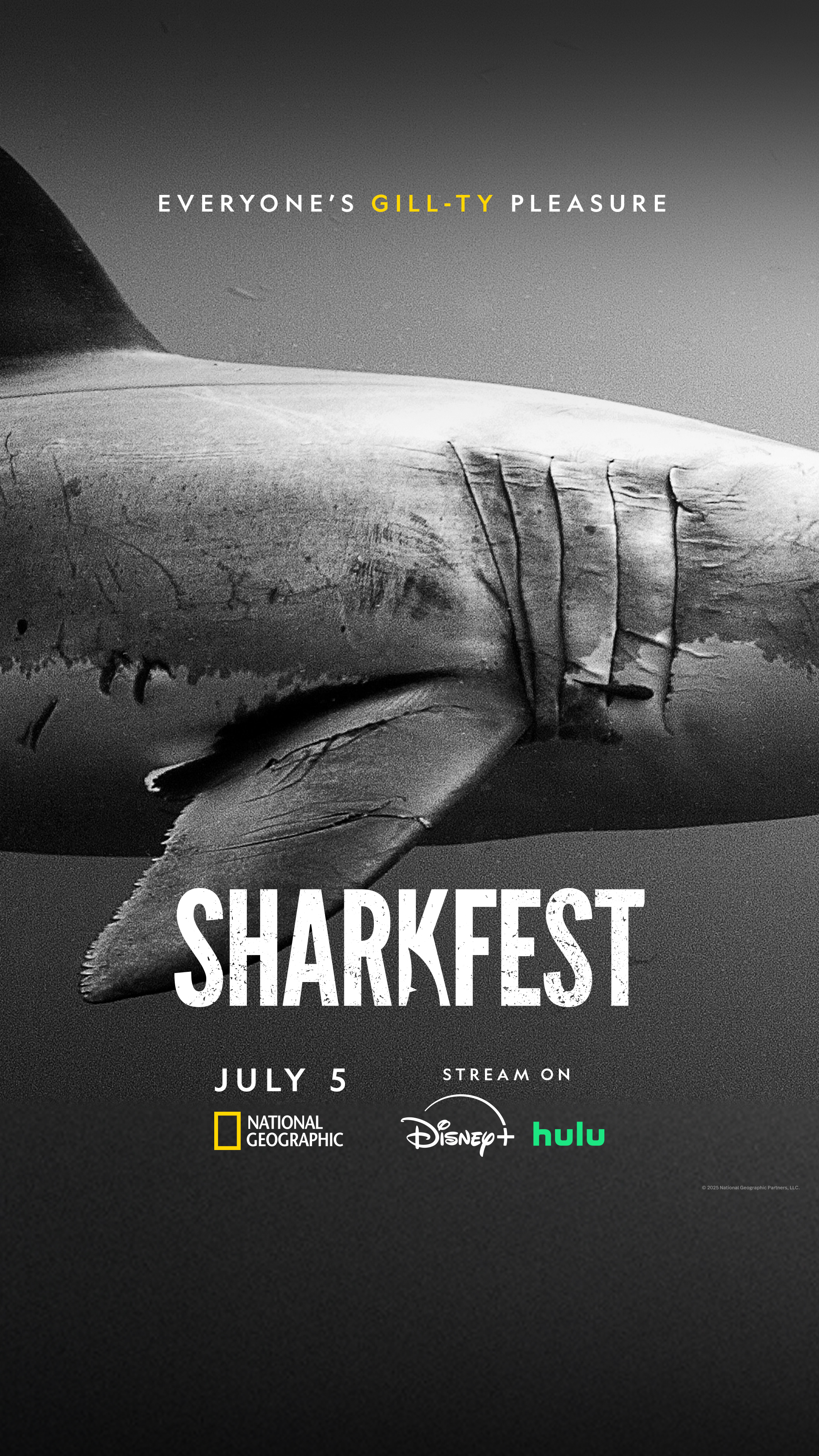
SHARKFEST 2025 | ©2025 NatGeo
If the sharks are eating rabid seals, while the sharks themselves cannot get rabies – that disease only exists in mammals – could they be a vector for transmitting rabies to humans?
Kuguru believes it’s extremely unlikely. “The COVID pandemic actually taught us a lot as a general public about zoonotic diseases and how they’re transferred. If I had to take a guess, and this is someone that is not a virologist, not a microbiologist, I would say that if a Great White shark ate a rabid seal, I would doubt that the shark would become [a rabies carrier].
“From mammal to mammal it’s very easy to spread. That’s why the seals got it; this is why also people are particularly afraid of the seals in South Africa. What if your dog, or even a stray, gets bitten by a seal, and then spreads it through the whole neighborhood?
“It’s already a disaster, at this point, so the good cetacean scientists that are out there, they’re trying to stem the tide of this tidal wave of disease. If I had to guess, I would also say humans might have had something to do with it, but it is what it is.”
Cetacean scientists are studying this? Wait, orcas eat seals – could this cause rabies in orcas?
Kuguru laughs. He doesn’t know if anyone has an answer to this yet, and they’re probably not going to get it in the waters around South Africa. “The orcas in South Africa are not attuned to eating other mammals. With South African orcas, we have two different eco-types. One is primarily fish-eating, and the other is primarily shark-eating.”
This has created a problem not only for the sharks, who will cede territory to the bigger orcas, but for shark scientists, who now have to search for their subjects in new places. Are sharks starting to turn up in unexpected locations? And are any species of sharks becoming more aggressive toward humans?
It’s not so much that any sharks have changed their behavior lately as it is that some are receiving more scrutiny. “We put a spotlight on oceanic blacktips as one of the species that I felt didn’t garner enough attention for its particular role in negative shark encounters.”
In 2022, Kuguru participated in SHARKFEST’s CAMO SHARKS, about sharks that can change their coloration. He worked with blacktip sharks in that as well, but he explains the blacktips in INVESTIGATION are not the same. “The species that I was working with in CAMO SHARKS are blacktip reef sharks; their Latin name is Carcharhinus melanopterus. In INVESTIGATION SHARK ATTACK, these are oceanic blacktips, also known just as regular blacktips, and their Latin name is Carcharhinus limbatus. So, it’s two different species, but both are so lovely. I love diving with both of those species, it’s great.”
Kuguru adds that Great Whites get most of the attention and blame, even though some of the major culprits are other species. “It being the fiftieth anniversary of JAWS [the movie] this year, we were also trying to uncover those stories. [Robert Benchley’s novel JAWS, the basis for the film] was actually loosely inspired by several attacks that happened in Matewan Creek, New Jersey, in 1916. But these were bull sharks that had been in several attack incidents, and the Great White got the rap for it.
“But I think that’s something that this show does really well is, it explores all the different species that live in a certain area, and then the likelihood that they’re involved in an attack when you look at the evidence – the time of year, the type of bite, the type of prey that was around them.
“As far as a shark [species] that you would not expect, I think we’re dealing with a lot of the usual suspects in most cases. The thing that surprised me in this season is that you had sharks that were popping up in places where they were not expected. And that is also, in part, our fault, due to permutations associated with climate change, like the water temperature is lower in one area and it’s higher in another area. So, for example, the Great Whites move northward to British Columbia in Canada, and now you have sharks outside of Vancouver, when they should have normally been in California.”
And what would Kuguru most like people to know about INVESTIGATION SHARK ATTACK?
“As a scientist, this is probably one of the most flattering displays of scientific expertise that I’ve seen, really just giving us nerds the ability to just riff and explore ideas in a nuanced way. So, if you’re looking for a show about shark attacks, but with common sense driven by data, then this is the show for you.” He thinks over what he just said. “That sounds so nerdy,” he laughs.
Well, SHARKFEST is designed to appeal to shark nerds, right?
“Yeah,” Kuguru agrees. “That’s what I like. They’re my peeps.”
Related: Exclusive Interview with Cinematographer Dan Beecham and shark expert Candace Fields on new SHARKFEST docs
Follow us on Twitter at ASSIGNMENT X
Like us on Facebook at ASSIGNMENT X
Article Source: Assignment X
Article: Exclusive Interview with INVESTIGATION SHARK ATTACK shark expert Gibbs Kuguru
Related Posts:
 Loading ...