




DANCING WITH SHARKS key art | ©2025 Discovery Channel
Journalist and shark expert Kinga Philipps became the first solo woman host of a Discovery Channel SHARK WEEK show in 2020 with TIGER QUEEN. Among her many achievements is being an ambassador for the organization Waves for Water, which provides clean water for those in need.
This year, Philipps is part of three SHARK WEEK productions. DANCING WITH SHARKS and CAUGHT: SHARKS STRIKE BACK both premiered earlier this week on Discovery Channel and are now available on demand and on Discovery and Hulu’s streaming platforms, while ATTACK OF THE DEVIL SHARK premieres Saturday, August 26.
DANCING WITH SHARKS features DANCING WITH THE STARS host Tom Bergeron. What’s that program like?
Philipps relates, “In DANCING WITH SHARKS, I am one of the judges. It’s a super-fun, very shark-positive show. The question that’s been asked repeatedly is, ‘Do the sharks actually dance?’ And the answer is, ‘Yes, they do.’”
How does that work? “We have some of the best shark handlers in the world, and they’re working with these sharks, it’s put to music, it’s choreographed, the shark handlers are actually dancing and, because they are guiding the sharks like you would a dance partner, the sharks in fact, one might argue, are also dancing. They’re actually competing for the Best Dance.”
Do the sharks enjoy this? For that matter, can it be determined whether a shark is enjoying something?
“I love sharks,” Philipps declares. “The thing about sharks is, they are massive apex predators, and we are in their world. It’s not ours. So, the only way for a shark to be present with us in any situation is for them to choose to be there. None of these sharks are ever forced into a situation. We’re not arm-wrestling them into dancing with us or interacting with us.”
Simply getting sharks to approach is usually a challenge. “This is an open ocean and oftentimes there will be chum present or bait present. We always have permits to do that. Realistically, if that’s not present, the sharks don’t even care to show up. But when there is some kind of bait or chum in the water, the sharks will come in to investigate the source of that, and that’s how we get the opportunity to interact with them, study them, take [tissue] samples, tag them [so that migration routes can be studied], all of that.

ATTACK OF THE DEVIL SHARK key art | ©2025 Discovery Channel
“So, in DANCING WITH SHARKS, the way these handlers are people who will often bring tourists down there so that they can enjoy and appreciate these animals, and they will have a bait box, and they will sometimes even be holding a fish. And as they move that fish, the sharks will follow that. So, the sharks are doing everything on their own, and when they decide to leave, they leave. So, there is no harm whatsoever to the sharks, and I would say if they’re enjoying being there, because they get a fish, then the answer is yes.”
What happens in CAUGHT: SHARKS STRIKE BACK?
“It’s a clip show where myself, shark conservationists and shark experts were shown clips of incidents involving sharks, whether it was an active attack or whether it was just a shark behaving a certain way that was maybe caught on camera – everyone’s got a GoPro or has a camera these days. That is a really interesting show for anyone who is interested in shark behavior, because we look at these clips and break down what happened in them, what mistake the human potentially made to get themselves into that situation, or what the shark’s behavior meant, or what external factors were present that could have helped create this perfect storm of a situation. I really enjoyed doing the research, when I got those clips, to understand what was happening.”
ATTACK OF THE DEVIL SHARK deals with the Caribbean Netherlands mythology surrounding a legendary tiger shark known as Jabwei. It begins with narration that sounds like it’s coming from a Quint-like fisherman, who describes Jabwei as “evil” and full of “hate.” How does a shark lover like Philipps feel about this introduction?
“I have qualms about that. I don’t love that language.”
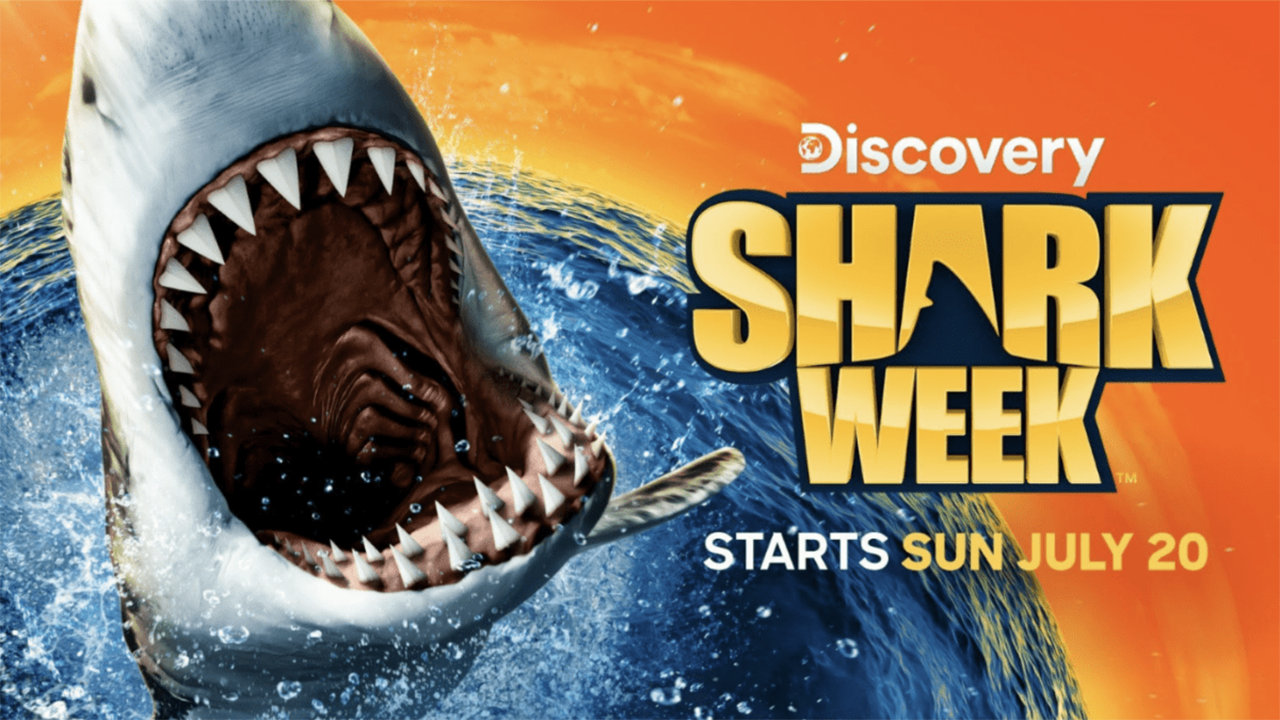
SHARK WEEK 2025 | ©2025 Discovery Channel
However, Philipps observes, there has to be a degree of showbiz razzle-dazzle in Discovery’s offerings.
“Discovery is great in the sense that some of our shows are entertainment. They’re fun, they’re drama, we’re creating a scenario. And then some are pure education. ATTACK OF THE DEVIL SHARK, as dramatic as the title is, and as dramatic as the intro is, it’s still such a fun show, and at the end of the day, we are working with scientists, we are conservationists, we are getting samples of these sharks.
Also, while it is rare, sharks do attack humans. “The reason the intro is that way is because we are basing it on two very tragic incidents – one of them was a fatality – and what was fascinating about that was that the shark implicated in those attacks actually turned out to be the same shark. So, is the drama pumped up there? Yeah, absolutely. I won’t deny that at all. [But] at the end of the day, we’re still taking samples and we’re studying these animals and we’re learning about a population of sharks that we didn’t really know was there before.”
The Saba Bank, where the attacks took place, had previously “kind of flown under the radar. A few scientists have been out there, but we got the opportunity to tag, to put a satellite tag, acoustic tags, take tissue samples, and that’s actually one of the big benefits of SHARK WEEK that people don’t think about, is that the shows fund that research. We pay for the tags. Science is expensive, and a lot of the universities and the research institutions don’t have a ton of money. So, a lot of times, when we come in, we’re bringing money in to be able to put these tags and to study these sharks. So, a lot of the data out there about sharks exists from shows like this.”
Where and how do the tissue samples get processed and what do the results tell the researchers?
“We put the samples on ice on the boat. We keep them clean, we put them in special tubes, and they get sent off to a lab somewhere on land, and then they get processed. There are different things that you can look for. We were looking at genetic analysis of these sharks to see if we could link any of these sharks to the Devil Shark, which is also the shark of legend in that area, the Jabwei.
“That in itself is also interesting. I have a background in anthropology as well. Usually, I’ve found in the types of shows that I do, when there are mysteries and legends in lore, there’s usually a seed of truth to something. So, again, as much as stories about the yeti or werewolves or Dracula can be very dramatic and use very dramatic language, if you look at it from an anthropological standpoint and really go back through history, there is usually a seed of truth, an inception, to where these legends originated, and that’s what we were looking for here. So, to circle back to that really dramatic intro, it’s meant to read like one of these very dramatic stories of lore, which is exactly what it is, it’s lore.”
How long has the legend of the Jabwei been around, and how long do tiger sharks usually live? Is it possible that the current supposed Jabwei could be the same as the original mythical creature?
Philipps believes this is unlikely. “Tiger sharks have quite a long lifespan [one upper estimate is fifty years, but] the legend of Jabwei has been there for a very long time. And what we suspected, and this is why it was so interesting, is that oftentimes, these legends aren’t with a particular shark.
What we suspected is that there is something in the region, whether it is the abundance of prey availability on the Saba Bank, or whether it has something to do with the volcanic nature of Saba itself, that is potentially attracting very large sharks. Because from a logical standpoint, and an anthropological one, it’s probably not one shark throughout history that people have seen repeatedly. Although it could have been for a while. But what would be more interesting to us as conservationists and scientists is to understand why very large sharks gather in that area.”
Saba Bank is notable for its offshore volcanic fissures, which attract many marine species. Therefore, prey is plentiful for tiger sharks. With so much normal food available, wouldn’t this make them less, rather than more, likely to attack non-prey items like humans?
Philipps says the inverse can certainly be true. “There are some situations in the world where we have seen exactly that, where prey populations decline. In Brazil, there was a port being built, and they damaged a reef, and suddenly there were these shark attacks, because the sharks that had lived on that reef and had plenty of food were suddenly looking for other food sources.
“[In Saba Bank], yes, there’s an abundance of food here. But that’s not always the only factor, and this is what makes sharks such interesting and nuanced animals. One of the things that we were looking at was taking the tissue samples, and one of the theories that I personally had was identifying whether there were a lot of pregnant females in that area that maybe could have hormone surges in their system that would make them more bold, [because] they were pregnant, so they needed to eat more. Another theory that we had is that is the volcanic activity affecting the behavior of the sharks, and inciting behaviors that maybe are a little bit more bold or aggressive.
“And then there’s a great theory by Dr. Eric Clua. He actually bluntly calls it the ‘a**hole shark theory.’” Per Philipps, Dr. Clua’s concept is that sharks are not mistaking humans for seals but instead recognize that something unusual is in their territory. “He says, ‘These are predators that have evolved over millions of years. They are rarely making mistakes.’
“It’s more likely that, like dogs or humans, sharks have very distinct personalities. I personally know that’s true. So, you must just have one shark that, in Dr. Clua’s words, is ‘an a**hole,’ or a shark that is just more investigative, more bold, more likely to go after food sources that are outside of its normal realm.”
Is it possible that sharks are aware that humans are a threat, and some attacks are based on this?
Philipps discounts this notion. “I don’t think that they think that far ahead. Sharks are very intelligent, and they also recognize us as not a food source. When you’re in the water as a diver with a big tiger shark, as it’s coming towards us, we will often go vertical in the water so the shark can see our entire structure, because that registers to the shark, ‘Oh, this isn’t actually a prey item for me.’
“With that said, tiger sharks are still very curious and investigative, and they’re also the garbage disposals of the sea, so that doesn’t mean that it’s not going to come in and bump you, and you might have to redirect it,” often by pushing its snout away, “because it’s curious to see what you are. But even tiger sharks, which do have a very broad diet, generally are quite picky and have their favorite things.” Which, fortunately, mostly don’t include us.
Follow us on Twitter at ASSIGNMENT X
Like us on Facebook at ASSIGNMENT X
Article Source: Assignment X
Article: Exclusive Interview with Shark expert and journalist Kinga Philipps on SHARK WEEK’S DANCING WITH THE SHARKS AND ATTACK OF THE DEVIL SHARK
Related Posts:
 Loading ...