


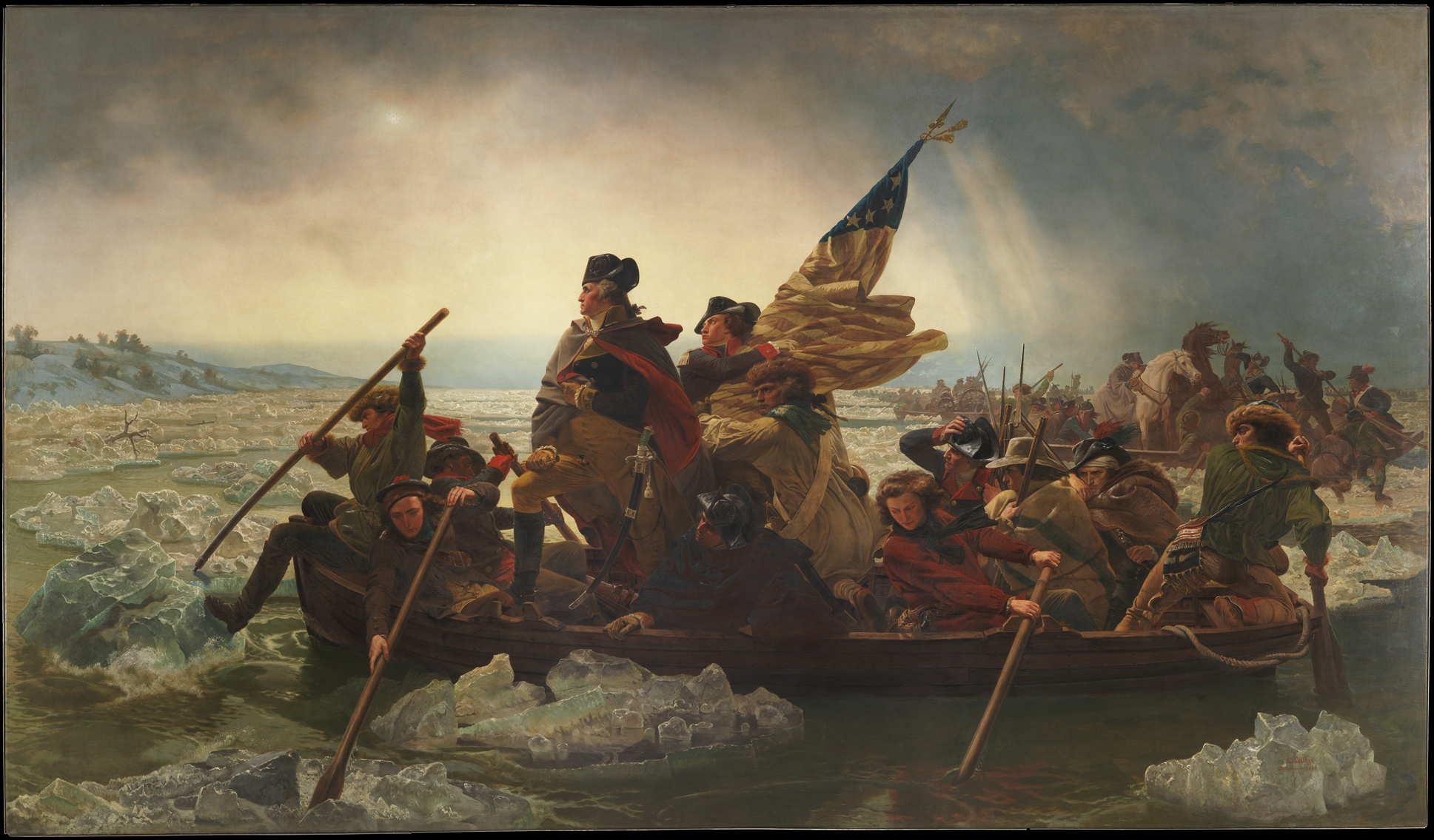
George Washington Crossing the Delaware; By: Emanuel Leutze; 1851 from | THE AMERICAN REVOLUTION | ©2025 PBS
THE AMERICAN REVOLUTION is a twelve-hour, six-part documentary series about the founding of the United States, premiering on PBS Sunday, November 16 and running through Friday, November 21. It will be available in 4K on PBS and the PBS app.
Directed and produced by the prolific Ken Burns and his frequent collaborators Sarah Botstein and David P. Schmidt, and written by Geoffrey C. Ward, THE AMERICAN REVOLUTION delves deep into many aspects of the American colonies’ efforts to break ties with England.
Burns, Botstein and Schmidt come together for a Zoom press conference to answer questions about THE AMERICAN REVOLUTION, a project that they’ve all been working on since 2015. This article highlights parts of the discussion.
What was the most surprising thing the filmmakers learned in making THE AMERICAN REVOLUTION?
For Burns, “I think for me, it’s just the sheer sense of how long it took, how bloody it was, how anybody involved in it didn’t know they were who they were. George Washington didn’t know he was going to be George Washington. The sense of contingency and the idea that it might not turn out the way we know that it did was the surprising aspect for us to try to work into our work.”
Schmidt elaborates, “It united the states. But I think what surprised me, and really unlocks this whole thing is that those three things – republic, union, and independence – were actually not the goals at the outset of this war. The war at its start was about standing up to tyranny, liberating Boston, restoring things to the way they used to be under the British Empire, and it’s only the course of the war that makes independence, union, and republic necessary.”
Botstein contributes, “Ken has talked a lot about how [the Revolution] is so far away and kind of draped in untouchable mythology and that we don’t get close enough to the Revolution, but I think once you do, it’s a very exciting and ultimately very patriotic story that we’re excited about.”
Burns notes that THE AMERICAN REVOLUTION somewhat debunks the popular image of George Washington as a military genius. “He makes two extraordinarily bad tactical maneuvers at the largest battle of the Revolution, [in] Long Island, where he leaves his left flank exposed. And then the reason why we’re in Valley Forge and not Philadelphia is because he does the same thing at a big battle, Brandywine, where he leaves the right flank.
“But saying that, he is the only person that could have kept everybody together. It’s a combination of personal probity and virtue, a kind of political savvy to be able to work with Congress, an ability to inspire people in the dead of night to fight. It’s also an ability to pick subordinate talent without fear of them overshadowing him. He’s really the one person you can say that about; it’s not us arriving in some kind of filmic fashion to this.”
Were there points where the Revolution could have been avoided if compromises had been made on either side?
“Absolutely,” Burns responds. “There’s a wonderful quote from an Englishman, Edmund Burke, about two-thirds of the way through the first episode, in which he says, ‘We’re trapped here in our rhetoric. The more we say that you’re being rebellious, the more rebellious. The more they say we’re being tyrannical, the more tyrannical.’
“And you have the sense that, at some point, somebody could have gone, ‘Okay, you’re right. What if we gave you this?’ And something may have happened. And then down the line, which is really important, is all those places where it could have ended.”
As to how Burns and company know any of this, he explains, “It’s the scholarship all up and down the line. And it’s extraordinary, particularly later on in this episode, where both Annette Gordon-Reed and Christopher Brown, two scholars who worked behind the scenes with us for years, but also submitted to the indignities of an interview, say that, without [Washington], we don’t have a country.”
How do the filmmakers feel about the attempts in some quarters to obscure or literally rewrite history?
Burns replies, “There’s a lot of superficiality to the way we teach any kind of history, and it sometimes migrates, as certainly the Revolution has done, into mythology, so the chopping down of the cherry tree and never telling a lie, and throwing a dollar coin, ‘don’t fire until you see the whites of their eyes,’ all the mythology. The removal of these things, or the changing of it, these are the first public sightings of stuff. We have been deep into the scholarship for almost a decade.
“So, we have been reading the books. All of this stuff is available. There’s nothing that doesn’t make it difficult. And that’s been PBS’s position on these things all along. And the reason why we’ve stayed here is the ability to take time to do it, to engage the many different scholars who know this, to not subscribe to any one perspective and interpretation of history. We just are calling balls and strikes.
And so, I think we feel tremendously excited about the possibility that, when perhaps we are trimming our sails in some ways and trying to oversimplify stories, we’ve got a complicated story, because that’s the way life is. And that is, of course, therefore the way all of history is. And this is, more than anything else, a super-complicated and super-fascinating story.”
Botstein says, “The only thing I would add to that is that one of the things we did in the film is have many different generations talking to one another. So, there are generations of scholars. The older scholars, Bernard Balin, Gordon Wood, Joe Ellis, are in conversation sometimes with their students and their students’ students. So, you have everyone from Alan Taylor to Kathleen Duvall to Maya Jasanoff to Jane Kamensky. And the archival characters that you get to know are different generations.
“I think we want history to be a conversation. We want history to poke a hole at things that we don’t typically learn about. We want to celebrate our achievements, look squarely at our failures, and make the history both exciting and real. So, we hope that the film will inspire conversations also of different generations who are watching the film.”
In terms of what THE AMERICAN REVOLUTION audience is seeing and hearing, Burns points out, “We have some secret weapons. First is Geoffrey Ward, who wrote the extraordinary script. Peter Coyote, who reads that third-person narration, and then the literally dozens of voices that read the first-person, [including] Domhnall Gleeson and Tobias Menzies and Tom Hanks and Josh Brolin.
“In addition to seeing the scholar Jane Kamensky, who Sarah referenced a second ago, I would suggest that there is no other film or television series that has as impressive a cast list as we have reading off-camera and bringing to life these stories that help us bridge the gap between the great distance of time, two hundred and fifty years, and the absence of photographs and newsreels that help us say, ‘Oh, that’s real. There’s a picture of Lincoln, he’s talking to [George Brinton] McClellan at Antietam.’ The paintings don’t have that same sort of immediacy, but these voices do. And to have Claire Danes and Laura Linney and Paul Giamatti and Morgan Freeman and Samuel L. Jackson and Liev Schreiber and not only Ethan [Hawke], but Maya Hawke, and I’ve named still only a quarter of the voices that are in this film. It’s just a tremendous gift to have, and we’re so grateful.”
Burns wants to make sure that everyone understands that, “There is no other place where this film could have been made but PBS. I could have gotten the money to do it instantly from a premium cable or a streaming service, but they wouldn’t have given me ten years to do this. And that’s the key to the value of public television, which I’ve said a few times, is the Declaration of Independence applied to the world of communications, because it is dedicated to lifelong learning, which is what the Founders meant by the pursuit of happiness.
“And so, you can’t then be a Chicken Little and sit in a fetal position, sucking your thumb and going, ‘Oh, woe is me.’ You have to go out and tell stories. And stories are what can help bring people back together. They may not restore attention spans, but in bits and pieces, we think this is as compelling a story as we’ve ever come across. And we hope a large number of Americans still have the capacity to understand that, and then self-select, self-curate and binge this.”
Follow us on Twitter at ASSIGNMENT X
Like us on Facebook at ASSIGNMENT X
Article Source: Assignment X
Article: Interview: Filmmakers Ken Burns, Sarah Botstein and David P. Schmidt on new PBS docuseries THE AMERICAN REVOLUTION
Related Posts:
 Loading ...