


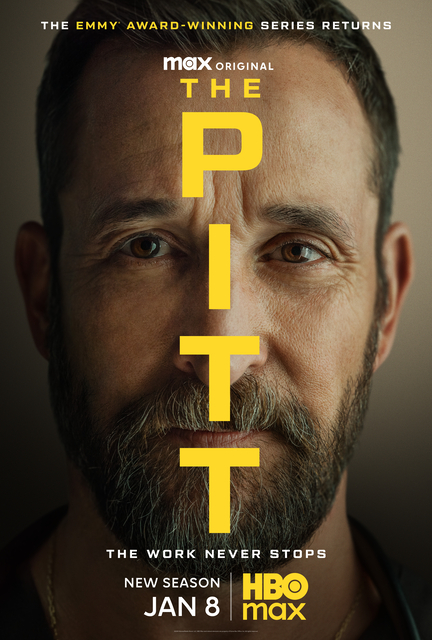
THE PITT Season 2 key art | ©2026 HBO Max
Created by R. Scott Gemmill, with Gemmill, director John Wells and star Noah Wyle among its executive producers, THE PITT is a drama following the moment-to-moment activities in an underfunded Pittsburgh emergency room. Events unfold in real time over a fifteen-hour shift.
The trio worked together on NBC’s long-running ER, where Wyle was one of the stars (as Dr. John Carter) for the series’ fifteen-season run, Wells was the showrunner and a writer/director, and Gemmill was on the writing staff.
THE PITT’s first season premiered on HBO Max in 2025 to instant acclaim and proceeded to win five Emmys: Outstanding Drama Series, Outstanding Lead Actor in a Drama Series (Wyle as the ER’s supervising doctor, Michael “Robby” Robinavitch), Outstanding Supporting Actress in a Drama Series (Katherine LaNasa as ER head nurse Dana Evans), Outstanding Guest Actor in a Drama Series (Shawn Hatosy as Dr. Jack Abbot), and Outstanding Casting for a Drama Series (Cathy Sandrich Gelfond and Erica Berger).
Gemmill and Wells also received Emmy nominations, for writing and directing, respectively, and THE PITT has received an impressive amount of other awards, including the American Film Institute’s TV Program of the Year.
THE PITT returns for its second fifteen-episode season on HBO Max beginning Thursday, January 8. It follows the Season 1 format of having each hour cover an hour of the day’s shift, beginning at 7 AM, and picks up ten months after the first season ended.
HBO MAX has a press event for THE PITT with three separate panels at West Hollywood’s London Hotel. The first panel has Gemmill, Wells, and Wyle grouped together, as they are all executive producers. Additionally, Gemmill is the showrunner and a writer in the series, Wells directs, and Wyle writes and directs (and is at the top of the call sheet).
For starters, with such a phenomenally beloved first season, what kind of pressure is the trio feeling about Season 2?
After all three of them joke about being wholly relaxed, Wyle gets serious. “Of course we felt it. The proverbial sophomore slump is real. And when you have something that’s as impactful and as successful as our first season was, it’s inevitable that you’re going to be combatting expectations. I will say that John alleviated a lot of that pressure for us early on by saying, ‘You don’t have to do it bigger, better, faster, stronger, you just have to do it again and remember what you did the first time and stay true to the characters and be honest and go from there.’”
Wells says they try to avoid being influenced by online fan reaction. “You want to be careful. We really appreciate the most vocal and engaged. At the same time, they’re not necessarily representing every viewer.”
Wyle relates that he gets sent a lot of fan-made artwork, particularly of him and young Dr. Dennis Whitaker, played by Gerran Howell. “Sometimes we’re cowboys and sometimes we’re in a hammock and sometimes we’re having a nap or taking a sandwich.” While it might be nice for any of the characters to catch a quick nap during their exhausting shifts, Wyle says, “It doesn’t make us want to write a lot more scenes for Gerran and me.”
Nevertheless, Wells adds that he’s happy THE PITT is inspiring some fan creativity. “There’s a wonderful thing that happens with fan fiction now, which is that people are basically writing their own show, which is fantastic, and I’m glad they’re doing that, but that’s not how we approach writing the show.”
The reactions the show does pay careful attention to come from real-world medical practitioners and researchers, Wells continues. “We [do] extensive research with medical professionals, and that’s really where their stories live.”
Gemmill elaborates, “One of the things we do at the beginning of the season is, we will sit down, multiple times a day, and talk to healthcare experts in various fields, whether it’s anesthesiology or cardiologists or mental health therapy, and ask them, ‘What’s going on in your world? What stories aren’t being told? What stories do you think should be told?’ And that’s how we get the nuggets of some of the medical stories that we do. Ultimately, the stories are told through our characters and what’s going on with them, but we’re trying to keep our fingers on the pulse of what’s going on in medicine, be as up to date as we can be.”
Sometimes they get additional unsolicited advice. Wyle recalls, “Back in the ER days, I used to joke that at 11:01 [right after the episode aired], my phone would ring. My mother, who was a nurse, would call me and say, ‘You never touch your face with bloody gloves and you never do this and I have to go to work tomorrow and I’m going to have to answer that, and dah, dah, dah.’ Now, thanks to the Internet, I’ve got eight million mothers to call me and tell me, ‘I think your stethoscope was backwards, jackass.’”
Does THE PITT help to demystify the American medical system for the viewers, who use that system in real life?
Wells says, “It’s important not to follow the headlines, which is kind of top-down, but to actually hear what the concerns are of the people who [are in the medical field]. Now, the people who do it also read those headlines and sometimes those are also their concerns.
“To talk about American healthcare, it’s in a crisis that is not getting better by pushing eight to ten million people off the insurance rolls, which means that they’re not going to be getting the primary care, which keeps them from showing up in the emergency room with far more significant problem. So, sadly, there are a lot of stories to tell.”
Wyle observes, “One of the things that I think we were all really gratified about back in the ER days was that if we said it on television, you could believe that it was true, that if we said this was a medical fact, you could take that to your doctor and have that verified.”
Unfortunately, Wyle continues, “Medical shows have played fast and loose with that over the years, and the culture has changed a lot. That relationship between patient and doctor t hat used to be pretty sacred now has a lot in between it, misinformation and cynicism and distrust and all sorts of things that make it difficult to have that engaged conversation with your practitioner.
“Again, we try to be so faithful to the medicine and the accuracy that you could take this back to your physical and open up that dialogue again and have it be a way of triangulating your own health journey through something you saw or heard on the show. Additionally, the messaging about, don’t take drugs that aren’t prescribed to you, letting everybody know what’s happening with fentanyl out there – those are all things that you shouldn’t have to remind people about, but that is important.”
“And it comes from the bottom up,” Wells points out. “That’s what the physicians and the nurses that we talk to all the time tell us. We say, ‘What is the problem? What are the things that you’re most concerned about?’ And they said, ‘This is what’s happening,’ and so it allows us to talk about it, because that’s actually something that a physician would say to a patient, and it’s very realistic to how they actually communicate.”
THE PITT company also did research by spending time in real emergency rooms. Wyle explains, “We have a lot of tremendous relationships with people that practice medicine in this city [Los Angeles], down at County [Hospital], which treats a population that’s pretty similar to the one that we depict on the show. The charge nurse down there, Cathy Griffin, was really generous in letting the writers come in and spend time and the actors come in and observe, just to get a sense of what it’s like to be there on a night shift.”
Also, Wyle continues, “The performers all went through various exercises. At boot camp, we all tried to stay on our feet for fifteen hours and just note where we were holding tension, note which got tired first, when did you feel hungry, when did you feel like you had to go to the bathroom. Write those things in your scripts and, as those hours in the shift come up, you’ll have your appropriate body language. So, it was a good exercise to let everybody know that this wears itself on your physically as well as emotionally.”
What does the team think the biggest differences are in medical drama storytelling since the days of ER?
Wyle tackles the question first. “One of the first things we did [on THE PITT] was, we had a huge dry-erase board. We just wrote all of the things that we never did on ER that could be talked about today. And we were amazed at how fast we filled up that board, whether it was talking about fentanyl or talking about trans rights or talking about gun violence or nursing shortages or boarding crises. It went on and on and on, and we thought, ‘Oh, my goodness, there’s a lot here that we could get into that feels extremely relevant.’”
Gemmill notes, “I think COVID obviously was a huge impact on healthcare, so we wanted to address that. It had and has long-term repercussions to healthcare professionals, as well as the general public. Also, I think the amount of disinformation that’s out there was something we never had to deal with before and that’s something that we’ve tried to address as well.”
While THE PITT is shot almost entirely on the Burbank, California Warner Brothers studio lot, there is a little location shooting actually done in Pittsburgh.
Wyle reveals they actually spent less time in Pennsylvania for Season 2 than for Season 1. “What we use Pittsburgh for is very focused, because we don’t go outside very often. This is intentionally a claustrophobic, immersive experience that keeps you in the emergency department as much as we can. Occasionally, we go up to the helicopter pad when a patient arrives [or] follow Robby into work and follow him home, but that’s pretty specific.”
What the location shoots do for THE PITT, Wyle continues, is “It gives us an opportunity to break the monotony of production in Los Angeles to take a field trip. To have everybody get to go away and really bond on location is significant just energetically.”
Additionally, “It’s great ambassadorship to the city of Pittsburgh, which has opened its arms to us, and Allegheny General Hospital, to allow us to shoot there, so we try to be really good and responsible stewards of that. Aside from that, we tend to want to get back to the soundstage, where we control as many variables as possible.”
Wells observes that location shooting, or indeed any outdoor shooting, for THE PITT has to be careful that the weather and time of day match, because no matter how long it takes to shoot, the sequence has to appear to be occurring within a limited period inside the relevant episode’s hour. “So, it’s very specific things that we can and can’t do in Pittsburgh.”
What did the executive producers learn making Season 1 of THE PITT that was helpful for Season 2?
Gemmill jokes, “We didn’t learn anything.” Then he goes on, more seriously, “We learned how to use our set.”
It should be noted that this is no ordinary set. THE PITT’s emergency department takes up a whole soundstage on the Warner Brothers studio lot in Burbank, with extra pieces on a second nearby stage. There are no flyaway walls or removable ceilings for crane shots. Everything is designed to be practical, with views through windows into hallways.
Indeed, set designer Nina Ruscio was hired to create and build the environment before the writing staff began their work on Season 1, so that they would be able to see where the action would take place. Because the sight lines are so wide, each member of the crew was issued five sets of their own scrubs, which they wear on set every day. Should a crew member or visiting series writer appear in the background of a shot, they look like just one more doctor or nurse.
Wyle contributes, “Yes, just the physical production, once we realized that certain things were working, and that was validated by the viewers, it gave us a little confidence to come back and put a little bit more emphasis on certain things and less on others.”
Wyle then considers what he’s said and decides, “That’s a vague way of answering the question.” He gets more specific. “We learned that it’s a really delicate balance between the [medical] cases and the characters. A lot of people respond to the medicine, for sure, but a lot of people respond more to the internal journey of our characters. So, coming back, it was less about coming up with sexy cases and more about being faithful to the interior architecture of the characters, and where they were, and how these cases that they are working on reflects on them to an even greater degree.”
Wells states, “The main thing we learned was that it worked, to be honest. When it went on the air, we were almost done [making Season 1]. We were shooting just the last few days, so the whole premise and this way of narrative storytelling [that] is very different, because it’s in a single day, and we had no idea whether that actually works, so the confidence from seeing that the premise worked was, I think, very helpful in the second year in the writers’ room.”
Gemmill recalls, “That first day with all the background [extras] and trying to organize was pretty chaotic. But now we’ve got it down to a real science and it’s really cool.”
Wyle counters, “We’re almost too smooth. In fact, that was John’s big note to us – ‘Things are starting to look too polished, too choreographed, you guys look too efficient, and the composition is too perfect. Don’t be so good at your jobs.’”
Wells explains this possibly odd criticism. “It’s because our actors literally physically didn’t know what they were doing at the beginning. Then, doing it for seven months, you get better at it, but the character is one or two hours farther along in their training, not seven months farther along. And so, continuing to keep the discipline of what do you actually know in the amount of time that you’ve spent as a physician in this setting.
“There’s nothing easy about what Noah does, but his character had been there for a long time and knew. Others started to get too good. And our camera crew started to get too good. Part of the rawness is bumping into things and not knowing exactly where you are and trying to keep up, because we’re really trying with the camera to say, ‘You are someone who’s trailing behind these physicians, and so you’re going to be in the way and it’s not going to be a perfect view and you’re not going to see everything all the time.’ And so, we had to remind ourselves not to get too good at it.”
How long did it take THE PITT team to realize that the show was a hit?
At first, Wyle says, “It felt slow. It felt like the medical community embraced it first and embraced it loudly. And since that was the audience we were really aiming at and hoping to get the stamp of approval from, that was extremely gratifying. And I feel like their stamp of approval gave other people the confidence to watch it and feel like this wasn’t going to be a waste of their time. And then word began to spread from there.”
Follow us on Twitter at ASSIGNMENT X
Like us on Facebook at ASSIGNMENT X
Article Source: Assignment X
Article: Interview: Executive producers R. Scott Gemmill, John Wells and Noah Wyle on Season 2 of the acclaimed medical drama THE PITT
Related Posts:
 Loading ...