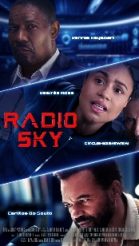



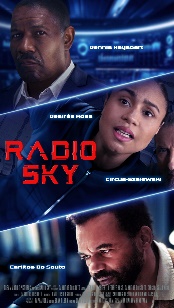
RADIO SKY movie poster | ©2026 Dream Artist Pictures
Independent filmmaker Carlitos Do Souto (pronounced Car-lee-TOUSH Doo SO-Too) has made his feature debut as the writer, producer, director and star of RADIO SKY, which premieres at the Pan-African Film Festival at the Culver Theatres in Culver City, California, on February 17.
RADIO SKY is about what happens when white-hat computer hacker Mac Randolph (Do Souto), unjustly confined to house arrest, finds himself in the position of being the only person able to communicate with astronaut Rose Finley (Desiree Ross) after she and her spacecraft have been hijacked. There are global and possibly universal implications in the incident. Dennis Haysbert costars as Rose’s father, NASA official Joseph Finley, who is willing to do anything to rescue his daughter.
Speaking by Zoom, Do Souto explains that, although he has already made a number of short films, “RADIO SKY is a brand-new concept, brand-new story. I’ve written several features and, because of budget, was not able to make them. So, I decided to write something that’s intriguing, something that’s unique, character-driven, that takes place in [a few] contained locations around L.A., Simi Valley, Sun Valley, Burbank, where it could be executable at a decent budget.”
How does Do Souto describe RADIO SKY? “I would say it’s a contained thriller, where you find an ordinary individual, Mac Randolph, who was framed by the government. So, he lives with distrust, the same distrust that our society is living at the moment. He’s in isolation. You have ICE making certain people go into isolation at the moment.
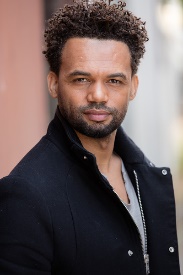
RADIO_SKY_©_2026_DreamArtistPictures
“You have a guy who, regardless of his struggle, he’s trying to use his ability to change someone’s life. And we have, in this country, people losing their lives to save other people. So, I think it’s a story about connection. It’s a story where you find an ordinary person being challenged with extraordinary challenges just to survive and help somebody else survive.”
In terms of the film’s science-fiction elements and production strictures, “I’ve always had a strong passion for learning about life outside our planet and writing stories that are very contained.”
Do Souto cites as inspiration “12 ANGRY MEN, ROPE by Hitchcock, PHONE BOOTH. That’s my go-to whenever I try to develop a concept. And for this film, as a debut, I wanted something that could be shot low-budget, but also that could be high-concept and make a good debut.”
Mac wasn’t originally written as a role for Do Souto. “I don’t start writing stories for myself.” Furthermore, “Mac is nothing like me. But as I was getting ready to cast this film, I was thinking about the struggle that I’ve been through in this town, the struggle that most of my other friends have been through.”
Having worked in multiple aspects of filmmaking, Do Souto said he decided, “‘Don’t depend on anyone else to help you see it through.’ Because the fact that I wrote it, directed it and funded it, it felt to me that I wanted to be on my own, because waiting on people to execute things for me has not gone well, such as act in the lead or directing. So, I said, ‘Make this your freedom project. Go through it. Once you get through it, maybe from this point on, you don’t have to wait on people.’”
When it came to creating characters, Do Souto knew that he wanted a relatively small cast. “I could not have many astronauts in space, due mainly to budget reasons. So, once I created the story, it was easier to fill in the gaps of who should be there and who should not be there.”
Haysbert became involved through the usual route of having the film’s casting director, Dean E. Fronk, reach out to his representatives. “As soon as he read the script,” Do Souto recalls, “he said he loved the script, and we were locked in.”
Haysbert even agreed to become one of RADIO SKY’s executive producers. This provided “a grounding name behind the project as well.”
Some of RADIO SKY takes place in and around Mac’s Southern California home, which was shot at a house in Simi Valley. Other scenes involve the inside of a space capsule and areas within NASA headquarters.
“When we shot NASA and the space environment, they were soundstages. I had a production designer, Arlan Jay Vetter, who was very experienced, who created the I.S.S. [International Space Station] from the ground up. [For] the Soyuz capsule, we rented a mock capsule that looked like the Soyuz, which is a Russian lifeboat in space.”
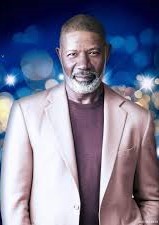
RADIO_SKY_©_2026_DreamArtistPictures
Mac’s faithful sounding board throughout his desperate quest is a betta, or Siamese fighting fish, called Dave. “The fish is actually my fish,” Do Souto reveals with a laugh. “He was very quiet, he was very joyful and friendly to everyone.”
Unlike some fish in movies, Dave was also kept safe at all times. “The fact that he was my fish, I was not going to let anyone harm him, so he wouldn’t be just a prop on set.”
For production, “Principal photography took eighteen days. We had some issues on set when my team lost a day of footage, so we had to reshoot, do another reshoot and some pickups. We used the Alexa 35 for the principal photography, and then pickups, we used the Sony Venice 2.”
RADIO SKY has a surprising amount of visual effects shots – Do Souto estimates about a thousand – for a low-budget film. These include not only what’s on a variety of computer screens, but also shots of planets, the I.S.S. and spacecraft.
“I had hired a guy in pre-production who did some of the hacking monitor screens, but for post-production, I outsourced all of them overseas, so I basically was working with guys in six countries, from India to Ukraine to Pakistan to Hungary, France, et cetera, et cetera. That actually took a long time, given that it’s very expensive to do that here in L.A. with that many shots.”
With so many different languages involved, was translation ever a problem?
“With countries such as India [where English is spoken by many people], I didn’t have that issue. Other countries – those special effects artists did not speak English, but with the technology nowadays, they were able to have some sort of device that translated on the spot, because even though they told me they did not speak English, communication was not much of an issue. Sometimes, we had to go over some things [repeatedly], but most of the time, it worked pretty well.
“A lot of these special effects supervisors and artists are very in tune with the sci-fi space stuff. Usually, the issues that we had challenges with were simple, specific things. We built the I.S.S. on set, so the set we had there, we had just dead monitors, so we had to composite the images [for the monitor screens]. And then the I.S.S. set didn’t have a roof, given that we needed to use that space for camera movements and lighting. So, they had to create a roof and match it with the existing I.S.S. set.”
Sometimes the effects technicians offered helpful suggestions.
“Those guys surprisingly were very knowledgeable about things like [what space exteriors should look like], and often, they actually would challenge me, saying, ‘This is not realistic and we have to have a talk about it.’ Because they care about their work.
I had a guy who said to me, when Mac pointed the camera of the telescope toward the sun, ‘NASA would never do that, because it would damage the telescope, which costs millions of dollars.’ I had to justify it by saying, ‘Well, Mac is a hacker,’” Do Souto laughs. “He wouldn’t know that, and he’s exploring. NASA would not do that, because they built the device, but a hacker would probably not care.”
Do Souto broke things down separately for himself as a director, as an actor, and to communicate with his crew.
“I’m an actor first. I’ve been doing theatre from high school, I graduated from Loyola Marymount University with a theatre degree, I did filmmaking at the New York Film Academy. So, my acting perspective influences my directing. And that is one of the reasons why I decided to direct it, rather than hire a young director, because this was a dialogue-driven film. A person who would direct that would be an experienced director, or a director who understands acting, given that a lot of young filmmakers, not to discredit them – in film school, you don’t learn to deal with dialogue. So, I thought it would be safer for me to do it myself than trust somebody else. So, I was able to communicate with my actors very well.
“From the beginning, I printed out three versions of my script. One was for directing, which I made extensive notes, and then the second one was for acting, made extensive notes, and the third one was for technicalities that I used with my d.p. [director of photography Rapha Bola] and my crew. I rehearsed with my actors and even my d.p. extensively.
“Whenever I was directing, I would operate from my directing script, which had my previous directing notes, and then, whenever I would switch hats to acting, I would pick up my acting script. So, all my directions were very specific at the moment.”
Do Souto considers himself to be a multi-hyphenate. “It began with acting, and then, when I began to learn the hardships, the powerlessness of an actor in this town, I began studying screenwriting.”
At this stage, “I wrote several scripts and could not make them because before you prove yourself in this town, before you do that one thing, it’s very hard for people to trust you, to help you, or get involved with you. So, then I decided, let’s go to film school and direct. So, I would say, ultimately, it began with acting, and then writing, but at the moment, once you catch the fever, it’s all of it. I have scripts ready. I have one script that I’m eager to make. Hopefully, after this film gets some lifeline in festivals and distribution, I can begin to commence on that one as well.”
And what would Do Souto most like people to know about RADIO SKY?
“As an independent filmmaker, if you have a dream, you can do it. Just be smart about it. When you do something of this magnitude, you’re taking a leap, either a leap of faith or a leap out of doubt, out of fear. Just know that lots of people have come to this place where they want to take this leap, but they don’t do it. Sometimes when I was doing this, I had fear, I had doubts, but I knew that I had to go through it and put faith in action. So, anyone that wants to do such a thing, develop a great sense of reference of what quality is, make sure you try to learn quality in every aspect of filmmaking, and then go for it.”
Follow us on Twitter at ASSIGNMENT X
Like us on Facebook at ASSIGNMENT X
Article Source: Assignment X
Article: Exclusive Interview: Filmmaker and star Carlitos Do Souto on new sci-fi thriller RADIO SKY
Related Posts:
 Loading ...