


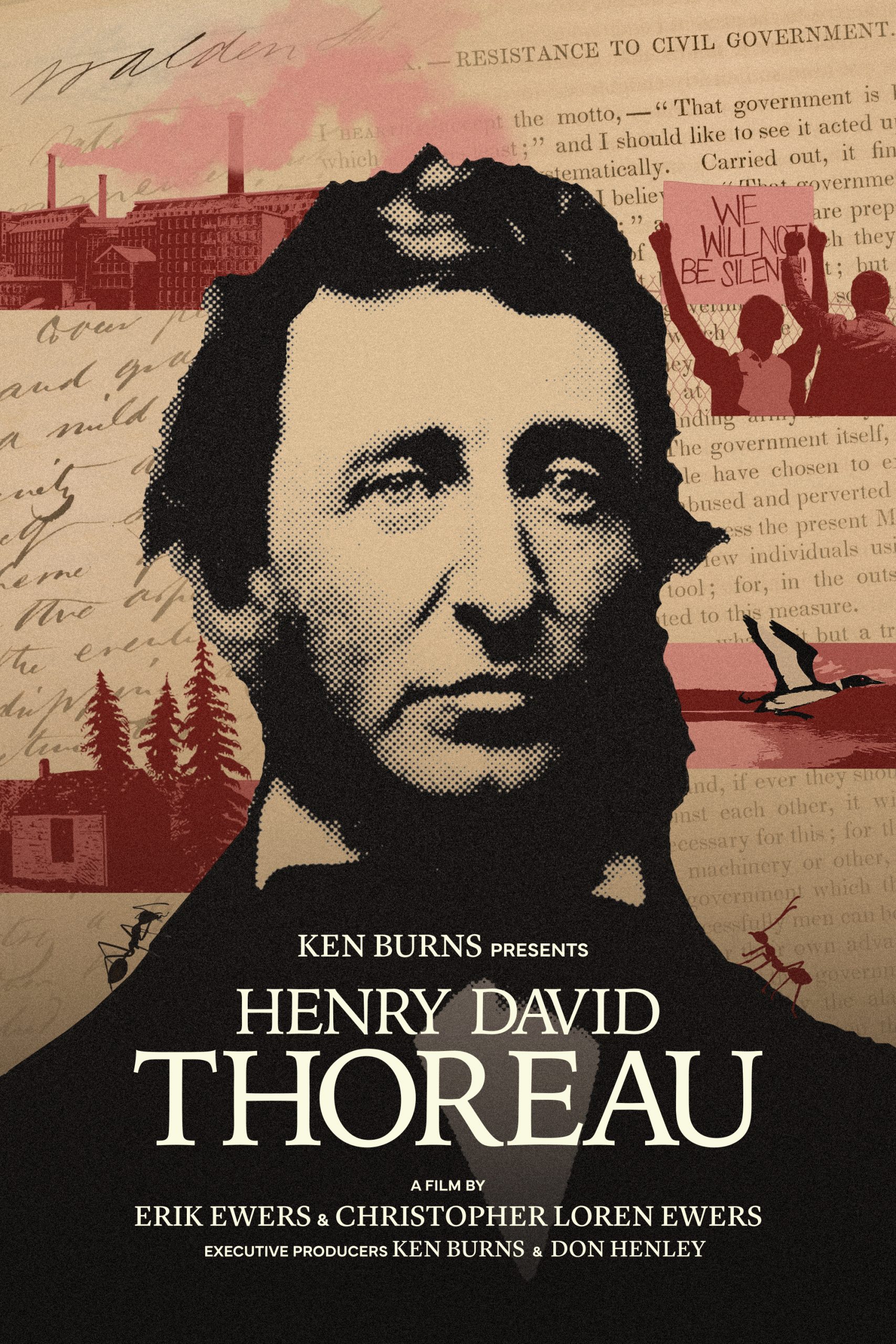
HENRY DAVID THOREAU Key Art | ©2026 PBS
If you don’t know much about Henry David Thoreau as a historical figure, don’t feel bad. Brothers Erik Ewers and Christopher Ewers have made a three-part, two-night documentary about the man, HENRY DAVID THOREAU, which premieres on PBS Monday, March 30 and Tuesday, March 31, and, when they started, they acknowledge they didn’t know much either. (For purposes of clarity, this interview refers to each of the brothers by their first names.)
“We had to renew our knowledge of Thoreau from high school, where we didn’t really appreciate him, let’s say, that much,” Erik says with a laugh. “And now, as adults, trying to figure out what this very dense and eccentric writer was all about.”
Both Erik and Christopher are longtime collaborators with famed documentarian Ken Burns, Christopher as a cinematographer and Erik as an editor. Erik won an Emmy for editing Burns’s 2014 docuseries THE ROOSEVELTS: AN INTIMATE HISTORY.
The brothers teamed up with one another to make their own documentary films, beginning with 2011’s UNSTUCK: THE MUSIC OF DAVID CIERI. They have formed their own production company, Ewers Brothers Productions, and together co-directed, with Burns, the documentary THE MAYO CLINIC: FAITH, HOPE AND SCIENCE and, co-directing with each other, the two-part HIDING IN PLAIN SIGHT: YOUTH MENTAL ILLNESS.
Christopher and Erik both get on a Zoom call from their respective separate residences in Fairfield, Connecticut, and Keene, New Hampshire, to talk about HENRY DAVID THOREAU.
The miniseries, Erik explains, originated with Burns, who is an executive producer on HENRY DAVID THOREAU, as is Don Henley of the Eagles. “I was an editor for Ken for thirty-seven years, always a film that he was making and I was editing. When Chris and I started Ewers Brothers, I was still editing for Ken, but Ken had endorsed Chris and I building our own company, one that would collaborate with him, and one that he would cultivate and help grow.”
HENRY DAVID THOREAU started as a much smaller project, the 2017 short WALDEN, Erik continues. “I got a call one day from Ken. Don Henley had contacted him and was interested in doing a twenty-minute film for the visitors’ center at Walden Pond. Ken asked us if we would be interested in making it, because Ken only does his own inside projects, doesn’t do outside work. And I said, ‘Oh, my God, we’d love to.’
“We finished the short film, and then, quite simply, we suggested to Ken and Don that Chris and I produce a film about Thoreau’s entire life, because there’s so much more to him than just Walden Pond and the quote-‘hermit’ living on the side of a lake in the woods.”
Erik adds that HENRY DAVID THOREAU has taken a good while to complete. “The initial idea for the Walden film, and I include that because we use some of the footage from that film in this one, started around 2015. And I think it took us about a year-and-a-half, two years, to complete. So, there was cinematography and research going on then, and then, while we were making HIDING IN PLAIN SIGHT, we did some peripheral research, continued to read Thoreau and his journal and his essays, and then, as soon as HIDING IN PLAIN SIGHT aired in November of 2022, we dove headfirst into the bigger Thoreau series.”
The voice cast for HENRY DAVID THOREAU includes George Clooney as the narrator and Jeff Goldblum as Thoreau, as well as Meryl Streep, Ted Danson, and Tate Donovan. How did the Ewers brothers attract such high-level actors?
On past projects, Christopher says that most actors came via Burns, since pretty much everyone is eager to work with him. However, “for this project, our other executive producer, Don Henley, was instrumental in making inroads to the incredible voice talent that we have for the film.”
This included as least one first choice, Christopher elaborates. “Erik and I had agreed early on that we thought that Jeff Goldblum would be the perfect voice for Thoreau, and it just so happens that I had worked with him years back on a different project, and through conversations then, I thought that he might be agreeable to it, and so he was the first one that signed on, which was wonderful.
“And from that point, Don worked his magic,” Christopher laughs. “Our narrator is George Clooney, and the first day that we met him, when we were recording his narration, he mentioned that he didn’t know very much about Thoreau, other than what everybody is taught in school. And we asked, sort of knowing the answer, how did he get associated with the project, how did he say or why did he say yes to doing the narration? And he said, ‘Well, when Don Henley calls you, regardless of what he’s asking, you say yes.’ But, as Don knew he would, he turned out to be the perfect voice for our narrator. Everybody involved really helped to elevate the project to where it is.”
When collaborating, Christopher is still the cinematographer and Erik is still the editor, but otherwise, how do they divide up filmmaking responsibilities?
“We do rock-paper-scissors,” Erik jokes, then adds, more seriously, “I think that over the years, we’ve figured out a nice working approach. We co-direct. Erik handles a lot of the script with our writer David Blistein, and it works out. [As cinematographer], I’m always behind the camera during the interviews, and Erik’s the one who asks the questions.”
For HENRY DAVID THOREAU, how did they decide who they wanted to interview?
Erik replies, “It’s a long process of reading, reading, and when we’re done reading, we do some more reading. I think the book that made the biggest difference for us, as far as how we wanted to approach this biographical story, was a book called THOREAU IN AN AGE OF CRISIS [an anthology first published in 2021]. Each chapter was by a different scholar who wrote about Thoreauvian philosophy in light of current events. It was fascinating, because we had already reread WALDEN, or actually probably for the first time,” he laughs, “and definitely a lot of Thoreau’s other works we had not read before.
“As an adult reading him, his words just scream with relevance to today. It’s just uncanny. I remember reading WALDEN and shouting to my wife, ‘I can’t believe it! He has something to say about mortgage versus rental. He has something to say about fashion, about living lives of quiet desperation’ – one of the most amazing phrases I’ve ever heard that is so true. And so, I think organically, we started that path of connecting to different scholars with different areas of expertise in an attempt to try to rassle this huge story about this very influential and eccentric author, to try and capture his entire story. So, it was really a process of discovery.”
Besides the contemporary resonance, what else did the brothers discover? The first episode, for example, discusses the paradox of Thoreau being an active abolitionist and yet socializing with people who enslaved others.
Christopher relates, “There were any number of things that were incredibly eye-opening about Henry. In high school, we were taught he was this prophetic hermit who lived and pondered life in a tiny cabin on a secluded shore somewhere in Massachusetts. He did that for two years, but there is so much more to the man that we didn’t know.
“The entire third act of his life after he left Walden was uncharted territory for us in the beginning, and I think a lot of viewers will have the same realization. He leaves Walden and he takes the experiment that was Walden back into Concord and into his life, and he goes to great lengths in scientific discovery, he lectures, he travels. Of course, he wrote most of his works after Walden. Henry truly is an onion – an individual with multiple layers that we were really only introduced to one of in primary school.”
As for the specific matter of Thoreau’s stance on slavery, Erik points out, “In the film, the scholar Rochelle Johnson, says that, ‘Yes, “contradictory” is probably an accurate description, but I prefer to think of it that Thoreau was always searching for the truth, and I think he was so obsessed with understanding the essential truth of things that he was willing to look at things from a different lens.’ And by looking at things from a different lens, sometimes that looked contradictory, but he was just trying to understand the opposing side.”
Speaking of different lenses, do the Ewers brothers see themselves as filmmakers in the style of Burns, or do they have their own style? If so, how do they define it?
Regarding Burns, Christopher observes, “You couldn’t have asked for a better mentor. We’re talking about a man who essentially reimagined the documentary film genre more than forty years ago. I think that in any creative endeavor, having a good foundation is crucial, and the foundation that we have gleaned from Ken, that he has imparted to us over many decades, is all about story and structure. We are storytellers; we don’t claim to be experts or historians or journalists. We are ultimately telling stories.
“For Erik and I, our approach has evolved. It’s important for us to make concrete connections between the history and our present moment. Serendipitously or by fate, each one of our films has come to be in a time where their message was deeply resonant.
“Our first film was about healthcare and the Mayo Clinic’s approach to it. Our second film, HIDING IN PLAIN SIGHT: YOUTH MENTAL ILLNESS, was about the normalization of the experience of mental health challenges, and each one aired, broadcast, at a time when that connection that we were able to make, using the past as a direct [parallel to] our current moment.”
Erik elaborates that they always seek a contemporary connection. “I think it’s important, especially when you see something resonate as much as Thoreau in his time, versus us in our time. When you see how relevant his words are, I think it’s almost an obligation to help our viewers understand their relevance today, rather than just allude to it.”
Allusion, Erik continues, would be “a perfectly valid way of doing a biographical historical documentary, to just tell the story of his life, but our experience with HIDING IN PLAIN SIGHT, where we saw such a profound impact the film made on viewers because we took all these stories and brought them to the forefront in the wake of a global pandemic. And to hear the feedback, that the film actually saved lives – even Ken was saying that about the film – it put you in a place where you realize that you have an opportunity to use history and to use storytelling to really make a difference.
“I think Thoreau and his environmental philosophies, his social justice philosophies, and his living-well-find-your-true-meaningful-life philosophy, are so needed right now, we felt an obligation to contemporize, if you will, his historical story in certain strategic moments in the film, so that viewers could really be aware and perhaps even think about some of the advice that he was trying to give.”
What is to be learned from Thoreau’s going into isolation and then coming back out of it?
Christopher opines, “Walden can sometimes be confused with a sort of escape fantasy, right? But it was quite the opposite. Walden was an experiment. It was a question. Thoreau is misunderstood as running from society, when in fact he was simply taking a step away from it to gain better perspective on it.
“When he finished his time at Walden – it was only two years of his life – he left and he wrote of his departure that he had many more lives to live, and what he did is exactly that. He took the experience that he had, the insights that he gained from his time at Walden, and brought them back into society. He spent the rest of his life in his family’s pencil factory, as a surveyor, a fruitful member of society. But he always took that experience, that perspective with him back and continued to ask the serious questions about his life, about the situation of slavery, particularly in the Northern states, and the Fugitive Slave Act. He continued to ask himself, ‘How does one live a moral life in an immoral system?’
“This is where civil disobedience sprang up, this is where his work with the Underground Railroad influenced his life heavily. So, I think to dismiss his time at Walden as basically just an escape from society doesn’t do it justice. I think the lessons that we can take from his time and his experiment is that we can do the same. He believed that he could constantly reevaluate his life, make changes, change course when things stopped feeling true for him, and that’s a lesson that we all could use.”
In terms of the making of HENRY DAVID THOREAU, Erik notes that one big challenge was finding appropriate visuals to chronicle a man whose first third of life happened “before the era of photography. As storytellers, we decided, ‘You know what? As long as we’re not getting images from the 1900s or something that is truly anachronistic, as long as we’re seeking to get responsible imagery, if photographs help tell the story, so be it.’
“For his childhood, we found a lot of paintings. Winslow Homer loved to paint children doing things that were not typical of that time period. Kids didn’t play in nature that much back then. Nature was something to be feared, generally speaking, in the early 1800s, and here’s Thoreau and his brother, frolicking in the woods, because his parents encouraged them to appreciate it.
“So, we had to chase down the idea of paintings, we had to chase down ‘what is the best visual archival imagery,’ which remarkably turned out to be those stereo cards that they manufactured in the early days of photography, especially in the 1850s, when photography first came on the scene. And they’re difficult to use, because they’re teeny little images. And then Chris should speak to the cinematography that he did. We wanted to create both historical environments with props and also capture nature the way Thoreau would have seen it.”
Christopher picks up the prompt. “Live cinematography is always a big part of our projects, and Ken’s. As storytellers, we want to create scenes, whether it’s through our interviews or script-writing or narration, whatever it happens to be, that show or tell information.
“So, we went to great lengths, as best we could, to recreate, for instance, Henry’s house. He didn’t call it a cabin. We created historically accurate props. We had a great art department team that helped us do this. The idea was, of course, that we want to invite the viewer into Henry’s world, and a great way to do that, especially in lieu of actual photographic material of these places was to recreate them ourselves.”
“You had to chase down nature,” Erik reminds his brother with a laugh.
“Yeah,” Christopher affirms. “We shot for many years, in all seasons, at all times of day, in all weather, in an effort to try to see Concord, the pond, the woods, through Henry’s eyes. And it was certainly an experiment. It took us some time.
“But I think, much as I’m assuming it did in the same way for Henry, as soon as that clicked, the world opened up. The woods and the pond and the surrounding areas blossomed, and I’m not speaking metaphorically. We were able to see beauty in decaying leaves in fall, and certainly in ice patterns in the winter. We had trained ourselves to see through Henry’s lens, and I hope it shows on screen.”
The Ewers brothers are now working on a series about adult mental illness that is a follow-up to HIDING IN PLAIN SIGHT. Erik says, “We felt that the first HIDING IN PLAIN SIGHT, which dealt with youth, was only half the story. We all worry about our nation’s youth and how they’re bearing the brunt of so many of the societal issues and family issues that they’re experiencing.
“But adults, especially as parents, or even individually, have to carry the weight of finding help, they have to be willing to find help for themselves. They probably have, in today’s day and age, more stigma than young people seem to, and a follow-up film has always been a part of our plan. We’ve already started our research and development phase. We actually finished fourteen interviews, and we’re just waiting for some more funding and we’ll dive into that.”
Was any of the exploration of mental health issues in HIDING IN PLAIN SIGHT useful for HENRY DAVID THOREAU?
Erik believes it was. “It laid the founding ideas for Chris and I as far as how we want to approach Thoreau’s story, given how Thoreau was, for lack of a better word, a quote-‘antidote’-unquote to the misery and the difficult times that we face in society on so many different levels.
“Here is this individual who spent a life in introspection and looked for ways to actually take what he learned and apply it. Isn’t that awfully close to mental health? You need to have a conversation with yourself, you need to find what truly is bothering you inside, what is troubling you, you’ve got to get to the source, and then you need to reach out and look for help.
“I think Thoreau is just an inspirational model on that front, and also, I think HIDING IN PLAIN SIGHT helped Chris and I really develop what kind of approach we want to take, at least to historical documentary filmmaking, and that is crossing that bridge into the present in the film, rather than just sticking to the history. I think there’s a value in that. And like Chris said, it’s something that’s different from Ken. Ken’s style of filmmaking is embedded in ours, but that’s where we found our own voice.”
It turns out that someone at a screening already asked the question of what the Ewers most hope viewers get from HENRY DAVID THOREAU. Erik shares the answer.
“Chris and I both really had to think about it. The one thing about Thoreau that I love the most is that all of his philosophies, all of his thinking, were focused on one essential thing, and that was truth. He was always looking for the essential truth of everything. And that truth was something he had to pursue, he had to actively seek.
“I think in today’s world, where there is so much misinformation and untruth, Thoreau reminds us that it falls on each and every one of us to not be swept up into that gullible nature of accepting what you read, let’s say, on social media, or even in the news, or hearing from your parents, or your friends, in all these different ways you get information. It falls on you to actually explore the truth before you can move forward with any kind of purpose and meaning. I think that is one of the biggest problems we face today, and Thoreau is such a solid reminder of that.”
Related Posts:
 Loading ...