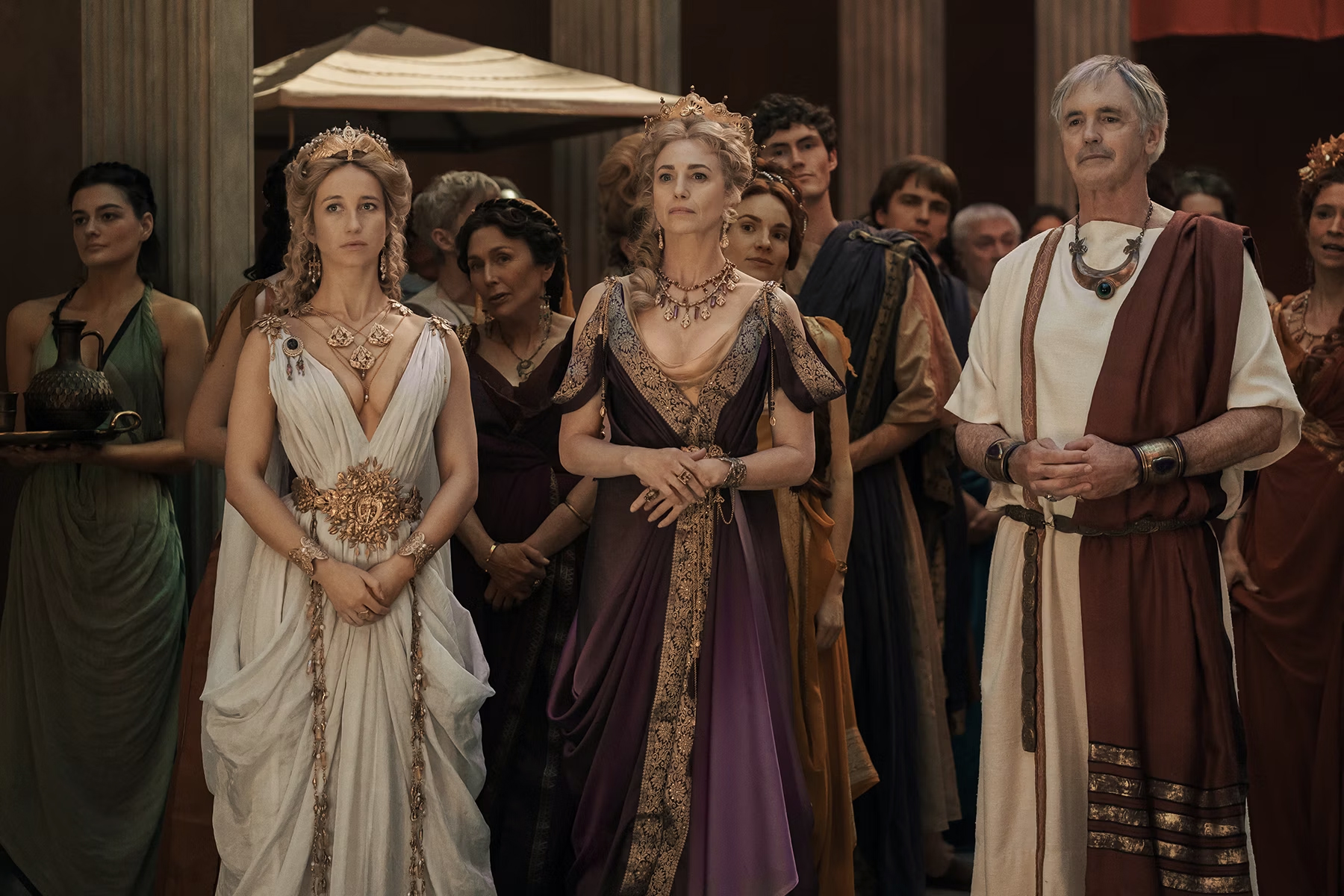
SPARTACUS: HOUSE OF ASHUR – Season 1 | ©2025 Starz
Starz’s new series SPARTACUS: HOUSE OF ASHUR premieres Friday, December 5, with new episodes dropping on both cable and streaming platforms on Fridays thereafter. It is a speculative follow-up to the SPARTACUS trilogy of series that ran on the premium network 2010-2013. All are created by Steven S. DeKnight.
SPARTACUS told the story of the rebel slave leader in ancient Rome. One of his opponents was the former Syrian gladiator Ashur, played by Nick E. Tarabay.
SPARTACUS: HOUSE OF ASHUR imagines a world where Ashur, still portrayed by Tarabay, survives the events of SPARTACUS and founds his own gladiator school, or ludus, using it to create a new kind of combat spectacle.
Claudia Black plays noblewoman Cossutia. Black is an Australian actor who has worked in her native land, New Zealand, where SPARTACUS is shot, Canada, and in her adopted homeland of the United States.
While Black has performed in many genres, she is probably best known internationally for her starring roles in the science-fiction series FARSCAPE and the latter seasons and telefilms of STARGATE SG-1. Black’s other credits include THE NEVERS, TIME NOW, CONTAINMENT, THE ORIGINALS, 90210, QUEEN OF THE DAMNED, PITCH BLACK, CITY LIFE and A COUNTRY PRACTICE. She also appeared in an episode of XENA: WARRIOR PRINCESS, which had future SPARTACUS lead Lucy Lawless in the title role.
Black gets on a Zoom session to discuss all things SPARTACUS: HOUSE OF ASHUR.
Black remembers becoming acquainted with the SPARTACUS series when it was on originally, although she didn’t have time then to watch much of it.
As the mother of two sons, “I think I was just deep in motherhood and, to be honest, possibly on the brink of a divorce. So, everything for me is sort of punctuated by what I was managing at the time, and I think some of this passed me by, although I remember seeing the aesthetic of it and thinking, ‘Oh, wow, that looks really cool. It’s sort of like 300, so it’s got room to be more bold and interesting and playful.’ That definitely was on my radar.”
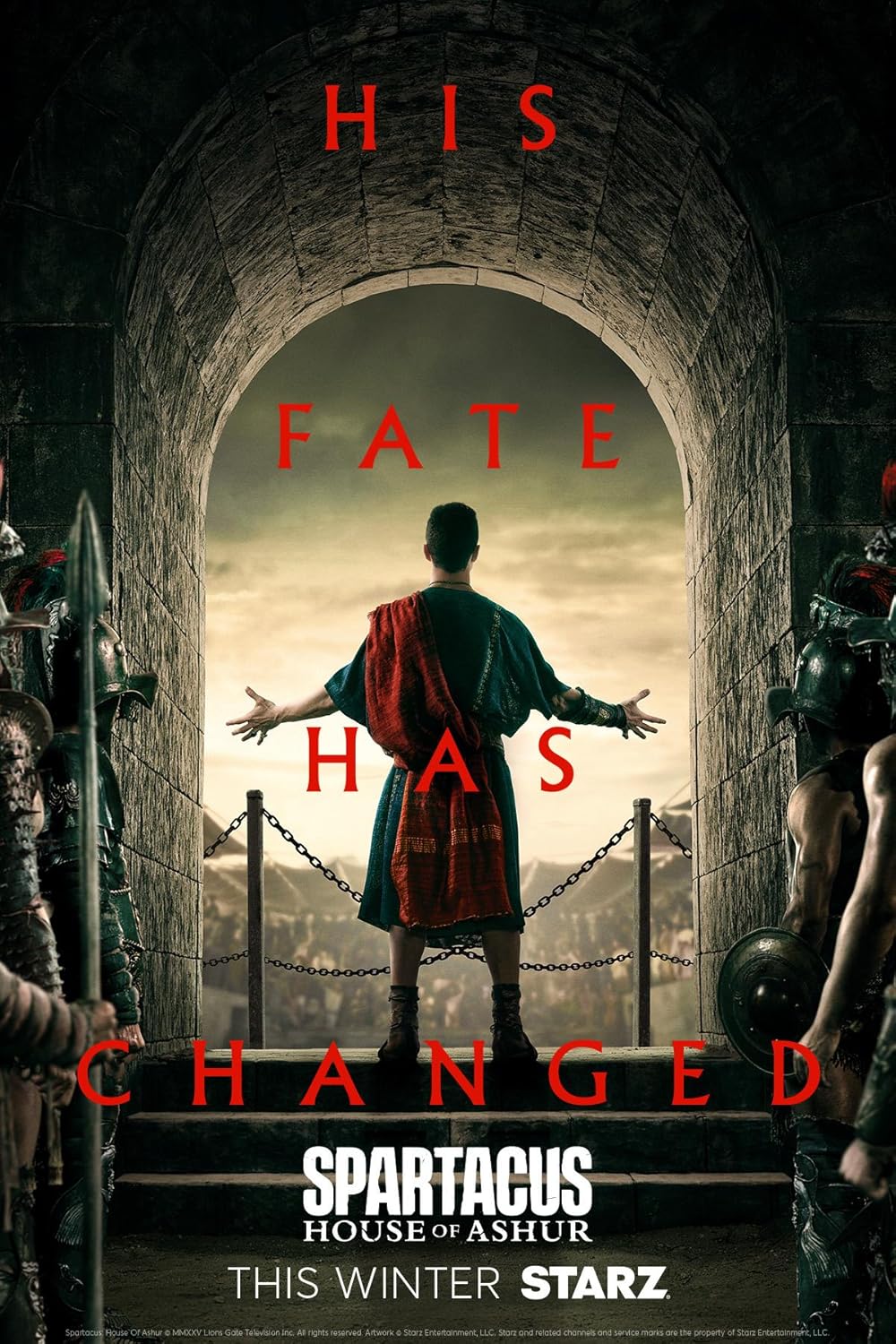
SPARTACUS: HOUSE OF ASHUR Key Art – Season 1 | ©2025 Starz
Another attraction for Black was “Lucy Lawless’s involvement, because I’ve tracked her for a very long time and still say that, had she not paved the way, I don’t know if some of my roles would have existed, because her portrayal of Xena opened up the space for more women to be able to [topline] shows. And I know subsequently, on the heels of her embodying Xena, some really interesting roles came through for me.”
Two of those roles were Aeryn Sun in FARSCAPE and Vala Mal Doran in STARGATE SG-1, which reunited her with fellow FARSCAPE lead Ben Browder. Does Black sees any similarities between Aeryn and Vala?
“They’re both girls who grew up with little to no parenting. I think that’s what makes them similar,” she laughs. “For me, personally as a performer, I don’t like do-overs and I really thought I was going to be done with science fiction for a while. I actually turned the STARGATE gig down at first when they offered it to me, because I thought, ‘I really need to do something different that isn’t so rigorous in terms of hours and just have a little bit of a body break.’ And then someone said, ‘What’s the harm in just going and doing one episode?’ Because that’s all it was originally. And then we ended up having such great working chemistry – Andy Mikita, the director at the time, and me with Michael Shanks [who played Dr. Daniel Jackson] – and they really loved what Michael and I did and they started talking about creating a whole spinoff show for us. I loved working with Michael.” The spinoff materialized in the form of a podcast that ran for three years. So, it was this little unexpected drip feed that grew.”
FARSCAPE and STARGATE SG-1 proved to be tonally dissimilar for Black. “The thing that was a nice antidote for me was that Aeryn had always been a such tragedienne. She carried the wounded heart of the story. Whereas Vala was able to be very much comic relief, because she hadn’t really gone too deep into her psyche and hadn’t really been challenged in the same way that Aeryn had by the presence of John Crichton [Browder’s FARSCAPE character]. Vala stayed very much on the surface until Michael Shanks’s character challenges her to grow up. So, I appreciated just being able to go onto the flip side and carry a lot of the comedy. I always had to feed jokes to Ben, because Aeryn wasn’t allowed to say them. She was the straight man.”
How would Black describe her SPARTACUS: HOUSE OF ASHUR character Cossutia?
“She is a senator’s wife who, similar to many women in history, is the woman behind the man, to an extent. She loves her husband dearly. He’s aging. they spend a lot of time apart because he’s often in Rome and [HOUSE OF ASHUR] is based in Capua, a town outside of Rome, so it’s Rome-adjacent. And that brings with it a lot of the insecurities that people have when they don’t feel like they’re at the real center of where things are happening or, as Hamilton would say, ‘in the room where it happens.’
“So, we see her using what she has to make the best out of a challenging situation. She has a beautiful, brilliant daughter, Viridia, [played by] the glorious India Shaw-Smith, whom Cossutia has raised within an inch of her being to be the best possible match for a nobleman whom she can muster, and that will allow both of them to have a better future. Since she finds herself in one of the original patriarchal structures, she has limited ability to maneuver. And yet, she is willing to do whatever it takes to find and carve out safety and a good match for her daughter.”
Does being the mother of teens in real life give Black any assistance in portraying the parent of an adolescent in the series?
“There are many who say, and I tend to agree, if you really do live as an artist, at the risk of sounding pretentious, there is no seam between the way you live your life and the way you approach your acting. And so, I would say everything I’ve learned is available to the characters if it serves them and their story to be enriched by my own personal details that I will share to give it a place of grounding or embodiment.”
Being a parent also gave Black insights that helped her relate to her castmates, Black adds. “My older son said something quite profound, and I shared it with some of the cast on SPARTACUS. [When] he was off to college for the first time, he said, ‘Until I know who my friends are, I’m not going to be able to concentrate on my studies.’ And when I mentioned this with the group of female cast when we were sitting around, they all audibly moaned in recognition of the profundity of that and how it resonated for them.
“And so, my bonding with India Shaw-Smith probably did more for my character and my approach in some ways, because once we went through the gauntlet of the emotional rigors of what was required of us, the way the schedule was to try to deliver a broad spectrum of really extreme emotions in Episodes 4 and 5 in particular, we r realized that we have a similar release mechanism that, once we’d focused and really tried to deliver something, we would release with humor. Once we realized we had a similar sense of humor as I do with my children, there was this really beautiful, seamless process for us. But I think also there are definitely ways that I perform when I’m playing the role of a parent that have been informed by my almost twenty years of parenting. Holy moly.”
Does Black see SPARTACUS: HOUSE OF ASHUR as broadly part of the same genre as FARSCAPE and STARGATE SG-1, or is it different in terms of subject matter but the same in terms of workload?
Black contemplates this momentarily. “I would say, to an extent, it bridges from science fiction, but this is a bit of a fantasy/sci-fi concept, to base HOUSE OF ASHUR on a what-if [as in, what if Ashur had survived and thrived]. But I love that aspect. Anything that’s creative and expansive and open-minded in that way is going to be appealing to me.
“Making it an historical drama, for want of a better term, it bridges slightly away out of genre. Some aspects of it are firmly in genre world, but more in the action space than in sci-fi or fantasy.”
As for the workload, “It’s one of the most ambitious things I’ve ever worked on. I always used to joke, growing up as an Aussie on fast-turnaround sets, ‘We won, right?’ Because it was a race. We were supposed to shoot this quickly, not well. This production is really trying to answer, as did FARSCAPE, the question of, can we do it quickly and can we do it well?
“It’s very rigorous for the actors, whether they’re in the physical gladiatorial world or in the senatorial world or noble world. Ours [the society of nobles] is more cerebrally challenging, and then there’s extreme physical vigor and requirements of the performers in the literal arena. And as I say, repeatedly, the pace of the shooting schedule is the villain, as far as I’m concerned, not any of the characters,” Black laughs. “I don’t shy from a challenge, but it was quite an adjustment, that’s for sure.”
A number of SPARTACUS: HOUSE OF ASHUR personnel, not only creator DeKnight and lead Tarabay, but also others both in front of and behind the camera, had previously been on one or more of the earlier SPARTACUS series. Did Black feel like a newcomer arriving in an already established group?
“Only on the technical side, because [executive producer and episode director] Rick Jacobson had really fought hard – the show is, I think, more expensive to make in New Zealand [where all of the SPARTACUS series, including HOUSE OF ASHUR, have been made] than it is in some of the countries in Europe right now that are offering these massive incentives. Rick was so loyal to the people he’d already created this with. He wanted to work with the same heads of department, because they’re so brilliant. And beautiful people, too. It’s a heady mix of talent and heartfulness, so why wouldn’t you want to work with those people again and be able to count on them?
“So, they were an established unit, and that benefitted us, because of the level of competency in every single department. They already had an established shorthand in terms of shooting and how quickly they could deliver things or create or set up something on a set, and this business lives and dies on shorthand.
“We benefitted from that as actors – I know I did – I shouldn’t speak for others – because we were coming into an environment where people love what they do, knew what they were signing up for, and were still excited to come to work every day, even though they were exhausted.”
Adjusting to doing something so complex at such a fast pace “took me a minute, especially when you’re speaking archaic language, you get one or two takes if you’re lucky. Being able to deliver a performance that I wouldn’t absolutely cringe at – it got to a point where I was just praying I didn’t have too much egg on my face,” Black laughs. “But I never felt that I was totally the left-out kid at a new school. Everyone did everything they could to make sure I felt welcome and heard and seen and it was a very lovely environment.”
Even though HOUSE OF ASHUR returns us to the gladiatorial arena, Black notes that SPARTACUS fans should be prepared for some build-up to the main event. “There’s a whole new world that does need to be set up, because they’re working from a new premise. So, it takes a while for the story to move, because Steven’s having to establish the upstairs, the new downstairs, and then how these worlds start to interact with one another. It gets very exciting. I remember reading the scripts as they progressed and going, ‘Oh, wow, now I see how all of this pays off.’”
Pre-Christian Rome was already an era and a civilization that intrigued Black. “I studied ancient history at school, so we covered, from our perspective in Australia and whatever was on the syllabus there, ancient Greece, ancient Rome. I’m still interested in it, I recently listened to an Audible about medicines in the ancient world from an academic standpoint. It was very detailed, about a woman’s role originally with regard to healing and medicine.
“Also, most importantly for me, being Australian-born, but a U.S. citizen and therefore considered an American now, what’s happening here [in the U.S.] politically, with Roe being overturned and everything that has ensued, history is repeating itself, and there is enormous relevancy for me now, being here and watching our rights as women erode, and other minority groups’ rights eroding. I think, as much as this show is a very bold and bawdy romp, it also has some important messaging.”
And what does Black most want people to know about SPARTACUS: HOUSE OF ASHUR?
“I understand for the fans who have a beautiful attachment to what was [in the previous SPARTACUS series] not to expect them to just sign on blindly. I am the person at the restaurant who orders the same thing every single time, because once you’re onto a good thing, why would you change it?” Black laughs.
“So, I hear them, and I’m hoping that they will come along for the ride and give it a go. I would say it to myself, too, when I’m faced with trying something new, to give it a go, because I really think you’re going to be delighted by all the work and heart that was put into this.
“They left no stone unturned. It’s all up there on the screen, it’s a beautiful feast for the eyes, it’s a feast for the senses. It’s a delightful, bold romp. It has so much energy. It takes the audience seriously; it does not take itself too seriously, and I think that’s great entertainment. We’re nervous and excited to see how it’s received, but we’re very proud of what we’ve made.”
Follow us on Twitter at ASSIGNMENT X
Like us on Facebook at ASSIGNMENT X
Article Source: Assignment X
Article: Exclusive Interview: Actress Claudia Black on new spin-off Starz series SPARTACUS: HOUSE OF ASHUR
Related Posts:
 Loading ...