


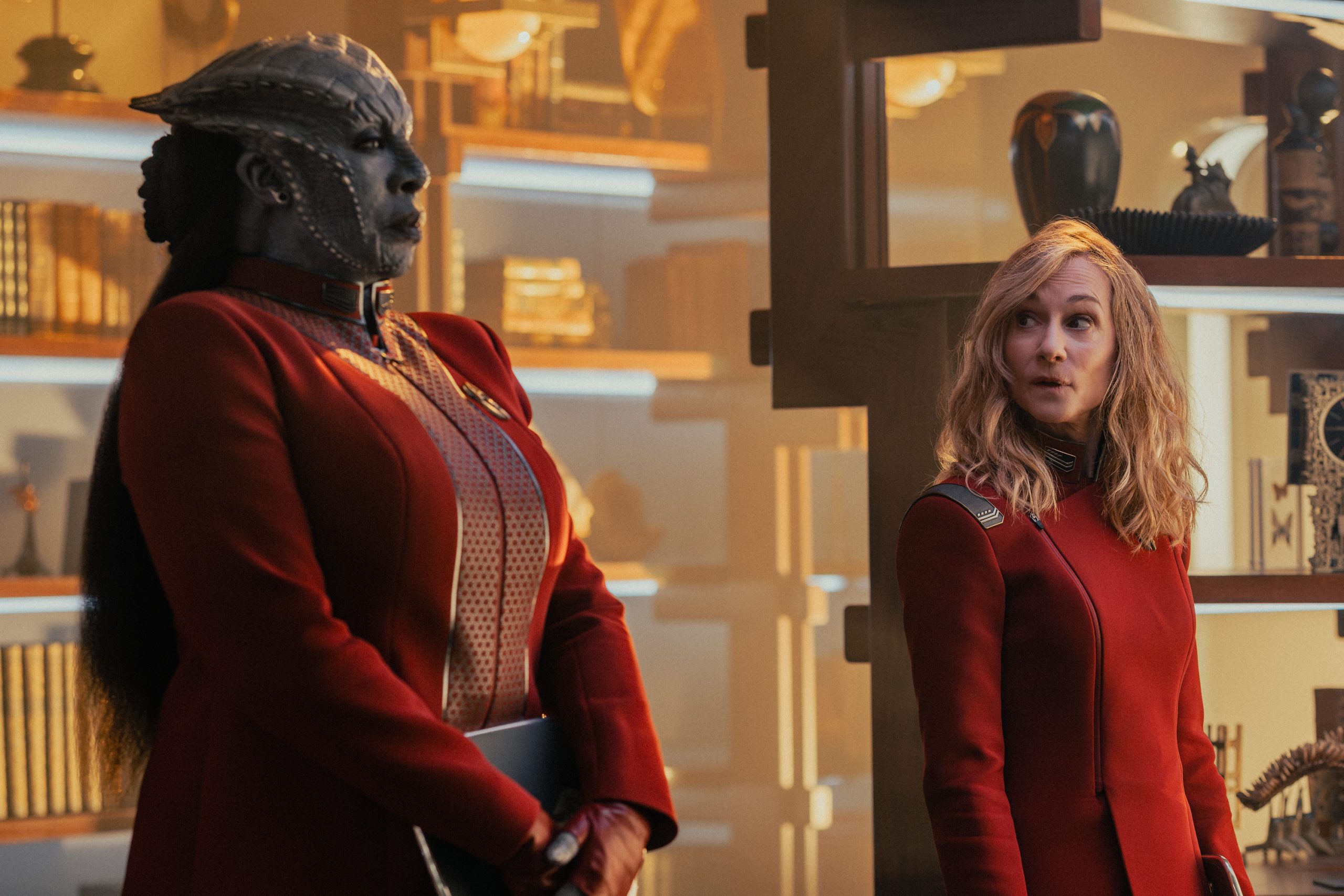
Gina Yashere as Lura and Holly Hunter as Nahla Ake in STAR TREK: STARFLEET ACADEMY – Season 1 – “Beta Test” | ©2026 Paramount+/Brooke Palmer
Starfleet Academy, the training institution for those aspiring to become crew members on Federation starships, has been a part of STAR TREK lore since STAR TREK: THE ORIGINAL SERIES, which debuted in 1966.
Now, sixty years later, that legendary center of learning gets its own series with STAR TREK: STARFLEET ACADEMY, now streaming its first season on Paramount+, with new episodes premiering Thursdays.
Based on Gene Roddenberry’s original STAR TREK and created by Gaia Violo, STARFLEET ACADEMY is set approximately a thousand years after the time of Kirk and Spock, and one hundred years after an event known as “the Burn” traumatized and reorganized the galaxy, Starfleet and the Federation of Planets. (For more on the Burn, see the series STAR TREK: DISCOVERY, which depicts the crisis.)
After being closed for a century, Starfleet Academy is reopening in San Francisco. The head chancellor is former Starfleet Captain Nahla Ake, played by Holly Hunter. Ake is a 422-year-old half-human/half-Lanthanite, who is compassionate, serious about her duties but with a mischievous sensibility. The Dean of Students is half-Klingon/half-Jem’Hadar Commander Lura Thok, played by Gina Yeshere. The academy’s chief physician/medical professor is the Doctor, an AI played by Robert Picardo, reprising his character from STAR TREK: VOYAGER.
In STARFLEET ACADEMY’s two-part opener, Captain Ake, while still in command of a starship, has a run-in with Klingon/Tellarite space pirate Nus Braka, played by recurring guest star Paul Giamatti. Fifteen years later, just as the Academy is about to restart, Braka is out for revenge. Ake and her team thwart him, but Braka will likely be back.
Actors Hunter, Yashere, Picardo and Giamatti get together with STARFLEET ACADEMY executive producer/director/co-showrunner (with Noga Landau) Alex Kurtzman in a special Zoom session organized by the Television Critics Association (TCA) to talk about their new series.
Kurtzman by now is a STAR TREK veteran, having served as an executive producer, as well as often creating and/or writing, on 2009’s STAR TREK and 2013’s STAR TREK: INTO DARKNESS feature films, the series STAR TREK: DISCOVERY, STAR TREK: SHORT TREKS, STAR TREK: PICARD, STAR TREK: LOWER DECKS, STAR TREK: PRODIGY and STAR TREK: STRANGE NEW WORLDS, plus the telefilm STAR TREK: SECTION 31.
However, Kurtzman’s resume doesn’t include a lot of high school/college fare. Were there any particular sources he looked to for inspiration for STAR TREK: STARFLEET ACADEMY?
“For me,” Kurtzman responds, “the show that was in many ways an anchor, maybe the best love story I’ve ever seen, certainly in the last decade, is NORMAL PEOPLE. I just thought it was this absolutely gorgeous, very truthful, very honest, and very surprising representation of what it means to be in love and what it means to be in love for the first time and what it means to capture that particular moment in your life where you’re really trying to figure out who you are and where you’re supposed to land. It was so cinematic, but it was so just people in rooms talking. And I loved that so much.”
Kurtzman continues, “There are also shows like FRIDAY NIGHT LIGHTS, where I think if you look at Starfleet Academy versus War College [another Starfleet cadet school housed on the same campus], there’s a lot of that in there, too. But you’re talking about shows that really focus on character, that don’t talk down to the audience and don’t trivialize the things that people are going through at that age.”
The adult characters matter as well, Kurtzman relates. “In many ways, it was just as important for us for the teachers to be as interesting as the students. What I kept saying to the writers’ room is, we cannot make a show where, when the adults show up on screen, the kids [in the audience] want to fast-forward. They have to be just as interested in the adults. And so far, I think it’s really worked. I think it’s because they’re learning from each other – the kids are learning from the adults and the adults are learning from the kids. And that’s how school should be.”
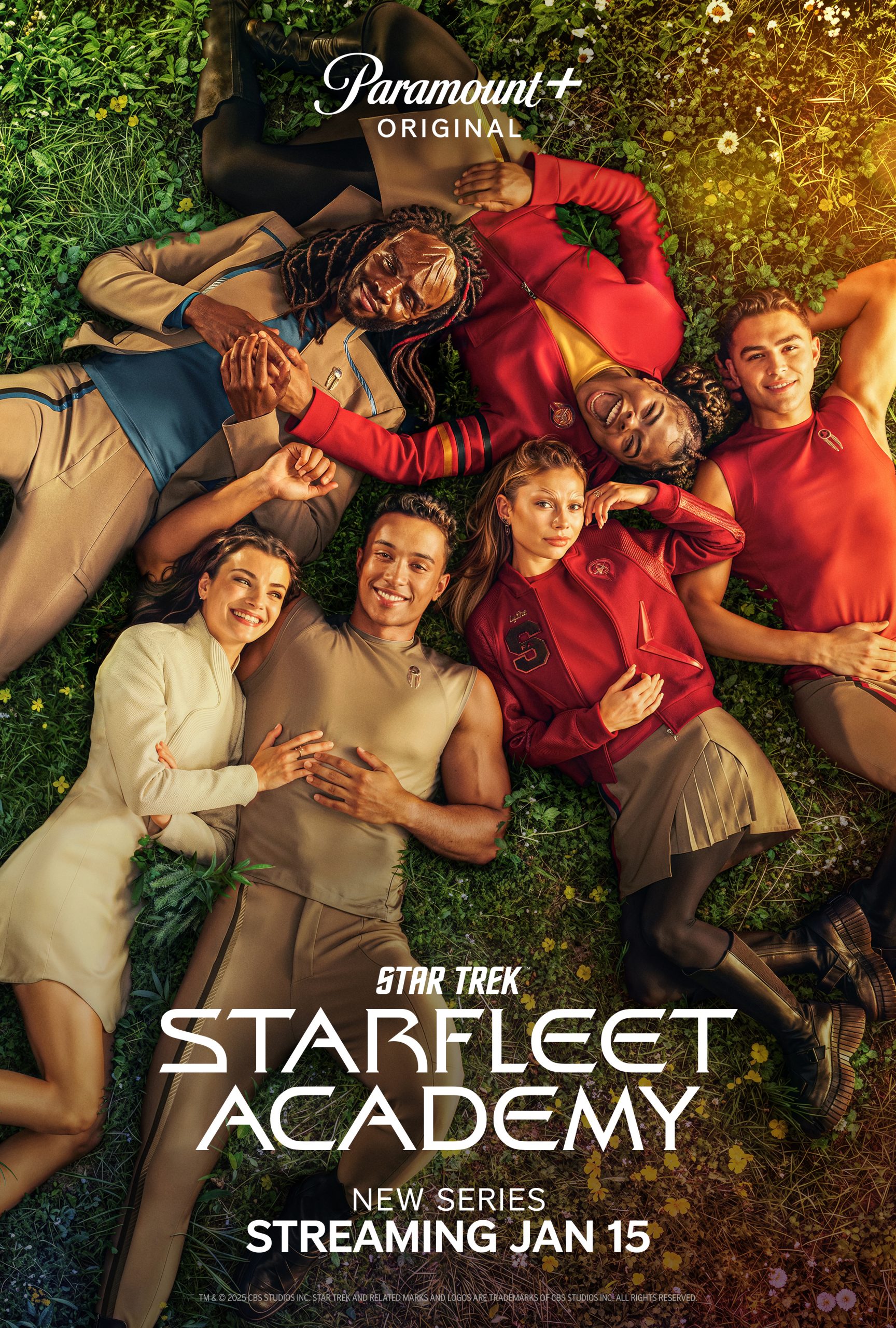
Zoe Steiner as Tarima, Sandro Rosta as Caleb, Bella Shepard as Genesis, George Hawkins as Daren, Kerrice Brooks as Sam and Karim Diane as Jay-Den in STAR TREK: STARFLEET ACADEMY – Season 1 Key Art | ©2026 Paramount+
Hunter and Giamatti are newcomers to performing in STAR TREK, but it’s hard to exist in Western culture without some familiarity with the franchise.
“I started watching it when I was a little kid,” Giamatti says. “My dad had watched it when it was originally on in the Sixties. And then when it was syndicated, he thought, ‘You’re a weird child, you might like this.’ So, he started putting me in front of it. And I loved it. I fell in love with the character of Spock. I don’t know why I found Spock so fascinating, but I loved it.
“And yes, I’m a lifelong fan. I’m a big DEEP SPACE NINE fan. I love VOYAGER. I was so excited to meet Robert Picardo, I was embarrassed with how excited I was. I was in drama school when DEEP SPACE NINE was on, and boy, [getting to audition] would have been terrific. So, it was a fantasy for me to be on this.”
Giamatti has drawn a conclusion from this fantasy fulfillment. “I’m just going to say this, because it’s, ‘It’d be great,’ and then it happened. So, dreams come true. You can manifest your dreams, kids. It’s the message here.”
For Hunter, “Like so many American families, when STAR TREK came out in the Sixties, my dad and I and my two brothers sat and watched STAR TREK. I had a glass of Welch’s grape juice with crushed ice that I once spilled on my mother’s white curtains. That wasn’t great, but it was probably during STAR TREK that happened.”
The early allure of the original STAR TREK for Hunter included “The beautiful mustard color of the suits that they were wearing and just the way they moved. The guys were so like pieces of granite, and they stood and talked, the three of them, just not moving until they moved to the chair. It was just very iconic and very Gary Cooper-ish.”
“It is a little like a Western in space,” Picardo offers.
“Yeah,” Hunter agrees. “It had some of the same feeling that Westerns had for me when I first started watching the show. But in my time of auditioning for stuff, I never auditioned for STAR TREK. And then Alex and Noga presented me with the script and asked me if I wanted to do it. And one of the reasons why I was immediately on alert is because Paul was attached. And,” Hunter jokes, “I was like, ‘Wow. This is a red flag. I should avoid this thing at all costs.’”
Hunter returns to a serious answer. “It was a really easy yes. I mean, wow, what an opportunity.”
The actors had to adjust to speaking lines of “technobabble,” where their characters expound on technology invented for the series.
Hunter acknowledges, “The vocabulary in the bridge was something that I had to ask, ‘What does that mean? How do I pronounce that?’ Wow. I got somebody to help me memorize the lines and I just drilled them in my head repeatedly. Sometimes I would even write them on the ceiling of my bedroom, so that I would see the writing on the wall when it’s time to have breakfast. One line was crazy, and I just drilled it until it was as comfortable as it could be. But the repeated scenes back on the bridge get more and more comfortable.”
Hunter is also very comfortable with how her character moves through the scenes, swiveling in her office chair, picking up objects and walking around barefoot.
“Alex and I talked a lot about the physicality of the character before we ever started shooting,” Hunter explains, “because Alex had written that my character was barefoot, and I loved that. And so, that opened up this whole idea for me of what she might be like physically.”
Furthermore, “The name of my character is Nahla, which means, ‘Water in the desert.’ And I thought, ‘Oh that would be really cool if I could bring kind of a fluidity to the character.’ And that just translated into a different way of moving that we didn’t talk about, because Alex and I rehearsed a lot together on the bridge. We went over scenes on the set, just him and me, talking about blocking ideas.”
Before she was a comedian an television professional, Yashere reveals, “I’m from an engineering background, and I used to build elevators for a living. And so I’m used to electronic [verbiage]. But STAR TREK is on another level. I had to learn some of this stuff phonetically and just memorize it that way. I was relishing the day I got to say stuff that I didn’t even understand. Because that’s the best part of STAR TREK, technobabble. That and the ship being attacked.”
Yashere co-created as well as costarred in the long-running CBS comedy BOB HEARTS ABISHOLA, but is happy to leave the writing on STAR TREK: STARFLEET ACADEMY to others. “I have no interest in poking my head into the writers’ room. The writers are doing a fantastic job writing for my character.
“For me, the joy of this show is, I get to just turn up and play, to come and just be the character. I don’t have to think of story arcs. I don’t have to think of budgets. Sometimes, on my last show, I’d be acting in a scene, and I’m looking at my costar in the scene and thinking, ‘Oh, I should write that line a bit differently.’ I don’t have to think about that.”
Then again, “The joy of doing this show is that Alex is open to ad-libs. So, we’ll do a scene a couple of times and then we’ll go, ‘All right, ad-lib, just add whatever you feel like. And so, a couple of those ad-libs actually turned up in the episode. So that’s the fun part for me as a comedian, I get to ad-lib a little bit. But the writing is so good, I don’t actually have to work that hard.”
Picardo has plenty of experience with STAR TREK dialogue and, moreover, says he hasn’t had “a huge amount of technobabble so far.”
However, Picardo continues, “What feels different is that the new STAR TREKs are in contemporary language. In VOYAGER, in my iteration of STAR TREK, we spoke in mid-galactic speech, it was nowhere in time. And now we speak in contemporary speech. It was a shock at first. I mean, they went nuts on the Internet that I said, ‘That would be super-helpful.’ ‘The Doctor would never say super-helpful.’ Well, in eight hundred years, the doctor may have changed a little. Also, he is now teaching cadets, so he has to speak in their language. The adjustment came easily because there’s a reason for it.”
Picardo also points out a wardrobe change. “The other weird thing is that, in VOYAGER, there were no zippers in the twenty-fourth century. Zippers are back. I don’t know why, but they’re back.”
The Doctor performs opera for the cadets, which Picardo reveals is the long-tailed result of crossed-wires communications with the VOYAGER creative team decades back. “I never wanted to sing on the show. The producers of VOYAGER misunderstood my suggestion that [the Doctor] listen to opera in sick bay while he was working, because I thought that it was funny that a character with no emotion would choose incredibly emotional human art to listen to. And then they wrote a show where I’m singing, and I went, ‘No, guys, you misunderstood me.’
“But it was too late, they’d already written it. So, I took a crash course, and Dennis McCarthy, our music guy on VOYAGER, helped me, coached me, and I did okay. So, that became part of that character. The notion that an artificial intelligence has hobbies is idiotic to begin with. The notion that he loves opera is really taking it out there. So, I think it’s always a fun quirk to the character.
“I was shocked and delighted to see that it was in the second episode [of STARFLEET ACADEMY] rather than later down the road, but again, it was fun. And our music director, Jeff Russo, was incredibly patient with me. And we really did it. I’ve heard it and I am delighted with how I sound. And I’m sure that was all Jeff’s work, not me.”
Regarding of the creation of a show with such a deep background that still resonates with novice viewers, Kurtzman says, “It felt like, if we’re going to make a show designed to bring in a new audience of, let’s say, young people who have no experience of STAR TREK, who haven’t watched sixty years of it, and yet also appeal to all the people who love STAR TREK and are steeped in sixty years of it, how do you do that? And how do you speak to that moment?
“What I think it gave us was this idea that you’ve got a generation – I’m speaking as a showrunner and a father – that’s inherited a very divided world. And it’s there job to figure out a way to find that optimism. And I see my son hold both of those things. I see him hold this sense of an uncertain future and also this absolute youthful exuberance that anything is possible. And it’s beautiful.
“I feel like that’s what STAR TREK is really about. And so, the idea that this show now, as all great STAR TREK does, speaks to that moment for that generation, feels perfect. It feels perfectly timed. And when you have actors of the caliber that we have here that are grounding it in legacy but also this incredible emotional reality, you’ve got something really special.”
Follow us on Twitter at ASSIGNMENT X
Like us on Facebook at ASSIGNMENT X
Article Source: Assignment X
Article: Interview with STAR TREK: STARFLEET ACADEMY Executive Producer Alex Kurtzman and stars Holly Hunter, Paul Giamatti, Robert Picardo and Gina Yashere
Related Posts:
 Loading ...