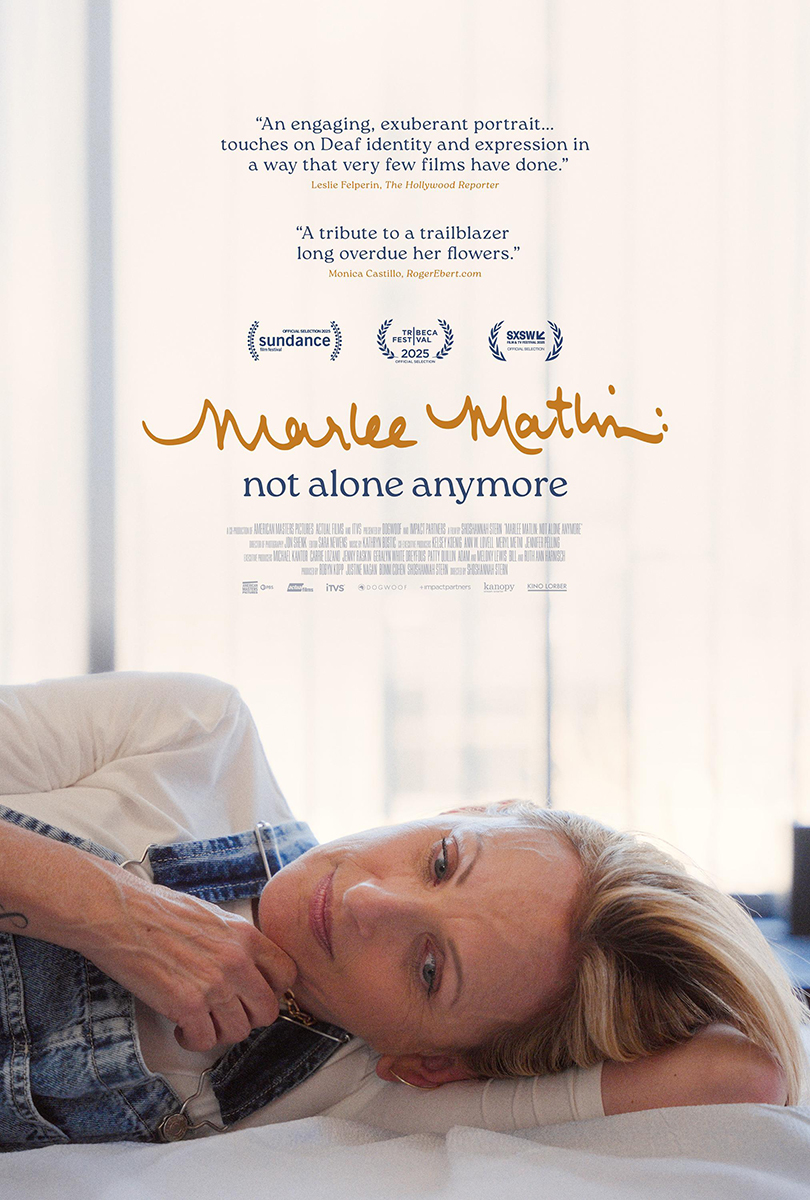
MARLEE MATLIN: NOT ALONE ANYMORE key art | ©2025 PBS
When Marlee Matlin won the Academy Award for Best Actress in a Leading Role for her performance in 1986’s CHILDREN OF A LESSER GOD, she became the first Deaf person to receive an Oscar for acting. Before and since, Matlin has had an extraordinary career as a performer, producer and author.
Now director/producer Shoshannah Stern has made a documentary, MARLEE MATLIN: NOT ALONE ANYMORE, for PBS’s AMERICAN MASTERS. The documentary premiered on October 14 and is now available on all PBS streaming platforms.
Stern is a Deaf actress and series creator. A native Californian, Stern has been in films including THE HAMMER and THE MAGNIFICENT MEYERSONS, was previously a series regular on the post-apocalyptic drama JERICHO and had recurring roles on WEEDS, SUPERNATURAL, and GREY’S ANATOMY. With fellow Deaf actor Josh Feldman, Stern both created and starred in the series THIS CLOSE.
Via email with ASSIGNMENT X, Stern discusses directing MARLEE MATLIN: NOT ALONE ANYMORE.
How did the documentary come about?
“PBS went to Marlee first to see about her interest about doing an episode of their series AMERICAN MASTERS. I wasn’t there, but as Marlee has consistently said, she [told them] she would do it on one condition – that they hire a Deaf female to direct it. They agreed and asked if she had any names in mind, and she gave them my name.
“I didn’t know any of this at all when I got that first meeting with AMERICAN MASTERS, and in all honesty, I had never seriously considered directing. I don’t think you can seriously consider anything if you’ve never seen someone like you do it before.
“The first time I saw a Deaf person direct a studio-backed film or episode of television was actually during my very first shoot for the documentary – when we covered Marlee when she directed her episode of ACCUSED. When she did, she accomplished another first by becoming the first Deaf person to ever direct an episode of network television and enter the DGA [Directors Guild of America]. I think I was number two, so it was crazy that we were both directing for the very first time together at the exact same time. How serendipitous is that?
“Despite all this, what I did know in that meeting was an immediate and very strong sense of her story and how I wanted to go about approaching it – it just felt like something I really wanted to do, even without knowing all that came about beforehand, and would come after. I’m very grateful to Marlee for putting such extraordinary trust in me and in PBS for taking such a ginormous risk on me and saying yes.”
Stern has been aware since childhood of Matlin as an actress and public figure.
“The first time I remember seeing Marlee was when I watched her win her Oscar. I was seven years old – and like many other people in our community, it was the first time I’d ever seen a Deaf person onscreen. It’s a moment I go back to a lot, because it changed my entire perception of myself and my understanding of the world. Maybe that’s why that moment is visited more than once in the film – while it’s such an iconic moment, it’s a layered one, and a lot lies just beyond what you think you’re seeing.”
Stern not only directed MARLEE MATLIN: NOT ALONE ANYMORE, but also is seen as interviewer. Did Stern debate with herself as to whether or not to appear in the film?
“I didn’t necessarily know right away, no. When I got the job, and started doing research by watching documentaries, even though I’d seen some of them before, I realized something I hadn’t prior to getting the gig – that the very form of documentary was rooted in sound. Some of my favorite moments were when the interviewer would catch the subject off-guard by asking them something off-camera.
“When I thought about how that would be executed by someone using sign language, there was nothing that came to mind as a visual reference because it had never been done before. I also knew intuitively that I needed to be the one to interview Marlee, because not only did we share the same experience of moving through the world, we also shared the same language, and I knew that was the leading reason why I was chosen. She’s been interviewed so many times before, and she’s so graceful and wonderful at that, but I felt by choosing me, she wanted something different, and so I wouldn’t be doing her justice if I just did things the way she’d experienced them before.
“But I didn’t have any of those answers yet, so I didn’t know how I would pull that off. I thought I would have more time, but then she landed the ACCUSED gig, so we both had to move quickly since it would be an amazing thing to capture for the film. On my way there, a thought came to me on the plane – ‘The film will show you who she needs to be.’
“That became a mantra of mine throughout that shoot, so when Marlee had that unexpected emotional response to what she was seeing on set, I knew I had to be there for her to support her. I knew I was breaking the fourth wall, but it didn’t matter to me at the time. I knew why she was feeling what she was and she needed to talk to someone who understood that feeling, too, or I would be doing her an injustice on a human level. I remember having a split-second thought before I stepped in to comfort her that, by doing that, I would probably be making that footage useless, but I didn’t care.
“Then when I saw the footage after we came back, I was like, oh wow, that’s the film. There she is. Like she said she would, she had shown herself to me, and it felt like she had found a way to tell me she wanted me to be on camera, so that’s what we did after that.”
Besides Matlin, how did Stern decide who else to interview? Did Matlin make suggestions, or were there specific perspectives Stern wanted?
“Marlee didn’t suggest anyone or anything in the film – which is pretty mind-blowing. I’ve had the good luck of getting to work with her before as a producer. She’s a fantastic producer because she is very hands-on and detailed, and wants to have her hands in everything – because she genuinely wants to know about everything that is happening. Then she has so many ideas and feedback about it all. It’s really a testament to her bravery and again, her trust, that she really just made her life a gift to me and said here, run with it.
“I knew exactly who I wanted to interview relatively early on, and who I felt could speak best to the very different and very specific aspects of her incredibly layered life. There were so many people I could have asked because she’s done so much on so many different fronts, but I felt like I was weaving them all together in a sort of tapestry I was making out of it all. The colors I needed for that felt really clear to me, and I’m very grateful that they all took part in it.”
What surprised Stern most in making MARLEE MATLIN: NOT ALONE ANYMORE?
“While the vision I had was very clear, it was shocking how quickly and easily it all came together, given it had never been done before. It’s really a testament to how game and excited my team was, particularly my editor Sara Newens, who was with me from the very beginning, and my producer Robyn Kopp and my DP [director of photography] Jon Shenk. When I first raised the idea of using split screens rather than cutaways to keep Marlee’s signing in the frame, it wasn’t a debate or even a long conversation at all! It was just like, ‘Oh okay, cool, what will the timing and formatting of it all be?’
“It was the same thing with the set-up of the film, with the four cameras we would need to use, with the sound system and earpieces we were developing to circumvent the traditional reliance on voiceover, even the sound design and soundscape with Bonnie Wild at Skywalker. We immediately moved on to the logistical parts of it, like what frequency we would use to hook up the earpieces and figuring out how many rooms in the spaces we were filming in we would need to make sure the cameras wouldn’t pick up the interpreters.
“I think people expected this process to be more of a fight I fought alone, but it was never that way. It was a full collaboration with my team the entire way and, without speaking for them, I think they were all as excited about working differently as I was. I think in terms of production it was surprising to me that what it takes to be a good leader is to be passionate and clear as possible about your vision when you communicate it, and then let them know you will be welcoming and depending on their help in figuring it all out.”
Were there any topics that Stern had wanted to include that either had to be cut because of time or because they didn’t fit into the film’s overall structure?
“While Marlee has had such an extraordinary life, it was an incredible feat to get it all in the time frame we had, I also feel very lucky that we were able to touch on all the central pillars of what I wanted to include in the film. While there were certainly details or interesting tidbits or quotes from people that we had to cut, I’ve seen every second of the film hundreds of times, along with my editor Sara Newens. We talked all day every day via text or on Zoom or in person during the editing process, and so everything we wanted in the film is touched upon, because everything that made it in is there for a very intentional reason.”
What does Stern hope that viewers get out of MARLEE MATLIN: NOT ALONE ANYMORE? And is that answer different or the same for Deaf and hearing viewers?
“I went into this film with the same intent I’ve always had as a writer. Every time I’ve been lucky enough to get to be in a writers’ room, I’ve always asked the room one question: what is the Deaf audience going to learn from the story we’re telling? This always felt important to me because I think the assumption about Deaf characters (and probably other characters from underrepresented groups if they agree) is that they’re there for the [hearing] majority to learn something from and then that’s where the road ends.
“I’ve always believed it was possible, even necessary, for both Deaf and hearing audiences to learn something – they could, or may have to be, different things, to be sure, but that would only add to the story, not take away from it. So, with this opportunity, I went into this film making sure that both audiences could learn something from it.
“It’s been truly amazing to have the conversations that I’ve had with audience members from both communities, because they’ve consistently said they feel as if I made the film for them, meaning hearing people come away from the film feeling as if I made it for them, just as Deaf people feel that I made this film for them! The truth is I made this film for absolutely everyone, because it is possible, and there’s absolutely no reason at all why all films shouldn’t be made that way, too.”
Follow us on Twitter at ASSIGNMENT X
Like us on Facebook at ASSIGNMENT X
Article Source: Assignment X
Article: Exclusive Interview: Filmmaker Shoshannah Stern on new documentary MARLEE MATLIN: NOT ALONE ANYMORE
Related Posts:
 Loading ...