


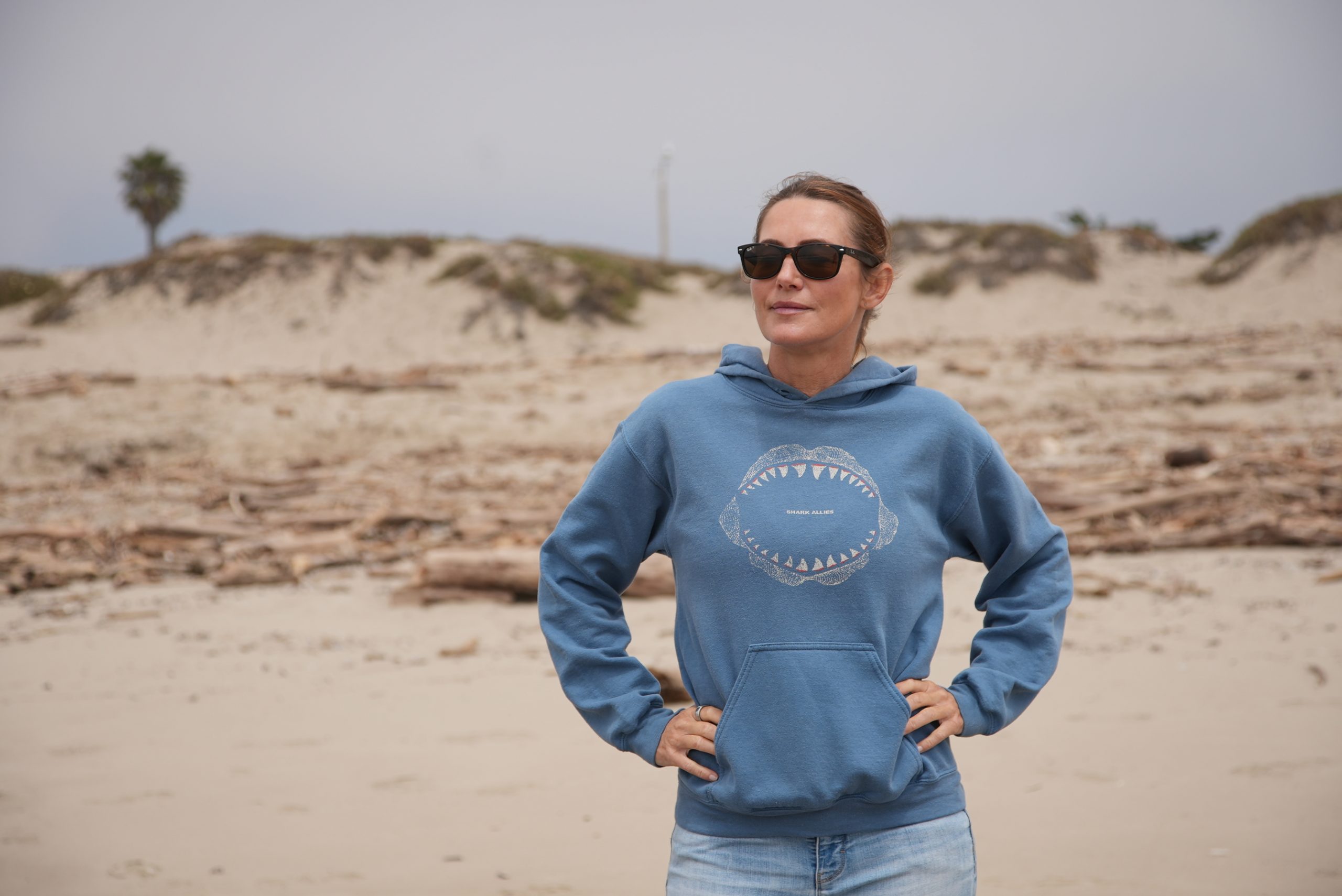
Kinga Philipps on the sand in SHARK WEEK: WHAT SHARK ATTACKED | ©2026 Discovery Channel
SHARK WEEK’s documentary WHAT SHARK ATTACKED? premieres on Discovery Channel and its streaming outlets on Wednesday, July 29. It follows shark researchers Tom “the Blowfish” Hird, Rosie Moore, and Kinga Philipps as they examine evidence from unfortunate human/shark interactions and try to determine which species of shark was involved.
Philipps and Hird get on Zoom for a joint call from separate locations to discuss WHAT SHARK ATTACKED?
Hird shares his office with a terrarium containing crested gecko lizard Ghibli, named after the famed Japanese animation studio. Hird describes himself as not only a big fan of Studio Ghibli’s output, but also “the world’s only heavy-metal marine biologist.” Originally from Halifax, West Yorkshire, England, Hird is an enthusiastic diver, whose writings include the book BLOWFISH’S OCEANOPEDIEA: 291 EXTRAORDINARY THINGS YOU DIDN’T KNOW ABOUT THE SEA.
Behind journalist and shark expert Philipps are a painting of the sea meeting the beach, plus a collection of rocks and a stack of books on sharks, topped by a smallish set of shark jaws. Philipps became the first solo woman host of a Discovery Channel SHARK WEEK show in 2020 with TIGER QUEEN. Among her many achievements is being an ambassador for the organization Waves for Water, which provides clean water for those in need.

Tom “The Blowfish” Hird looking at the horizon in SHARK WEEK: WHAT SHARK ATTACKED | ©2026 Discovery Channel
The discussion gets off to a jocular start in determining who it is who says in WHAT SHARK ATTACKED? that, “More people are killed by coconuts.”
Philipps thinks it was her, but “I actually don’t remember. Do you remember, Fish? I know I’ve said that a million times. I will say, I think every shark conservationist, scientist, shark-adjacent person has used that. So, you can probably attribute that to any of us. Or. more toilets kill people than sharks. That’s one of my personal favorites.”
Toilets are killing people? How does that happen, and do we want to know?
Hird, not unlike a shark, takes the bait. “Well, people are wandering around, late at night, they’ve had a big day, toilet’s starting to lose its mind a little, it sees you coming, and then, bang. It’s just how toilets do it – dropping from height, biting your ankles off – you know. We’ve all been attacked by a toilet at some point.”
Philipps, laughing, supports this explanation. “They’re very aggressive.” She amends her comment to explain that it’s more likely toilet fatalities are caused by people falling in bathrooms and hitting their heads, but still maintains with a straight face, “Yes, toilets can be aggressive.”
The producers of WHAT SHARK ATTACKED? provided the footage and other materials to aid the shark experts’ investigations, Philipps relates. “They bring it to us for analysis. Oftentimes, these are recent incidents, these are things that are viral.
“For a type of show like this,” Philipps continues, “you need something that isn’t entirely identified, or maybe there are some clues there, maybe the media has put out some information, but you want more of an expert eye to take a look at it and really break it down and analyze it. So, those are the ones that the production has gathered for us, and we put our beady little eyes on it.”
Hird and Philipps examine the footage and other evidence separately before conferring with each other about their conclusions.
Hird opines, “In a way, that’s best, because then we’re not influencing each other’s opinion. With a lot of this user-generated content, when it’s been filmed by the person that’s been in that kind of scenario, you don’t get clean shots of the shark.”
Additionally, says Hird, “There are a lot of sharks within the reef shark family that look really, really similar, and it can be so easy for one person to see it and go, ‘Oh, that looks like a gray reef, that’s a silvertip, that’s a whatever,’ and then you quite rightly go, ‘Well, yeah, it kind of does,’ because you don’t have the best picture of it. So, you can almost miss the details. But when we see them independently, you are then digging into it a lot more, you’re watching it back a lot more, because you don’t have someone like, in my case, someone with the experience that Kinga’s got.”
Philipps responds to this with a self-deprecating, you’ve-got-a-ton-of-experience-yourself expression.
SHARK WEEK: WHAT SHARK ATTACKED | ©2026 Discovery Channel
Hird maintains, “If Kinga turned around and said to me, ‘Oh, that’s a “this” shark,’ I’d say, ‘Yup, cool, no worries.’ So, seeing them independently gives us a chance to [be] a bit more rigorous, scientific, rather than decision by a group. We get to say, ‘That’s what I reckon’ and there can be discussion afterwards. And we can also say, ‘Actually, I don’t agree with you, I still think it was this.’”
Were there any sharks involved in biting humans that surprised the investigators? On another 2026 SHARK WEEK program, nurse sharks – which are considered comparatively docile – are written off as “harmless,” but one of them does something that has the species included on WHAT SHARK ATTACKED?
Hird reports, “I wasn’t surprised by any of them, personally. The usual culprits were still there. But a shark, any shark, any species of shark or ray, has teeth. And just like any human can potentially bite you, be it a baby or an eighty-year-old, any shark species can potentially bite humans.
“Those of us in the know, especially those of us who have worked in aquariums, where nurse sharks are quite common, [have found that] they have got a shocking bite. It is so nasty. I’ve seen [aquarium workers] that have gone in to feed nurse sharks, and the nurse shark has sucked the wetsuit off their body and bitten a clean hole through the wetsuit, exposing their body underneath. So, they’ve got a serious chunk to it. And I’ve been nipped by the smaller ones as well in my day. So, there were the usual suspects there, but there certainly wasn’t any one I was surprised to see.”
Philipps nods agreement. “Definitely. I think the audience is probably more surprised than we were, because those of us who have spent a long time interacting with sharks, we know that, just like the tiniest, sweetest little dog can bite you in the right environment, it is the same thing with sharks. I think that clip that you’re referring to in our show, if you really break that down, that was incredibly human-created, that situation.”
“Big-time,” Hird affirms.
Unlike some sharks who are territorial or view mammals as potential prey, it’s likely the nurse shark in question was startled and simply wanted more information. However, lacking the ability to reach out with limbs, sharks primarily investigate by taste.
Hird observes, “With nurse sharks, you’d be lucky if it’s awake most of the time. But any animal that doesn’t have hands, if you go and put your hand in front of its face and see what it does. Squirrel, budgerigar [parakeet] – in that particular bit of footage, that swimmer was unfortunate, but the nurse shark probably didn’t even see her, to be honest. They’re not smart.”
Philipps elaborates that the shark may have been expecting the human to provide a fish. “You can also see that footage, and it wasn’t mentioned, but those of us who are aware, and if you know, you know, that was obviously a situation where the sharks are regularly habituated to humans, probably with food, and they’re incentivized, and just that environment with the nurse sharks, you don’t go into an ocean and see that in the natural world without some kind of human involvement. So, those sharks were really conditioned to expect food from humans and, unfortunately, sometimes those are the results of those times of situations.”
Beyond providing SHARK WEEK programming, the research done for WHAT SHARK ATTACKED? has implications for shark preservation, Philipps says. “In every single instance, the more data that you can collect, the better. We’re looking at these situations from all types of perspectives, from the environment, the time of year, the exact location, you’re really looking at data that you can use and apply to situations across the world.”
Philipps continues. “Not in this one, but in a lot of these shows, we are actually doing everything from biopsies to tagging. So, we are always gathering data. But when it’s shows like this, it’s mostly information-heavy, and we’re deducing what shark attacked, you are gathering data, you are gathering information, and that is always useful.”
Hird concurs. “And there is a global shark attack file as well, but it doesn’t get much information into it because, as we said, the events are so, so rare. But that’s really useful, because the goal for all of us is for there to be no negative interactions between sharks and humans. And if we can be in a position where we’re not doing destructive and moronic things like drum lines and shark nets and culls and that are just bonkers, stupid, but instead we have enough info to be able to say, ‘Okay, these are the behaviors we need to watch out for, these are the colors you need to wear or not wear, this is the place you need to swim,’ whatever, then that just means that we can get these numbers smaller and smaller and smaller, until we get to a point where people go, ‘Shark attack? What’s a shark attack?’”
And what do both Philipps and Hird most want viewers to get out of WHAT SHARK ATTACKED?
Philipps replies, “I think SHARK WEEK walks the line so beautifully of entertainment and information. So, the key is always to get people to watch. And obviously, for us, especially because we’re scientists and conservationists, we want people to take away, the numbers and the statistics are always in your favor [as a human] and, even though we are showing you what happens when there is an incident when there’s an encounter between sharks and people, I think Fish and I say at the end of the show, the chances of something like this happening are so very, very, very low.
“We know that the media hypes it up every time something like this happens, and I think a lot of people think it happens more than it does. But the reality of something like this happening is unbelievably low. So, I think that’s the main takeaway. The ocean is a beautiful place.”
Hird seconds this. “Hell, yeah.”
Follow us on Twitter at ASSIGNMENT X
Like us on Facebook at ASSIGNMENT X
Article Source: Assignment X
Article: Exclusive Interview: Shark experts Tom “the Blowfish” Hird & Kinga Philipps on new Discovery documentary in SHARK WEEK: WHAT SHARK ATTACKED?
Related Posts:
 Loading ...