



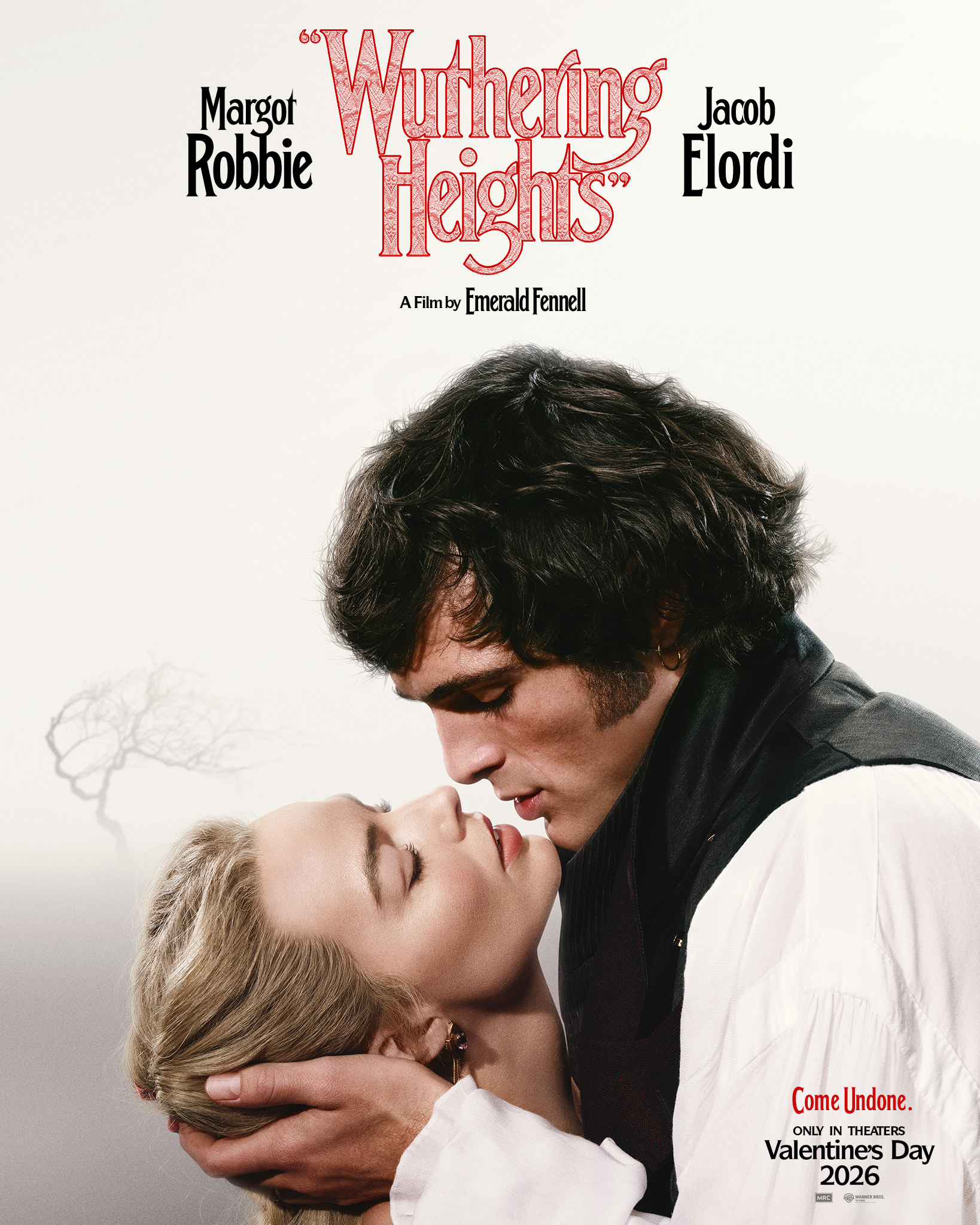
“WUTHERING HEIGHTS” | ©2026 Warner Bros
Rating: R
Stars: Margot Robbie, Jacob Elordi, Hong Chau, Alison Oliver, Shazad Latif, Martin Clunes, Charlotte Mellington, Owen Cooper, Vy Nguyen, Ewan Mtichell, Amy Morgan
Writer: Emerald Fennell, based on Emily Brontë’s novel
Director: Emerald Fennell
Distributor: Warner Bros./MRC
Release Date: February 13, 2026
Emily Brontë’s only published novel, 1847’s WUTHERING HEIGHTS, has been adapted for film many times over the years. And why not? For romantics, there’s something compelling in the tale of a love that can survive anything and everything: time, betrayal, social class, death, and impossible behavior, not necessarily in that order.
Now, director/screenwriter Emerald Fennell has taken up the gauntlet with “WUTHERING HEIGHTS”. The quotation marks are part of the title, indicating that the new movie is more inspired by than faithful to its source material.
There’s nothing wrong with this. Filmmakers (and playwrights and novelists and graphic artists and probably origami makers) have their own takes on Shakespeare and the Brothers Grimm and the DC and Marvel catalogues all the time. Some combinations of sensibilities are serendipitous, while others clash.
Fennell starts with solid advantages, not least of which are her leads, Margot Robbie and Jacob Elordi (Fennell previously directed Elordi in 2023’s SALTBURN). Individually, the two actors are considered by most viewers to be extraordinarily attractive; as such, they both are visually convincing as objects of desire.
“WUTHERING HEIGHTS” begins with what seem to be the moans of lovemaking but are revealed to be in fact death throes at a public hanging. This would appear to be guiding us toward an overarching theme, but it’s a good while before we return to anything like this notion.
For those wholly unfamiliar with WUTHERING HEIGHTS, here are the basic plot points that have turned up in every adaptation thus far. We’re in nineteenth-century Yorkshire, England, a county full of misty moors and wild woods. Middle-class Mr. Earnshaw (here Martin Clunes) brings home a street urchin (Owen Cooper as a boy, Elordi as a man) and “gives” him to daughter Catherine Earnshaw (Charlotte Mellington as a child, Robbie as an adult). Cathy names her new companion Heathcliff and the two grow up inseparable, running wild together on the heath.
Cathy swears she’ll never leave Heathcliff, and Heathcliff obviously loves Cathy. But the Earnshaw family fortune is being spent down. When a wealthy neighbor, Edgar Linton (Shazad Latif), moves into the estate on the next hill, he soon comes courting. Cathy is torn between her deeply felt but undeclared feelings for the penniless Heathcliff and her yearning for physical comfort and to get away from her family (in this film, it’s her father; in other versions, it’s a mean-spirited brother who has been written out here).
A misunderstanding causes Heathcliff to leave without a goodbye. Cathy finally marries Edgar and settles into life as the wife of a rich, smitten man. After five years of absence, Heathcliff returns as abruptly as he left. He now has a fortune of his own and is determined to get revenge on those who he thinks wronged him.
Fennell has made multiple alterations to the original plot. With the omission of Cathy’s brother, Mr. Earnshaw now has the full weight of growing familial villainy on that side; Clunes sinks into the role with an oozing relish, until Earnshaw’s deterioration resembles that of a doomed character in a Stephen King short piece.
Edgar’s sister Isabella is now his ward here, played so delightfully by Alison Oliver that she threatens the balance of our attention. Isabella is so eccentric and unworldly and marvelously creative that we start to resent the other characters (especially Cathy) for not appreciating her gifts.
While Cathy initially responds to Isabella’s adoration with affection, she pronounces the younger girl “dull.” But Isabella has, as another film recently put it, an aptitude for devotion. When Heathcliff seduces Isabella to get back at Cathy and Edgar, the scene is so intentionally funny and lively and wholly honest – perhaps never before has consent been so fully ascertained – that at least some viewers may find themselves pulling more for this couple than for Heathcliff and Cathy.
There’s a similar though less impactful issue with Edgar. Besotted with Cathy, Edgar has had the walls of her bedroom made to resemble her skin, freckles and all. There are also some notable artworks emphasizing human body parts throughout the Linton mansion.
Are we meant to think that Edgar has a hidden side akin to David Cronenberg, or is this the filmmaker just throwing in elaborate production design for its own sake, even if it doesn’t jibe with the character? Since Edgar appears to otherwise be a conventional, albeit exceptionally kindly and doting, upper-crust Englishman, we suspect the latter.
Jacqueline Durran, who also clothed Robbie in BARBIE, has likewise designed a wardrobe full of showstoppers, but what are we supposed to make of Cathy and Edgar dressing like they’re at a ball when they’re just taking tea on the lawn?
Finally, there’s the question of Cathy and Heathcliff as two individuals who feel themselves to be soulmates. Without going into Brontë’s or other movies’ argument for this, it doesn’t feel like it adds up here.
Do Cathy and Heathcliff genuinely love one another? Yes. Do they burn for each other beyond all measure? Sure. Should this mean they identify with each other? Well, Heathcliff’s only goal in life is to be with Cathy. Cathy wants to be with Heathcliff, but since she also wants at minimum physical comfort and at maximum luxury and social status, these wouldn’t seem to be matched ambitions.
Since Heathcliff shows himself capable of going out and making a ton of money, why he doesn’t just tell Cathy he intends to do this earlier on and ask her to wait is one of those questions where the real answer is, “But then there’d be no story.”
Even without this, what Cathy and Heathcliff seem to have most in common is a talent for sulking, misinterpretation, and taking their unhappiness out on others. Granted, these are distinctive traits, but they’re not customarily what draw people to each other. Their overall relationship emerges as less what’s either been chronicled in other versions or what’s described by the characters, and more what seems like the filmmakers think their target audience wants out of a period romantic tragedy.
Robbie captures Cathy’s stubbornness, vulnerability and snappishness. Elordi is sincere, plus appealing when Heathcliff decides to lay it on. Latif is the epitome of well-meaning decency. Hong Chau is persuasive as the watchful servant Nellie.
“WUTHERING HEIGHTS” is never boring, and it shouldn’t be judged by anything other than the aims it sets for itself. However, it’s a movie where the side flourishes are more compelling than the main attraction.
Related: Movie Review: THE MORTUARY ASSISTANT
Related: Movie Review: THE STRANGERS: CHAPTER 3
Related: Movie Review: PILLION
Related: Movie Review: JIMPA
Related: Movie Review: ISLANDS
Related: Movie Review: WORLDBREAKER
Related: Movie Review: MOTHER OF FLIES
Related: Movie Review: 28 YEARS LATER: THE BONE TEMPLE
Related: Movie Review: NIGHT PATROL
Related: Movie Review: THE CONFESSION (2026)
Related: Movie Review: WE BURY THE DEAD
Related: Movie Review: ANACONDA
Related: Movie Review: AVATAR: FIRE AND ICE
Related: Movie Review: IS THIS THING ON?
Related: Movie Review: MANOR OF DARKNESS
Related: Movie Review: DUST BUNNY
Follow us on Twitter at ASSIGNMENT X
Like us on Facebook at ASSIGNMENT X
Article Source: Assignment X
Article: Movie Review: “WUTHERING HEIGHTS”
Related Posts:
 Loading ...