



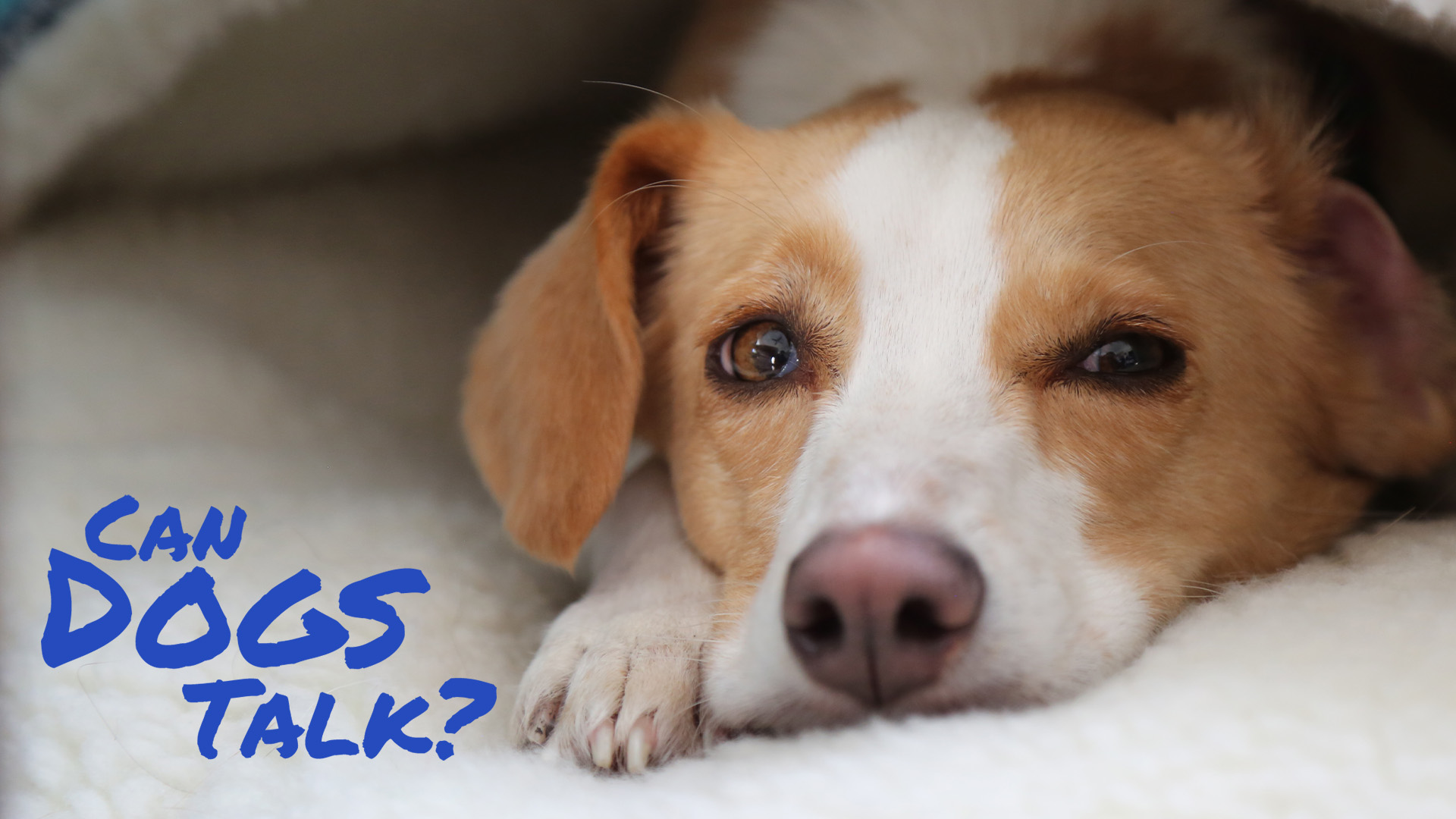
CAN DOGS TALK? Key Art | ©2026 PBS
The PBS NOVA documentary CAN DOGS TALK? premieres on the network Wednesday, February 4. It explores the phenomenon of dogs that have been trained to communicate with humans via a specially-adapted Soundboard, a device with buttons that each say a word when pressed. It is the same as a system used for working with human children who are pre-verbal or non-verbal.
Children’s speech language pathologist Christina Hunger pioneered this type of canine/human interaction with her dog Stella. Acquired by Hunger as a puppy, Stella is part Australian cattle dog and part Catahoula.
Hunger is the author of the newly-published book YOUR DOG CAN TALK: A STEP-BY-STEP GUIDE TO BUTTON TRAINING. “It’s a culmination of all my years of teaching other people how to teach their dogs to talk. I really honed in on the methodology through all my years working with other dogs, too. My first book, HOW STELLA LEARNED TO TALK, was just the story of me and Stella.”
In an exclusive interview over Zoom, Hunger explains that she didn’t initially adopt Stella with the idea of trying to teach her to “talk.”
“I didn’t have this big plan or big question until I got Stella,” Hunger says, “and I didn’t know the extent of what I was starting. My question was, ‘If dogs understand words, why can’t they say words? What if I had a device for Stella and taught her the same way I taught my students at work?’”
Dogs, of course, do not have the kind of vocal cords required to produce human speech. But, Hunger continues, “Because I was a speech therapist, I noticed a lot of similarities in how Stella communicated to how kids communicate right before they say words, with a lot of gestures and vocalizations. And so, when I saw those skills, I thought, maybe if Stella had a different way to say words, a device, she would eventually be able to say some basic needs, and we would always know what she wanted.”
The effort progressed beyond Hunger’s expectations. “As I was teaching her, she kept progressing, and showing demonstrations of new skills that I’d never really thought would be possible. And it just continuously evolved over months and years.”
Hunger pioneered her work with Stella without anticipating it would become the focus of university studies, as well as individuals hoping to replicate the results, much of which is chronicled in CAN DOGS TALK?
But, since Hunger wasn’t teaching Stella with the aim to publicize the communication, how did it become so popular? Hunger cites a 2019 article in PEOPLE MAGAZINE.
“It’s just a wild story,” Hunger laughs. “I started a blog, and I had just a few hundred people following along, mostly just family and friends and friends of friends. But one connection happened to share it to her own personal Facebook, and that person’s cousin is a writer for PEOPLE MAGAZINE. And she saw it and said, ‘How has nobody covered this?’ She reached out to me and asked if she could do an interview.
So, she wrote a really great piece, and the day it came out, it went insanely viral. It was the Number One story on People.com, it was trending on Apple News, and then camera crews and news organizations came to my apartment, filmed Stella, and interviewed me and then people just started asking how they could do it, read my blog, and then I came out with my first book, HOW STELLA LEARNED TO TALK, which sparked even more people being able to do it.
“We invented all of this. I discovered that dogs were capable of this type of communication, and what happened after was thousands of people around the world started doing the same thing that I was doing with Stella, and that caught the attention of researchers, who then formed this very large study.”
The button boards are very brightly colored, but this is for the benefit of the human children who are still the primary customer base for Soundboard, rather than for canines. Dogs do see high contrast of colors, but the reason that there are different colors is just the packs that they come in, it’s not for, ‘This color means this.’
“When I was initially teaching Stella, I needed to find buttons that were the size of her paw that she could press that would then say words, so I found something that already existed, which were these recordable buttons that were typically used for kids. The way that dogs learn is actually through memorizing the location of where the buttons are on their mats or in their homes. It’s like a keyboard or when we memorize where apps are on phones, because we press them so many times, we develop muscle memory for them.”
In comparison to a human child’s development, where does Hunger place Stella?
“I would say it’s similar to between a two- and three-year-old. I also am the mom of a one-year-old and a three-year-old, so this is all really relevant for me right now. I worked with kids professionally in that age group, but now, seeing my own children on a day-to-day basis and what they’re communicating about and how they’re using words, what Stella is doing is definitely right in that range.”
How do Stella and Hunger’s children relate to each other?
“My kids know that they can ask Stella questions and use her buttons to communicate, and they know that when Stella uses her buttons that she’s communicating something to us, so they respond. I think it’s really interesting to see them having these little back-and-forths and little conversations, and that, from such a young age, my kids get it and they can use it with Stella, too.”
How does Stella understand who the children are in relation to Hunger?
“Stella was there when I came home from the hospital with them and through my pregnancies, and we all live together and care for each other, so definitely there is an understanding that we’re all a family and probably all a pack in Stella’s mind. She asks about my kids when they’re not there, she gets excited when they come home.”
Hunger adds that dogs in multi-animal households can learn to use the buttons. “Normally, one dog will take the lead and then the second or third dog will learn from the model dog, and then their human as well. It’s cool to see different dogs within the same home with access to the same words, communicating differently, based on their own personalities and preferences.”
It’s not just dogs that use button speech, Hunger reports. “I’ve seen success with a lot of other animals, too. Cats have learned to use buttons to communicate, some farm animals like horses, pigs, and goats that share an environment with humans and interact with them every day and already have some understanding of words.”
This said, “I do think there’s a really special bond between humans and dogs, because we’ve evolved together for so many years. I don’t think it’s really that dogs want to make their humans happy, but I think it’s that they’re living in our homes, hearing words every day, understanding them, and we’re using words to communicate with them, and expecting that they’ll understand. So, I think it’s just giving access to this two-way street of communication, so they can say the words that we’re expecting them to understand, too.
“I think they’re far more intelligent than we realize, even through buttons and what has come to date. I still think we’re at the tip of the iceberg of all that they’re capable of and using so many senses, too, that we don’t even have a full appreciation of.”
Hunger is proud of Stella for being able to use words not just one at a time, but together.
“She’s sort of demonstrating that ability on her own. About a year-and-a-half into my teaching with her, I would see how she would be using words and, as a speech language pathologist, recognize what that would mean for language development and, cognition-wise, kids who are typically saying that would also be capable of learning or understanding.
“So, I would take that knowledge and then add more concepts that would be similar or the next level of development and introduce them to Stella and try teaching her. Now she combines up to five or six words sometimes to create these phrases and short sentences.”
Of the growing interest in this form of human/animal communication, Hunger relates, “I wouldn’t say that it’s changed what I’ve done with Stella and her buttons, but I think it has just opened my mind to how many more questions there are for how far we can go in studying this concept and how many more topics we need to learn about and get good data and research on to figure out all that dogs are capable of saying.”
Sometimes there are purely practical applications, Hunger notes. “One of my training clients who I had recently told me that her dog said, ‘Help, potty,’ and then the client took the dog to the vet the next day and she had a bladder infection, and the client wouldn’t have known otherwise. It’s just incredible, some of the implications here.”
There are no “true” or “false” buttons on the Soundboard.
“We have ‘yes’ and ‘no.’ I don’t think it’s ever come up where Stella has said ‘no’ to me if she thought I wasn’t being truthful, but if I say something and we haven’t done it, she’ll definitely ask and then keep checking in again. And sometimes she’ll find a different way to say the same thing.
“For example, she might ask to go to the park and I might say, ‘We can’t go now, we can go later,’ or ‘We can go soon,’ whenever it’s time for the park. And then, if it’s gotten to that point and we haven’t gone, she’d probably ask for ‘park’ again, and then she would say something like, ‘Play outside,’ or ‘Play ball outside,’ all these different ways to communicate the same thing and check in on it.”
Are there things that Hunger wants Stella to communicate that she hasn’t been able to do so far?
“The tricky part about this is that she can only say what we give her access to. So, there’s always a question in the back of my mind – ‘Could she be seeing a lot more that she doesn’t have the words for?’ I try my best to use what I know about language and development to have the right words available for her, but I do wonder if she could ask more things about, like, her memory of things before today.
“I wonder if she could communicate things about events that happened in the past, and I wish she could just tell me all the words that she needs to be able to fully communicate everything that she wants to, which I know is like a Catch-22 situation. But that’s what I really wish I could know, would be how many more words she needs and what they are.”
For example, it’s currently hard for Hunger to gauge exactly what Stella can remember, because of the difficulty of translating concepts like “yesterday.”
“I haven’t used days, like ‘today,’ ‘yesterday,’ and ‘tomorrow.’ I’ve stuck with time, as in ‘now,’ ‘soon,’ or ‘later,’ but I wonder if she had those types of words available, if she’d be able to talk about things in the past.
“We used to live in California and now we live in Chicago, and I wonder if she ever thinks about our life there and memories there, or just things from when she was younger, too. I’m curious how far memories go back for dogs.
“When we moved, for the first three weeks, she kept asking, ‘Where beach?’ Because we used to live right by the beach, and that was just heartbreaking.”
How did Hunger respond? “For something like that, I would say, ‘Beach bye,’ to communicate that it’s not there anymore. I also wanted to be back at the beach, but she obviously had that memory of, ‘We used to be there and now we’re not. Where did this place go?’ So, it’s hard to describe those types of bigger life transitions.”
What does Hunger most want people to know about this type of interspecies communication?
“I think just knowing what’s possible is really, really helpful for people as they take care of their pets and look at their pets. I think that when people or animals aren’t communicating with words, unfortunately, it’s easy to dismiss all that they’re understanding, and I don’t agree with that.
“But I really wish that people would see the complexity that we’re dealing with here. If dogs are cognitively capable of putting words together and making phrases and short sentences, that’s what kids do, too, and they deserve the same respect and care as humans.
“And that’s really what’s at the heart of all of this. Some people will say, ‘Well, dogs already communicate so well.’ And that’s true. That’s why their communication is the whole foundation for this. And so, buttons are one more tool that they can be even more specific and descriptive than just gestures alone. But it wouldn’t work if they weren’t so communicative.”
Follow us on Twitter at ASSIGNMENT X
Like us on Facebook at ASSIGNMENT X
Article Source: Assignment X
Article: Exclusive Interview: Speech pathologist Christina Hunger on new PBS NOVA documentary CAN DOGS TALK?
Related Posts:
 Loading ...