



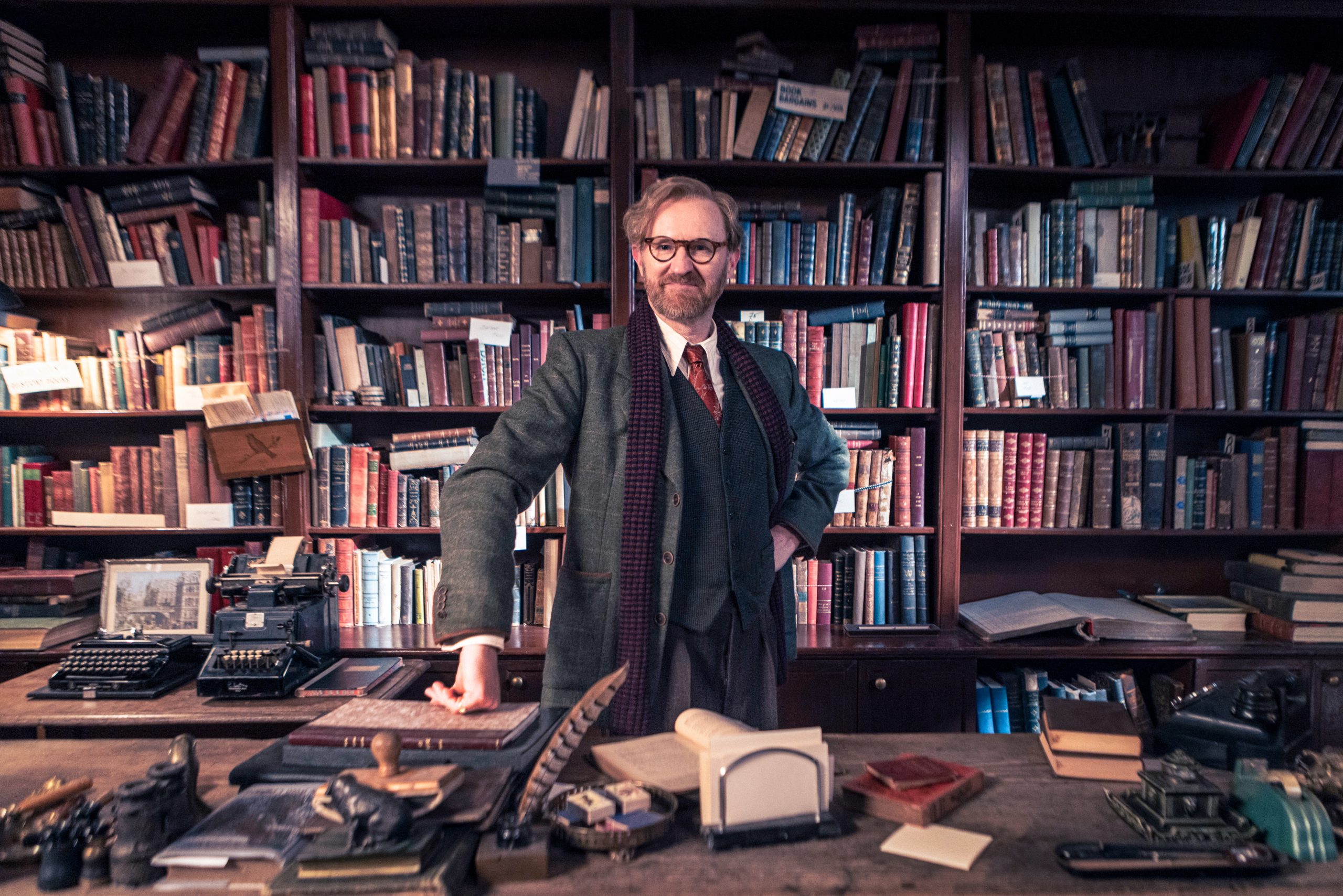
BOOKISH Key Art | ©2026 PBS
The British period investigative procedural BOOKISH has its U.S. premiere on Sunday, January 11, on PBS. A second series is already in the making.
BOOKISH creator Mark Gatiss stars as Gabriel Book, proprietor of an antiquarian bookshop in 1946 England. With his wide-ranging knowledge from all his establishment’s tomes, Book helps the police with their inquiries when murders occur. Book is also a gay man at a time when simply existing as such could lead to arrest and imprisonment, so he is married for the sake of appearance to his childhood best friend Trottie (Polly Walker).
Gatiss is famed for many things. The Englishman was part of the original League of Gentlemen comedy troupe as both a writer and performer. THE LEAGUE OF GENTLEMEN subsequently became first a telefilm and then a series, with Gatiss acting, writing and producing. He has continued in all three professions, adding director, biographer and novelist to his resume in due course.
As executive producer and co-creator/writer, Gatiss and fellow co-creator/writer/executive producer Steven Moffat won the 2016 Emmy Award for Outstanding Television Movie for SHERLOCK: THE ABOMINABLE BRIDE. SHERLOCK, Gatiss and Moffat were jointly nominated for three more Emmys in the category. Additionally, Gatiss played Sherlock’s older brother Mycroft throughout the SHERLOCK telefilm series.
Gatiss’s many other acting credits include GAME OF THRONES, MOONFLOWER MURDERS, THE FANTASTIC FOUR: FIRST STEPS, DRACULA, 3 BODY PROBLEM, two MISSION: IMPOSSIBLE films, THE FATHER, WOLF HALL, and THE FAVOURITE. Some of Gatiss’s stage performances have been recorded by England’s National Theatre Live, including his turn as John Gielgud in THE MOTIVE AND THE CUE, which earned him a Best Actor Laurence Olivier Award for the stage version.
An avid DOCTOR WHO fan from childhood, Gatiss wrote nine episodes of the rebooted series and acted in five, plus writing and acting for the DOCTOR WHO podcast. He also wrote the script for the teleplay of AN ADVENTURE IN SPACE AND TIME, a drama about the making of the first DOCTOR WHO.
Among Gatiss’s other writing credits are episodes of P.R.O.B.E, RANDALL & HOPKIRK (DECEASED), POIROT, QUEERS, and the anthology A GHOST STORY FOR CHRISTMAS, the telefilms THE WORST JOURNEY IN THE WORLD, MR JAMES: GHOST WRITER, THE AMAZING MR. BLUNDEN, A CHRISTMAS CAROL: A GHOST STORY and THE FIRST MEN IN THE MOON, and the miniseries CROOKED HOUSE and DRACULA, the latter with SHERLOCK’s Moffat.
PBS organizes a Zoom call for multi-hyphenate Gatiss and five journalists to talk BOOKISH.
To start with, what was the genesis of BOOKISH? Did Gatiss want to create something where he could play a sleuth or a bookshop owner or set something in post-WWII England?
“Yes, all of those,” Gatiss replies. “It was really a synthesis of a lot of my favorite things. I’ve always wanted to play a detective and I always wanted to create a detective. I had the idea about eight or ten years ago of a man called Book who ran a bookshop and that, perhaps because every detective has to have a thing, he could solve crimes through access to all the books in his shop, or in fact all the world’s writing somehow. It seemed to me a positive attribute to have as a detective, that you could actually learn stuff.
“So, that plus the idea of him being a gay man in a dangerous world in a marriage of convenience with his best friend, and particularly the post-war setting, which I’ve always been interested in and I think is very under-examined. It’s a curious, liminal time. We always seem to rush towards the Fifties in our memory of it. It’s a weird time, I think, and therefore really good for crime, as well as everything else.
“I think I really came to [appreciating the era] through the films of [Michael] Powell and [Emeric] Pressburger. In the popular imagination, because of austerity, it’s a very drab period, but they were making films in lustrous Technicolor. I always though the dichotomy between the two things was rather fascinating. People came back from the war, everything turned upside-down, and yet they were also very optimistic about the fact the world would be different after it. Didn’t quite work out.”
How does recently having survived WWII affect BOOKISH’s characters?
“Because I feel like I’m immersed in this period so much in the films and the novels and writing of this period, I had an idea about how people would talk and what sort of characters I wanted to have in it. Having Nora [played by Buket Kömür], who’s really bloodthirsty – she’s only fifteen or something, but she knows far too much and Book slightly disapproves, but secretly loves it. And then Jack [Connor Finch] is this wide-eyed innocent who walks into this strange new world [of the bookshop], and then Book and Trottie have this mysterious relationship, which we then discover more about, et cetera, et cetera.
“So, I think it’s very much inflected by the war. And there are constant callbacks to the war, because of what everyone has been through. I find that very interesting. And it casts such a huge shadow over everything. I think it’s a very rich soil to work with, because it has implications for so much.
“There are so many long-buried secrets. The country was awash with guns, the country was awash with servicemen who didn’t know what to do with themselves anymore or were forced back into their old life. I remember reading a memoir from this man who came back from Japan or from the Southeast Asian theatre of war. He worked in an insurance office or something, and he just went back to work. And on the Tuesday afternoon, he was just sitting there with his sandwich and he thought, ‘This time six months ago, I was strangling a man, and now I’m here. What am I supposed to do?’ And there was nothing in terms of care. It’s amazing so many people got through it as they did.
“I was reading about James Stewart the other day when he made IT’S A WONDERFUL LIFE just after he came back from being a war hero. He was a colonel. And he was never the same again. And you can see it in that film – his emotion is raw, he’s a shattered man. I think there’s no surprise that we venerated that generation so much, because they came back and went on with their lives despite the terrible things they’d seen, unforgettable things.”
While Gatiss has created various projects on his own, BOOKISH marks his first time as the solo creator of an ongoing TV series. Does he miss having a partner, or does he feel a sense of freedom?
“It’s a bit of both. I was very blessed on this show to have Matthew Sweet, who co-wrote Episodes 4 to 6 with me. He’s a brilliant man and hadn’t written for television before; he never really had the opportunity. But he’s a historian and I knew he could write brilliantly. So, he was the perfect person to work with on this.
“Having created and established it, what I basically do is oversee the whole thing. I have to make everything connect. There are certain things that have to be seen, which might not exist in a script when it first arrives, because it’s a new set of characters, several people have been murdered, these are the suspects, but you’ve also got to find room for what’s happening to Jack, what’s happening to Nora, what’s happening to Trottie, what’s happening to Book in their own lives.
“So, a lot of it is show-running, really, but I wanted to create the entire world and then set it running. That’s what I’m trying to do with second series as well, is bring in some more writers and lead it and show where it’s going and then control everything across the six episodes, but very much give people the room to play within it, because I think that’s what keeps everything fresh. In terms of creativity, thank goodness I’m pretty much being given my head, but I have a lot of wise people around me.”
What has Gatiss learned making BOOKISH Season 1 that’s been helpful for Season 2?
“I’ve learned a lot of things. Writing an ongoing series is a very interesting challenge. I’ve done a lot of episodic television, but writing the whole arc and trying to work out where individual modules are, so that the back story doesn’t become more important than the murder of the week, which is of course why people have tuned in, but also, people do then get very interested in the back story and where that’s going to go. I’ve done an awful lot over the years and I’ve got a good producer’s head on in terms of what’s achievable.
“So, I suppose what I’ve learned is how to write it without limiting my imagination, but also with one eye on how it’s actually going to be done, [and] what I feel is the character and what fits.”
Gatiss has played characters that he’s created from scratch, characters that he’s adapted from known material (such as Mycroft in SHERLOCK) and characters that predate him completely, such as those in the works of Shakespeare. Does he find one easier than another?
“It’s much easier to do it from scratch, definitely. But at the same time, I remember the first time I spoke [Book’s] lines out loud was at the audition for the character of Jack. I said to Carolina [Giametta, who directed BOOKISH’s entire first season], ‘I haven’t said this before. I don’t actually know how I’m going to do this yet.’
“We were lucky what was shot first were all the exteriors on the lane. There was some big stuff, but there were lots of little bits. It’s like trying on a pair of shoes. You actually get to do it for a bit before you have to commit to a large section of being Book. I found that very useful, because I had to make all kinds of decisions. I knew what I wanted to look like vaguely, and I knew how it sounded in my head, but there’s a big difference between that and actually doing it.”
What sorts of fictional mysteries inspire Gatiss?
“I’m an avid fan and reader of all of them, really, all the Golden Age ones and lots of new ones, too. But [Agatha] Christie is obviously predominant still, and there’s a reason. When Billy Wilder made the film [adaptation of Christie’s play] WITNESS FOR THE PROSECUTION, a journalist dared to say, ‘Why are you wasting your time with Agatha Christie?’ And Wilder figuratively grabbed him by the throat and said, ‘Listen, my friend, Agatha Christie’s characters, her dialogue, I could write in an afternoon, but her plots are like f***ing ball bearings.’ It’s so true. My Go, idea after idea, after idea, after idea, that’s the most amazing thing.
“I think if you’re lucky, you can get a good combination of memorable characters and a clever mystery which will keep people watching. Christie remains my favorite, and obviously [there’s a lot of inspiration from] Sherlock Holmes, because he’s my first love. But I’ve got loads.”
Why introduce us to Book when he’s already established his connection with the police, rather than at the start of it?
“Because I’m not thirty-five,” Gatiss laughs. “I’m a big fan of coming into the middle of anything. I think it’s much more interesting. Any conversation, any scene, come in as late as possible. And then you can have a lot of fun with existing relationships. It gives you the chance to do flashback episodes where you could explain all this much later on, once you’ve got people interested.
“Secondly, and this is a big practical thing, I can’t bear shoe leather in scripts. I can’t bear stuff which is just there for administration. Book is not a policeman; therefore, he would not [normally] be allowed on crime scenes. So, he has to have a best friend who’s a policeman, and also a special letter from Winston Churchill, which gives him special access.”
Gatiss likens the letter from Churchill to the psychic paper in DOCTOR WHO, which says whatever the bearer needs it to say, invented by that series’ rebooter Russell T. Davies. The plot devices are so similar that “I told Russell and I got permission. It’s a brilliant idea. Otherwise, you’ve got to spend ages [justifying], ‘Well, why is he here?’ And I think that’s just boring. That’s not why you’ve tuned in. If you come in [in the middle], then all that stuff is established. You can get on with the murder and then you can enjoy unpacking the reasons why he might’ve got there in the first place.”
Although BOOKISH is set in England, it is mostly shot in Belgium. This, Gatiss explains, is for tax reasons. Shooting in Belgium “is a wonderful thing, fantastic crews, fantastic new locations. So, I enjoy that and embrace that. It’s been a delight.”
Are there any obstacles? “You do have to make compromises for budget reasons, and sometimes that can be very frustrating. I’m a big fan of limited budget. I know that sounds counterintuitive, but it makes you think cleverly, and it makes you think on your feet, and it makes you make good decisions, as opposed to big, flabby, indulgent ones.”
That said, “Sometimes it would be really nice to have a little bit more time, a little bit more money. For instance, there’s a scene in Episode 6 where I interview an Albanian princess [played by Angeliki Ruhije]. As I wrote it, it was set in a British transport café, a downhill diner, because I was deliberately trying to bring this haughty aristocrat down to the ground.
“But we couldn’t afford to build that set or go to that location for one scene. So, it had to take place in the hotel, and it’s on the back of another scene set in the same hotel restaurant. I find that very frustrating, because in terms of storytelling, I’m trying to tell a story about doing something different, but we literally couldn’t afford to do it. So, those are the obstacles, really. But that’s just the mechanics of television, and you have to grin and bear it, and also try and find a clever solution if you can.”
BOOKISH has plenty of intriguing characters played by a slew of marvelous actors, but the most scene-stealing performer is probably Dog, who is, as his name suggests, a dog. Gatiss’s own Labrador retriever Bob has been patiently sitting through the Zoom call with his human.
“Obviously, because we shot in Belgium, Bob couldn’t [play] Dog, but every show should have a dog in it. My friend Scott Meek produced a show called HAMISH MACBETH years ago with Robert Carlyle, and he had a little West Highland white terrier called Wee Jock, and I’ve never forgotten how much a part of tuning in was seeing the dog. I think that’s clever. Some of it is cynical, but mostly it’s because dogs are the best thing in the world. I think you can like dogs and cats. I like cats as well, but I believe this really sincerely – I think people who don’t like dogs have something missing. Yeah, I’ve said it.”
With Season 2 currently underway, does Gatiss know how long he’d like BOOKISH to continue?
“You’ll be pleased to know that Series 2 is still 1946. It’s a very busy year. I do know how [BOOKISH] ends, but I’d like to carry on for a good while yet if everyone is willing and the fates allow us, because I think I’m really enjoying it. It’s very hard work and writing now with the prospect of filming again later this year, time catches up with you, but it’s so much fun. And I do have a lot of ideas. Murder mysteries are very tough things and trying to wring changes is very tough. But the post-war setting throws up so many curious little things. And I think that’s exciting.
“Sherlock Holmes said there is nothing new under the sun, and he’s absolutely right. But what you can do is give it a new coat of paint or change the furniture around, and present it through a different prism to a new audience is what we’re all trying to do. So, for me, this show as an entertainment is a package of all the things I love, and therefor I’d be very silly if I didn’t want to carry on doing it.”
What does Gatiss most hope people get out of BOOKISH?
“Entertainment. I’m a very strong believer that the best shows do an awful lot of stuff. And I don’t just mean on a surface level. This is my favorite way of having a good time. I saved WAKE UP DEAD MAN to watch on Christmas Day, because that’s my kind of film to watch on Christmas Day, and I want to make stuff like that for other people because I enjoy those so much.
“So, to me, it’s a combination of a wonderful atmosphere, very interesting time, great characters, beautifully designed, interesting and complex murder mysteries, but within it is the story of a man whose sexuality would put him in prison and this strange marriage with his childhood best friend and how they both navigate that. And I’m very pleased that a lot of the press response to the first series has really focused on that. Again, that’s not what the show’s about. It’s not a show about a gay detective, it’s a murder mystery. But I think if you’re lucky, you can smuggle a lot of stuff in, which makes people think and ask questions.”
Follow us on Twitter at ASSIGNMENT X
Like us on Facebook at ASSIGNMENT X
Article Source: Assignment X
Article: Interview: Creator and actor Mark Gatiss on new PBS detective series BOOKISH
Related Posts:
 Loading ...