




SHARK WEEK 2025 | ©2025 Discovery Channel
Makos are believed to be the fastest species of shark. They come in two varieties, shortfin and longfin. Generally, they are blue on top and white underneath, but shark tagger Keith Poe encountered an uncommonly dark mako in the deep waters off the California coast.
This discovery led to the 2025 SHARK WEEK program BLACK MAKO OF THE ABYSS, which chronicles the expedition attempting to find and perhaps get a DNA sample from the animal to analyze its unusual coloration.
BLACK MAKO OF THE ABYSS premieres on SHARK WEEK Tuesday, July 22, on Discovery Channel, and is thereafter available for streaming on Discovery and Hulu.
Marine biologist and documentarian Kendyl Berna, who founded the conservation organization Beyond the Reef, participated in BLACK MAKO OF THE ABYSS and gets on a Zoom call to discuss the project.
It seems hard enough to find a specific wild animal on land, where there may at least be tracks and spoor. How confident were Berna and her comrades about being able to find a single specific mako in the open ocean?
“Not confident,” Berna acknowledges. “It was a miracle, truthfully. I’ve been a part of three SHARK WEEKs now, and when Keith Poe, who’s been out in these waters for thirty years, and previously seen maybe two of these darker-pigmented makos, told us about it, we were like, ‘What are the chances that we could find one of these on a SHARK WEEK timeline?’ Because like any project, whether it’s for science or for entertainment, you have a limited window and a limited budget.
“So, finding kind of a unicorn in the ocean was a huge challenge, and I thank whatever shark gods were looking down on us looked down on us this time. So, we were amazed, and I was also very grateful that I got to be one of the ones in the water when this happened. I like to think I had the best dive this time, which hasn’t always happened in the previous years. So, yeah, I got a front row seat to seeing one of these darker makos and, as someone who’s been in the water with makos before, I can genuinely say it was very different-looking from what I’ve seen previously.”
The search took place off the waters of Southern California’s Catalina Island.
“We took our boat out from Los Angeles initially, and went out past Catalina into much deeper waters there, which is I think why we were able to find one of these mako sharks that is darker. I think it’s probably happening in even deeper water, and that’s not very studied, and it’s also not all that fished. Much of our data comes from fisheries’ bycatch, but I think there’s just not a ton of people out in the waters where we were. Sometimes the further you go off the coast, the more seasickness you get, but you get better science as well.”
The team members have a number of theories as to how and why the darker mako exists. One concept is that this is actually a hybrid offspring of a female mako and a male Great White. Why is everyone so certain that the female would be the mako?
Berna explains that Great Whites are larger than makos and, in both species, the females are larger than the males. This means that there’s a less prohibitive size differential between a female mako and a male Great White.
“Also, male sharks are always the ones that approach female sharks. At least from our understanding, a female shark is never going to approach a male to try to mate with it. A male will approach a female and likely grab on to her pectoral fin area to be able to insert his claspers, which is its equivalent of a penis. He has claspers on either side, so that he can go in either direction of the [female] when he’s next to her. So, we would assume that the male White shark would have to approach the smaller female mako shark.”
Another possibility is that the deep-water makos are evolving to have darker coloration as camouflage.
“Petty much any time an animal has a certain coloring, it’s essentially camouflage. Maybe not a camouflage in the sense that a cephalopod, for example, an octopus, can blend into its environment. It has something called chromatophores that can change [the octopus’s color in moments]. A shark’s not going to be able to necessarily change what color its skin is, but it’s going to adapt to have the best coloration to where it’s living. And so, that’s why we’re thinking that if a shortfin mako is becoming darker, it’s likely that it’s going into deeper, darker waters and trying to camouflage better. There is a reason that sharks are the colors that they are, and it’s generally because they would like to blend in with their environment.
“And they’re usually lighter on the bottom and darker on the top, and that’s because, if you’re an animal looking up, you would see a white belly, which would kind of look like the water above it and the skyline, and if you’re looking down and see a dark side, you’re just looking into the abyss. So, it’s camouflaging on both sides, whether you are an animal looking up or looking down on it.”
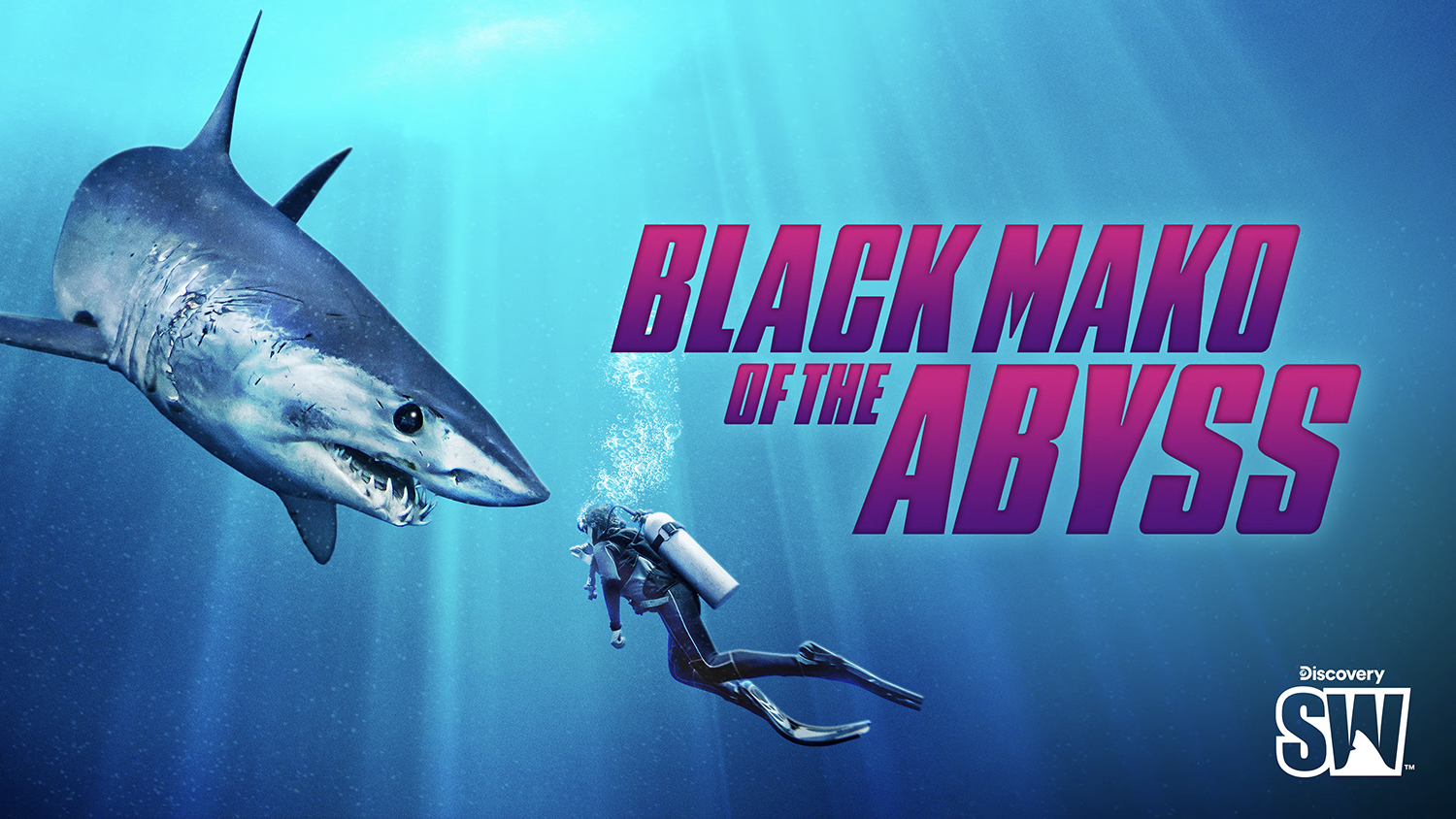
BLACK MAKO OF THE ABYSS key art | ©2025 Discovery Channel
In closeups of various sharks, we see something that looks like an upside-down eyelid coming up to cover their eyes. Berna tells us what we’re looking at here.
“Different shark species have different adaptations to help them. A lot of them have something called a nictating membrane, which is like an eyelid that rolls back over to protect their eyes.”
This is useful because, “A lot of times a shark will put its nictating membrane over its eye, in case it’s attacking a sea lion or something that could have some sharp claws that could go towards it, or even just fish scales. Eye injuries in sharks are fairly common, because it’s right next to their teeth, and that’s the area that they’re attacking with. So, not uncommon to have something happen to the eyes.
“But luckily for sharks, their eyes are just one of their senses. They have some really cool other senses, like a lateral line, which helps them detect water movement. They also have Ampullae of Lorenzini, which is this jellylike membrane that’s under their snout area that helps them detect electromagnetic frequencies, which we all emit.”
Fish of course also emit electromagnetic frequences, but sometimes sharks aren’t sure of the difference between something they want to eat, like a fish, and something they don’t, like a human, until they’ve taken an experimental bite. In BLACK MAKO OF THE ABYSS, we see a lot of the team deter sharks from coming in too close by pressing down on the animals’ snouts. Is this a good method for getting a shark to turn away?
“Yeah. I always say that I really like sharks, so long as I have a mask on. Any time I can make eye contact with a shark, I feel like you can do a dance with it in order to understand each other’s movements. if you are making eye contact with a shark, it’s likely to not come at you all that fast, so you are able to move it around.
“Or, oftentimes, we’ll have large cameras, with a big dome lens on them, and you can kind of use that to bounce off the snout as well. It’s definitely something that takes time to learn. I wouldn’t suggest someone just goes out and grabs a shark on the snout and tries to deter it, but that is probably the most-used method for deterring a shark, to go where its nose is and push away there, so that you’re clear of its teeth, but everything is still with risk.”
Berna’s nonprofit Beyond the Reef does shark research from its headquarters in the British Virgin Islands.
SHARK WEEK 2025 | ©2025 Discovery Channel
“I love talking about anything that has to do with sharks. The conservation aspect of the research is what’s so important to me. We’re doing research on a lot of different species in that area, which is first-of-its-kind research there, with the goal of making sure that we protect the reef systems and mangroves that they are so dependent on. So, that’s one of the things that fires me up the most is making sure that we have data, so that we can use it to create legislation and protection, because at the end of the day, we can all love sharks, but really, it’s turning that into actual policy that will ultimately help protect them. Any time data can be collected, it just helps us to understand them, and it helps policy makers to be able to put policies in place to actually save them.”
Are there actions Berna would suggest for fellow shark lovers?
“Yeah. For the everyday person, I would encourage them to learn how important sharks are to our waters, and how bad something like shark finning, for example, can be. For our policy makers, I would encourage them to just look at the data that comes in from both fisheries’ dependent and fisheries’ independent data. There are a lot of sharks that just really are not doing okay [in terms of population loss] and are still allowed to be fished in certain areas. So, I would really say continuing to fund science that allows us to understand population numbers is tremendously important to being able to protect these species.”
Related: Exclusive Interview with Shark expert and survivor Paul de Gelder on HOW TO SURVIVE A SHARK ATTACK
Follow us on Twitter at ASSIGNMENT X
Like us on Facebook at ASSIGNMENT X
Article Source: Assignment X
Article: Exclusive Interview with shark expert Kendyl Berna on BLACK MAKO OF THE ABYSS and SHARK WEEK on Discovery
Related Posts:
 Loading ...