


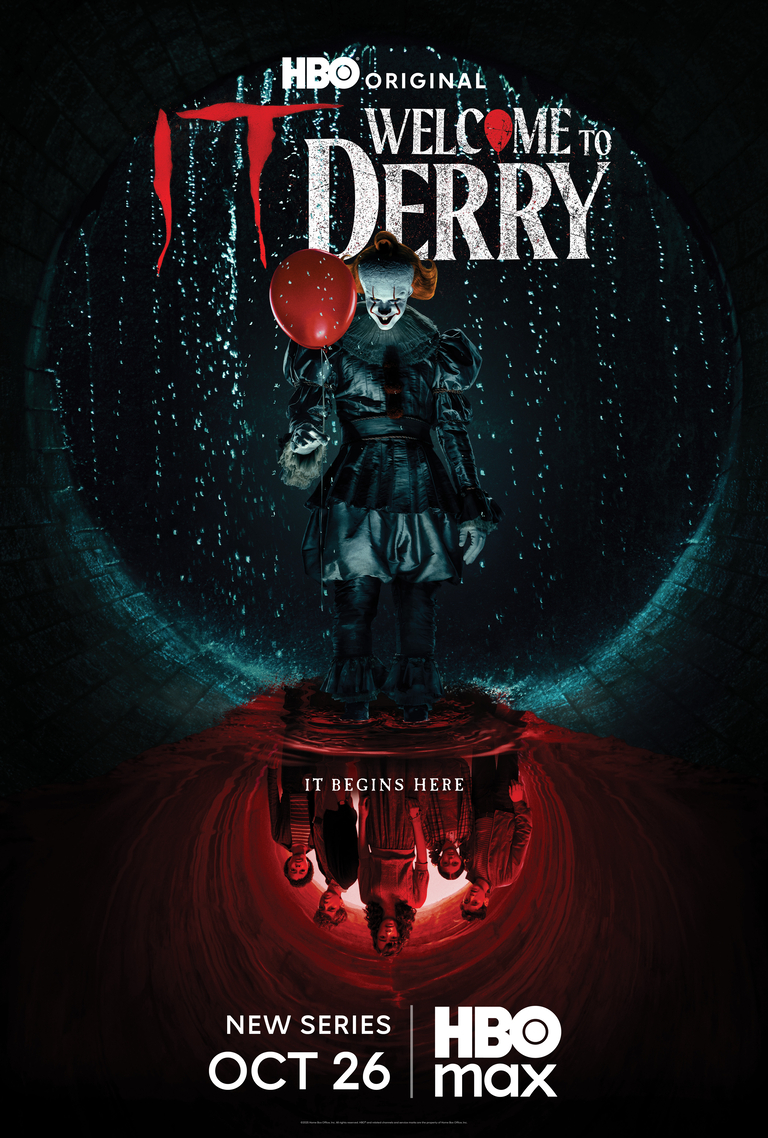
IT: WELCOME TO DERRY Key Art | ©2025 HBO
Stephen King’s novel IT was originally published in 1986. It was first adapted as a television miniseries in 1990, then made into a two-film duology, 2017’s IT and 2019’s IT: CHAPTER TWO. Both films were directed by Andy Muschietti, with his sister Barbara Muschietti as one of the producers.
IT is set in Derry, Maine, where a nameless, shapeshifting monster surfaces every twenty-seven years to prey on the town’s denizens, especially its children. All iterations of IT follow the seven preteens of their self-titled Losers Club who band together to defeat it. When they don’t entirely succeed, they return to Derry twenty-seven years later to finish the job. Their adult timeline is the reader/audience present, with their youth three decades earlier.
Now the Muschiettis, with Jason Fuchs, have created the HBO series IT: WELCOME TO DERRY, which currently runs on Sunday nights, is available for streaming on HBO Max, and has already been renewed for a second season.
The Muschiettis and Fuchs also serve as executive producers on the series, as does Bill Skarsgård, who plays It’s terrifying clown persona Pennywise in the two movies and the series. Andy Muschietti has directed several episodes; Fuchs, along with fellow exec producer Brad Kane, serves as showrunner.
HBO has a screening event for the first episode of IT: WELCOME TO DERRY (the episode’s title, “The Pilot,” is has the playful double meaning of being a TV pilot and about a character who’s a pilot) at the Steven J. Ross Theatre at Warner Bros. Studios. This is followed by a Q&A with the Muschiettis and cast members Jovan Adepo, Chris Chalk, Kimberly Guerrero, Taylour Paige, James Remar, and Stephen Rider.
How did the IT: WELCOME TO DERRY series come into being?
Andy Muschietti reveals, “It started as we were finishing IT: CHAPTER 2 and we were starting to feel that that was it. And I started having conversations with Bill Skarsgård. Together, we were sort of high on the experience and it was just speculating about making the origin story of It, of Pennywise. How did It become the clown? And we thought there was something there, a great story. The book is very cryptic. Stephen King intentionally makes it very mysterious, shrouded in this enigmatic feel. It’s exactly what drew us to that.”
A few months after that, Andy Muschietti says, Skarsgård came up with some suggestions, “and I picked the idea up and went back to the book. I realized that there’s so much story, starting with the interludes. If you’re going to go to the past, why don’t we make up a bigger journey? And soon enough, I found myself visualizing an invisible hidden story within that incomplete puzzle that Stephen King created. And that got us excited. There is a reason why we’re telling the story backwards that you won’t know yet. But it just felt exciting and that’s how the thing started. I talked to Barbie and we decided to go on.”
“I’m Barbie,” Barbara Muschietti clarifies for anyone present who may be confused. “We first talked to Steve [King] – ‘Uncle Steve’ to Andy, ‘Steve’ to me – we are incredibly lucky to have this very loving relationship with him. He’s trusted us with this incredible masterpiece.”
It helped that King, Andy Muschietti relates, “was very happy with the films. On this new stage, it was different, because we were detouring more. The book is arguably more literal, in the sense that we’re covering what the main story is. I think that Stephen King at this point had enough confidence in us, or in the possibilities, that we could bring that he said, ‘Just go for it.’ Of course, he’s always reading and blessing everything, every single step. But he was very open to this hidden story that I was talking about. And that involved a lot of creation of something that is not in the book.”
Not only that, Barbara Muschietti adds, “He gets excited by it and he writes to us all the time as we’re going, which is just the best. Without expecting anything, you wake up and you find an email from Stephen King loving a blood explosion, or whatever we’re doing.”
A very specific question receives a very all-encompassing response from Andy Muschietti. If, as we see in the first IT film and again in IT: WELCOME TO DERRY, It/Pennywise is eating children, how can their bodies remain to be floating around in a slow tornado of corpses underground?
“There’s a passage in the book,” Andy Muschietti explains, “when the Losers [what the group of friends call themselves] are clueless and they’re speculating about this, one of the things that they discover is that the bodies are not fully eaten. So, Pennywise just takes a chunk normally of a kid or a young person and goes away. That leads them to speculate that maybe this entity is not an eater of flesh. They conclude that he’s an eater of faith. And why kids? Kids are the beings more capable of having faith and imagination and believing in things that don’t exist. That’s their power and basically their misfortune as well, [because they are being hunted by] that kind of predator that preys on fear, that preys on faith.”
This concept, Andy Muschietti notes, “only appears once in the book, but because I read it a thousand times, for me, it’s a thousand times. It’s an eater of faith. Everything we have faith in is for this thing to take. Your fears are the opposite of that. You fear everything that might truncate every dream. And I think the question – it lingered in the book and it lingers in our show and in our movies – is, does It exist because we believe in it?”
Her brother’s ability to pick out and interpret the most minute details of King’s book, says Barbara Muschietti, is “sometimes wonderful and sometimes exasperating.”
Tonally, Andy Muschietti strives to emulate King. “Stephen King mixes tones, and he basically puts a scoop of everything he likes in the same world. Because that’s what life is also made of. It has comedy, it has drama, it has horrific events.”
Adepo is Zooming in from Hungary. He was previously in the 2020-2021 miniseries version of King’s THE STAND. In IT: WELCOME TO DERRY, he plays U.S. Air Force Major Leroy Hanlon, who IT fans know will one day be the grandfather of IT major character Mike Hanlon. What attracted Adepo to IT: WELCOME TO DERRY?
“Initially, it was just getting the opportunity to work with Andy and Barbara. I’m a fan of their work, so getting the opportunity to play a character who is essentially the inception of the Hanlon family coming into Derry was an exciting prospect. The character himself relates to my father a lot. My father was in the Air Force and was a very strict military man, so I was very familiar with [Leroy’s son Will’s upbringing as a young man trying to understand his father. Horror gives so much space for freedom and telling stories.
“There’s so much that you can explore outside of the sensational aspects of it, just what experiences people are going through. So, I think that being involved in this particular world was really exciting and gave us a lot of room to play and, of course, live in Andy’s brain as far as storytelling and getting to work with these talented people who are on the stage right now. It was a dream come true for me. Every day going into work felt like a blessing.”
Paige, who plays Leroy’s civil rights activist wife Charlotte, says she was also drawn to IT: WELCOME TO DERRY by the Muschiettis. “Their parents did a good job. We spoke in depth for, I think, two hours in our initial meeting. We had this divine matching tattoo that actually says, ‘Fear Not.’”
Quite a coincidence, given that Paige and the Muschiettis did not yet know each other. “So, there was that,” Paige acknowledges. “But I also keep saying, my grandmother was born in the late 1930s and she passed away in 2021, but I’ve always considered, we have no choice when we’re born, where we’re born, what we’re born into. And I think about the dreams that died with her. She was so freaking funny, like Lucille Ball funny. My grandmother said, ‘I’m not getting on that freeway, I’m not down for that Russian roulette.’ She had layers.”
As IT: WELCOME TO DERRY is set in 1962, Paige’s character Charlotte is about the age Paige’s grandmother was in that year. “I was like, ‘I get to include my angel grandmother,’ and just the layers of a woman who’s kind of bursting at the seams and feels she has so much to offer the world and is swallowing all of that to be what you must be [as a Black woman] in 1962.”
Chalk plays the psychically gifted Dick Hallorann who, as an older man, is a major character in King’s novel THE SHINING, and an even older man and then a ghost in King’s DOCTOR SLEEP. Given that Dick was portrayed by Scatman Crothers in THE SHINING feature, by Melvin Van Peebles in THE SHINING miniseries, and by Carl Lumbly in the DOCTOR SLEEP movie, did Chalk look to any of those performances for inspiration?
“I did look to the past, because I want to respect the people who have been so generous to lay a groundwork of great ease for me. It’s a character that had already been written excellently, it had already been played excellently, and then it’s already written excellently in this script. All I do is act for a living, I should be able to do that. It is a great joy to get to pull something from all of these performances and then co-create with Andy, Jovan, Stephen, Taylour.
“As we’re vibing and creating, that’s the exciting stuff, because we’re discovering who [the character] is as we bring him back from what people know. We’re playing with the idea of, ‘How can we play with the audience’s expectation of what he is?’ Because he’s such a gentle soul in the versions that you know. And it’s not just that. It’s not that guy anymore, because he’s having a human experience, learning to live with devastating psychic powers. It seems cool until you realize everyone around you is depressed. Then it’s not super-fun. So, [making IT: WELCOME TO DERRY] has been great. I get to hang out with people I like and do my favorite thing in the world. I’m so happy.”
Rider plays Hank Grogan, a movie theatre proprietor wrongly accused of murders actually perpetrated by It/Pennywise. Rider realizes how what he starts to relate may sound. “I was going to say, ‘It was a dream come true to play somebody accused of …’” he laughs. “No, I’m joking. But I grew up in Wilmington, in Newcastle, Delaware, and I fantasized about a lot of things and I had to escape life in my imagination. I didn’t grow up with my father. I grew up with an incredible grandmom and people who love me. I think Hank represents an Everyman, an Everywoman. And in my neighborhood, like a lot of Black neighborhoods in this country, people are just living ordinary lives. But the beautiful thing about living an ordinary life is that, every once in a while, you can do an extraordinary thing. And I think Hank reveals the extraordinary, because he’s pushed.
“What I loved so much about doing this with Andy and Barbara and Jason and Brad was that I got a chance to discover how courageous I could potentially become and how willing I would be to allow myself to jump and hopefully allow them to catch me. It was awesome, because I was scared. If I’m being very honest, Hank is more courageous than I am. That’s the beautiful thing about where we come from in terms of theatre acting, where we all come from, is that you get to play these people in extreme situations. Although we get excited, there is a part of us that is like, ‘I don’t know if I’m going to be able to do this.’ With Hank, I was able to go on that journey.”
Hank is the father of Ronnie (Amanda Christine), who is one of the children targeted by It. Rider fondly recalls a bowling party organized by himself, Adepo and the Muschiettis for the IT: WELCOME TO DERRY company that had “all the kids there. It was awesome, because kids just come up to you. Everybody’s bowling. And from that moment we became a family.”
“Bowling does that,” Andy Muschietti observes.
“Especially when you lose to the kids,” Rider elaborates. “They love you for some reason even more. I lost – I was so mad at myself.”
Being the father of Will, played by young Blake Cameron James, is likewise a big part of Adepo’s Leroy. “These kids are incredibly talented. To talk specifically about Blake, and I’m sure Taylour can agree, he takes the work so seriously, I tease him about it. In between takes, he’d come over and,” Adepo lifts his voice to sound like James, “Mr. Jovan, could you take a second to talk about the scene with me? Can we talk about stakes and what’s happening in this moment?’ You can tell that he cares about the work. And I would say that all the kids share that type of passion for the storytelling. On the other side of that, it reminded me as an actor not to take myself too seriously and to remember to be in the moment and play. So, as far as Blake goes, he was a fantastic scene partner.”
As Will’s mother, Paige has many scenes with James as well. “I love these children.” She praises the creative team, including the casting directors. They “did an incredible job. These are such sweet kids.”
Talking with James, Paige discloses, “He said, ‘It’s hard to watch [oneself], because you’re like, “I wish I did that differently.”’ And I’m like, “That will be with you for the rest of your career and life, but it’s okay. We strive to get better. And also, give yourself grace. You’re incredible.’ He was like, ‘Yes, ma’am.’ All of them break my heart in the best way.”
Guerrero plays Rose, the leader of the local indigenous community who has more understanding than most of the evil plaguing Derry. Guerrero points out that while the novel IT referenced indigenous mythology, this was not extensively explored in the source material.
“We don’t get to know the story. So, Rose and her community and Derry represent that story. There were humans that encountered this creature first. Rose is the direct descendant of those people. We get to unpack that a layer at a time. It is so deep and so rich and is going to be such a massive lore drop for Pennywise fans and for Stephen King fans, and I think even for his other work – it’s in THE SHINING as well, this sense of place as character and that that place is haunted. Why is it haunted? What was the history? What does the land remember that we’ve forgotten?
“What we had to do is to bring that here. We had our lovely premiere, and we had John Bear Mitchell, our Penobscot Elder, and that [indigenous Penobscot] community in Bangor, Maine, has been there for thousands of years. So, that’s the story we’re getting to tell, that’s a story you’re going to get to see as the season unfolds.”
Remar plays polite but manipulative U.S. Air Force General Francis Shaw. Shaw is in command of the secret military operation aimed at capturing and weaponizing whatever supernatural power exists in Derry. An educated guess is that his efforts do not make things any better in the region.
Remar has a vast resume of film and television credits. When it’s observed that he’s worked in every genre imaginable, he jokes, “That’s because I’m one hundred years old.” The role of Shaw appealed to Remar because the man is multi-faceted. “You always want to have some kind of turn. Just playing the same thing straight through is not something that requires any effort, but to have a turn and play someone who may be a villain who is resisting villainy. I resist villainy when I approach a character that’s authoritarian, because I have to uncover that character’s humanity so I can fall in love with that character. Because it’s impossible for me to play somebody I hate. I’ve played a bunch of bad guys – I’ve played some good guys, too – that I love and can respect and treat them as a human being. Because if they’re not human, then they’re just an automaton and not terribly interesting.”
Rider agrees. “As an actor and as a person, we all are a collective of the human condition. Chris [Chalk] played James Baldwin [in the miniseries FEUD: CAPOTE VS. THE SWANS]. James Baldwin talked about [how] we all have to look within the great wilderness of ourselves, and I think that the beautiful thing about Stephen King and what Andy uncovers is that, yes, It is this entity, but in reality, it’s a reflection of what we fear the most.”
Paige adds, “And who we are.”
What do the actors make of the true nature of It/Pennywise? Chalk says, “I don’t think we necessarily had conversations about what It is, but we have our own interpretations, of course. I see it as our incessant addiction to our own fears instead of facing fear. What we do instead is hide and duck, and we don’t evolve, and It takes advantage of that. It is saying, ‘Hey, grow up, or we’re going to devour your world.’ I see it as a lesson in, if you never grow up, this thing will continually come back and eat you alive.”
“You should have told me that three years ago,” Andy Muschietti laughs.
Rider thinks “It is constantly showing us ourselves and revealing our blind spots. It reveals things about us that we refuse, as humans, to face.”
Remar comments on the universality of It, bringing up concepts from Shinto Buddhism. “In the religion of Shinto, everything has a life force – the table, a rock, everything is connected by the same energy as what causes your heart to beat … I believe that everything is connected, and as far as It is concerned, It appears in every culture as the embodiment of unnamed fears. It could be the Boogeyman, it could be Satan, it could be Loki. It is this malevolent force that somehow exists in the hearts of people, too.”
Given Derry’s history of imperialism, racism and general destruction, Paige believes, “That environment creates the perfect place for that to exist.”
Guerrero concurs. “Welcome to the last five hundred years of our lives.”
“It’s like, ‘Mm, I have a sense it doesn’t have to be this way, that just doesn’t have to exist,’” Paige observes. “But it does. It’s very natural, but it goes against who we really think and wish we could be.”
For Guerrero, IT: WELCOME TO DERRY’s themes relating to indigenous people are resonant. “We’re in such a unique time to be born and to be walking on this Earth, and it’s such a gift as an indigenous person, because our voices have been silenced for so long. But we’ve never stopped telling our stories. We’ve never stopped singing our songs.”
Guerrero notes that, for the Tongva people, the prayers are for outsiders rather than tribe members. “And the relationship with the seen and the unseen – that veil is very thin for us … So, it’s an exciting part of our generation that we finally get to join the table with our fellow human beings and share some of our knowledge.”
How is it acting in scenes with a manifestation of It? Chris Chalk confirms that these are usually practically present on set. “That’s the thing about coming into a project where they’ve already created a world.”
All the elements are revealed beforehand in storyboards and discussions, Chalk continues, so there are no surprises. “My job is to play a human being having human experiences. Andy’s job is to make it scary. So, if two eyes opened up in the middle of nowhere, Dick’s scared, but Chris Chalk’s f***ing horrified. That’s not hard to do.”
Do the creators ever get scared on set? It looks like neither Muschietti wants to confirm or deny, but Barbara Muschietti allows, “Bill Skarsgård is pretty imposing.”
Follow us on Twitter at ASSIGNMENT X
Like us on Facebook at ASSIGNMENT X
Article Source: Assignment X
Article: Interview: The co-creators and cast talk about the new HBO mini-series IT: WELCOME TO DERRY based on Stephen King’s novel
Related Posts:
 Loading ...